We Don't Know What Will Happen
An American coach who knows almost nothing about soccer, an English team that nobody believes in, and a sign on the wall that says BELIEVE. Sixteen soccer words, and one small word to say what you think will happen.
Warm-up
Ask and answer with a partner, or with me. Tap a card when you have answered it.

Kick-off! Today you meet a coach who knows almost nothing about the game, you learn sixteen soccer words, and you practice one small word for the future: will. Nobody knows what will happen, but everybody has an opinion.
Useful language
Soccer words
How many soccer words do you know? Click a word, then click its meaning. Correct pairs turn green. The audio button says the word.
Now eight more soccer words. Each one is a picture, described in words. Choose the word for each picture. When you finish, cover the answers, read the descriptions again and say the words from memory.
-
Picture: a blue shirt with the number 10, blue shorts, white socks and a pair of cleats: everything a player wears for a game.
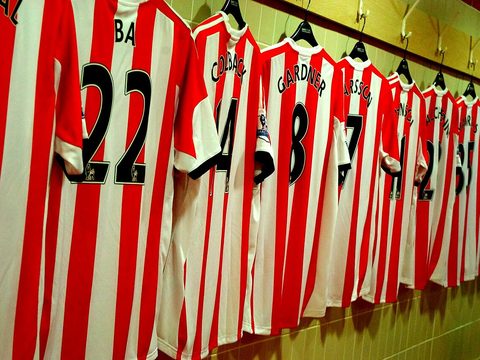
All the players on a team wear the same uniform, so everybody knows who plays for who. In British English, it's a kit.
-
Picture: a white circle in the middle of the grass, with a straight white line across it.
The game starts there, with the ball right in the middle of the field. The British spelling is centre.
-
Picture: in front of the goal, a big white rectangle on the grass, with a smaller rectangle inside it.
Inside the penalty box, the goalkeeper can use his hands. A bad foul there gives the other team a penalty: one kick, one player against the goalkeeper.
-
Picture: the whole green place from above, with white lines and a goal at each end.
The penalty box and the center circle are small parts of it. In British English, a soccer field is a pitch.
-
Picture: a field from above, with a red dot. The dot shows a player who stays near his own goal.
A defender stops the other team before they get to the goalkeeper. The striker is at the other end, near the other team's goal.
-
Picture: a very happy boy with a gold medal holds a cup over his head.
The winners get the cup and the medals. In the past, win is won: We won the game!
-
Picture: a player in a yellow shirt looks down at the grass with a very sad face.
His team has fewer goals at the end, so the other team wins. In the past, lose is lost.
-
Picture: the score on a TV screen at a World Cup game: Brazil 1, Switzerland 1.
The same number of goals, so nobody wins. Tie is a noun and a verb: It's a tie. · They tied 1–1. In British English, it's a draw.
Complete the sentences
Click a word in the bank, then click a gap. Click a filled gap to clear it.

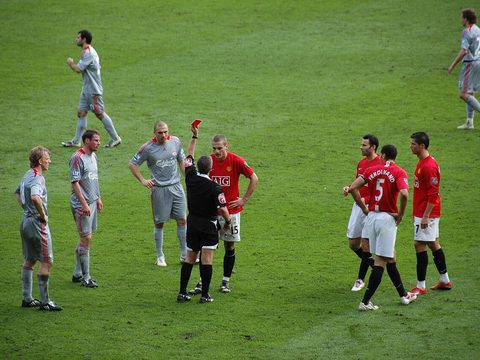 The
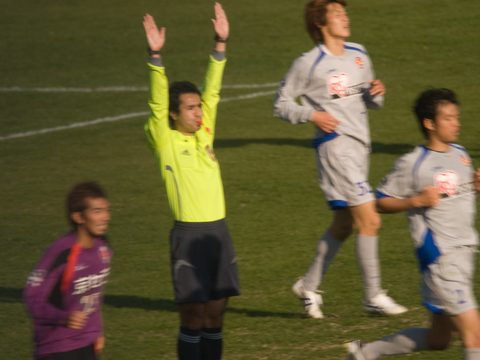
_____ shows the player a red card and sends him off the field.
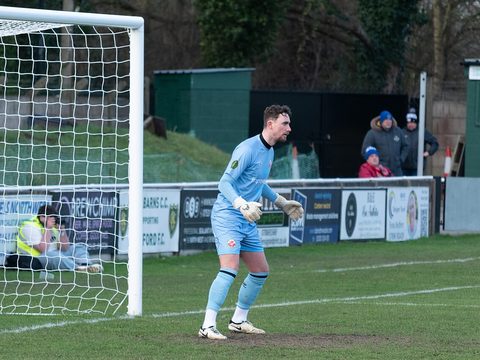 Our
_____ wears big gloves and stands in front of the net for the whole game.
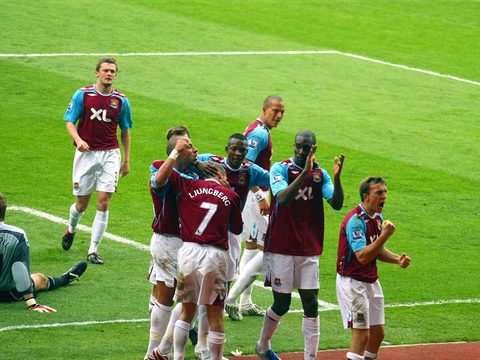 Our new
_____ scored three times in his first game. He plays near the other team's net, and scoring is his job.
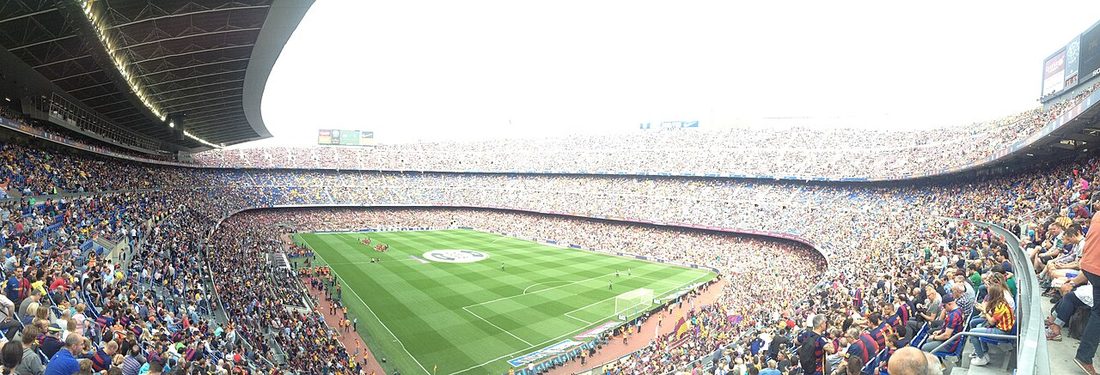
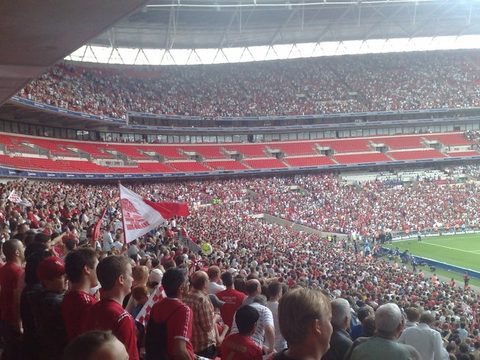 The stadium is full of
_____ in red shirts. They sing and shout for their team all afternoon.
 At the end of the game, the referee blows his
_____ three times.
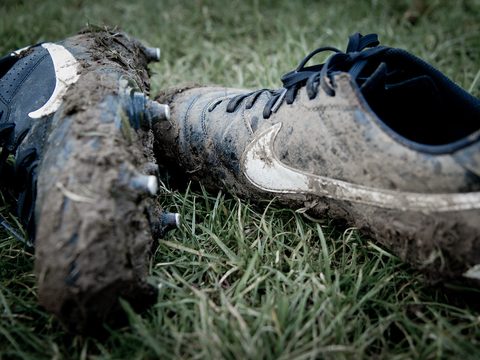 I can't play today: I forgot my
_____ at home, and normal sneakers slip on wet grass.
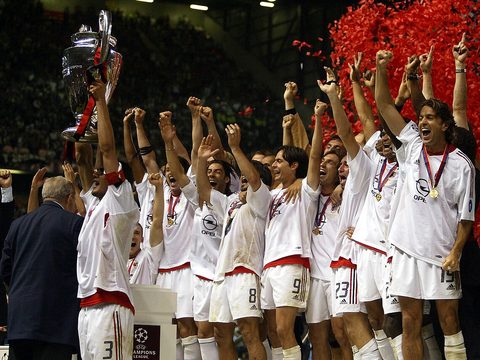 The captain lifts the big silver
_____, and the whole team celebrates. They are the champions!
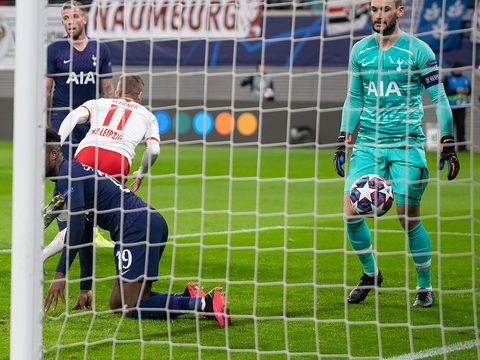 The ball hits the back of the net: it's a
_____! Everybody jumps and shouts.
A coach who believes
Watch the trailer of the TV show first: two minutes. Then read the story of its first season. Will is in bold. Tap a dotted word to see what it means.
One day, AFC Richmond, a soccer team in London, needs a new coach, and it chooses Ted Lasso, an American football coach from Kansas.
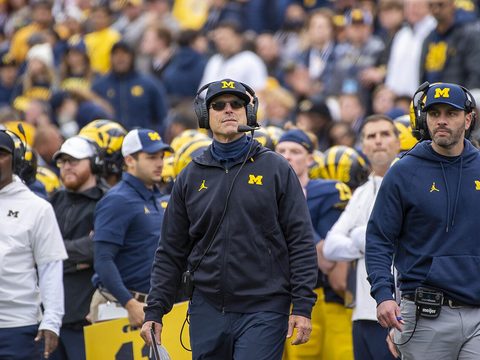
There is one big problem: Ted knows almost nothing about soccer. He doesn't even know that a game can end in a tie.
So at Nelson Road, Richmond's stadium, the fans shout that he doesn't know what he's doing. Nobody thinks he will do a good job.
The players don't believe in him either. So, on his first day, Ted puts a simple sign on the wall of the locker room: BELIEVE.
He can't teach them much about soccer, so he teaches them other things: to be kind, to work together and to be brave.
He also listens to everybody, even Nate, the young man who takes care of the team's uniforms. Nate has great ideas, and Ted uses them.
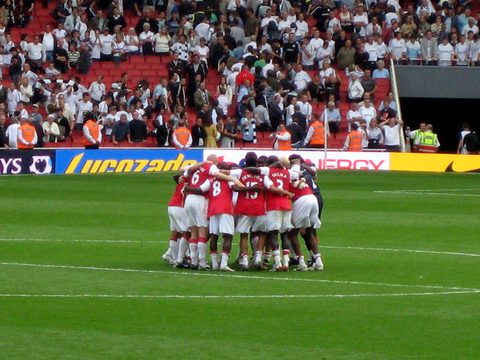
Little by little, Richmond becomes a team. In the last game of the season, against Manchester City, a tie will keep them in the top league.
Near the end of that game, the score is 1–1, and the fans are full of hope. Nobody knows what will happen. Then City scores and wins 2–1.
So Richmond goes down to a lower league. Ted offers to leave his job, but Rebecca, the team's owner, wants him to stay.
For Ted, success is not only about winning. So he and Rebecca decide to try again, and one season later, Richmond is back in the top league.
Multiple choice
The stamp shows the moment in the trailer. Click an answer and read why.

-
Who does AFC Richmond choose as its new coach? 00:13
The news at 00:13 says it: Richmond has a new manager, the American football coach Ted Lasso. In England, a team's coach is often called the manager.
-
What is Ted's big problem? 00:19
A reporter says it to Ted: he is an American in charge of a team, and he knows very little about the game. His sport is American football, a very different game.
-
What does Ted learn about soccer games? 00:28
Ted says "win or lose", and somebody adds "or tie". He didn't know! In American football, a game almost never ends in a tie.
-
What is Nelson Road?
It is the home of AFC Richmond, the place where the fans watch the team's games. The stadium and the team are not real: they only exist in the show.
-
What do the fans shout at Ted? 00:30
They shout it twice, and they are angry. At the start, nobody in the stadium believes in the new coach.
-
Why does Ted put up the sign BELIEVE?
The fans don't believe in him, and the players don't either. The sign is for the players: they see it every day in the locker room.
-
Ted can't teach much about soccer. What does he teach the players? 01:07
At 01:07 you hear one of them: "being brave". He can't teach the game yet, but he can teach the players to be a team.
-
In the last game of the season, what does Richmond need to stay in the top league?
A tie is enough. And remember: at the start, Ted didn't even know that a game can end in a tie!
-
How does the last game end?
It is 1–1 near the end, so Richmond is very close. Then City scores one more goal, and Richmond loses.
-
After the game, Ted offers to leave his job. What does Rebecca, the owner, want?
The team loses, but she still believes in Ted. And one season later, Richmond is back in the top league.
-
For Ted, what is success about? 01:19
"Success is not about the wins and losses," he says at 01:19. For him, it's about the people: the players are young, and he wants them to be their best.
-
Which sentence best summarizes the story?
Nobody believes in him, so he teaches the players to believe and to work together; they lose the last game, but they are a team now, and one season later they are back in the top league.
Soccer quiz: how much do you know?
Do the quiz with a partner. Read each question out loud and agree on an answer before you click. Who knows more? Then read why.
-
Where is Cristiano Ronaldo from?
He is from Portugal, from the island of Madeira. He played for big Spanish and English clubs, but he is Portuguese.
-
Which country has won the most FIFA World Cups?
Five times: 1958, 1962, 1970, 1994 and 2002. Germany and Italy have won four each.
-
What is the shape of a soccer field?
It is rectangular: longer than it is wide, with a goal at each short end.
-
What is the area around the goal called?
The big rectangle in front of each goal. You saw it in Exercise 02.
-
How long is a normal soccer game?
Two halves of 45 minutes. The referee usually adds a few extra minutes at the end of each half.
-
Who has won the most World Cups as a player?
Pelé won three with Brazil: 1958, 1962 and 1970. Messi won one, in 2022, and Cristiano Ronaldo has never won it.
-
Who is the only player that can touch the ball with his or her hands?
And only inside his or her own penalty box. Everybody else plays with the feet, the head and the body.
-
Arsenal has won the Champions League. True or false?
Not yet. In 2026, Arsenal played in the final, but Paris Saint-Germain won on penalties.
-
Who won the Golden Ball, the prize for the best player, at the 2022 World Cup?
Messi, the captain of Argentina, the team that won the cup that year. Mbappé scored the most goals.
-
Which club has won the most UEFA Champions League titles?
Real Madrid has fifteen, many more than any other club.
Will for the future
Read the box, then answer. The first question builds the rule; the others put it to work.

One word, every person. To say what you think or believe about the future, put will before the verb. It's the same for I, you, he, she, it, we and they: no -s, no to, no do.
- Affirmative: I will call you. · short form: I'll call you. · They'll love it.
- Negative: will not = won't: It won't be easy. · We won't stop.
- Question: Will + person + verb? — Will it rain on Saturday?
- Short answers: Yes, it will. / No, it won't. In a short yes answer, never use the short form: not Yes, it'll.
- Use it for what you think, believe or guess about the future: I think our team will lose. · Maybe she won't come.
-
The title of this lesson is a line from a TV commercial for AFC Richmond: "We don't know what will happen." To talk about the future, we use the modal verb…
Will happen is about the future. Don't know is about now: today, we don't know.
-
After will, the verb is…
Like can: the verb after it never changes. No -s, no -ing, no to.
-
Won't is the short form of…
The spelling is strange, but the rule is simple: will not → won't. Say it like don't, with a w.
-
Which question is correct?
Will makes the question alone, so no does. And the verb stays simple: come, not comes.
-
"Will you call me tonight?" "Yes, I ___."
A short answer ends with will, the full word. Yes, I'll is never possible.
-
Which sentence is WRONG?
Will never takes -s, not even with he, she or it.
-
The sky is very dark, and the wind is strong. I think it ___ rain soon.
Dark sky, strong wind: that is a sign of rain. I think it will… is a guess about the future.
-
Our best player has a broken leg, so I'm sure he ___ in the next game.
Nobody plays with a broken leg. I'm sure he won't… is a strong guess.
Eight lines from a commercial
These eight lines come from a TV commercial for AFC Richmond, Ted's team. The video of the commercial is private now, so there is no video here. Put the words in order and write the whole line.
-
awhat / we / happen / know / will / don't
-
bgo / we / But / can / further
-
cbraver / Be
-
dback / Come / stronger
-
eeven / We / can / harder / believe
-
fcan / And / looks like / we / change / what victory
-
gwill / we / know / how / it / don't / end
-
hbut / we've / know / already / won / we
Now read the eight lines again, from a to h, and answer. The last four questions are about the words people use for the game.
-
What is the message of the TV commercial?
Be braver, believe even harder, come back stronger: the lines are about believing, not about the score. They even say "we've already won" before the end.
-
In England, people call this game football. In the US, people call it soccer. Why?
Two names, one game: soccer is the American word, and football is the British word. In the US, "football" means American football, Ted's sport.
-
In British English, people say pitch. In American English, it's a…
The whole green place where they play: a soccer field.
-
In British English, a team's kit is the clothes the players wear for a game. In American English, it's a…
Shirt, shorts and socks, all in the team's colors.
-
In British English, players wear boots on their feet. In American English, they wear…
Cleats have small points under them, so players don't slip on the grass.
Write it with will
Write the whole sentence with will. The cue on the left says what kind of sentence: affirmative (+), negative (–) or question (?).

-
+she / think about the plans
-
–the team / win the next game if they play like this
-
?you / buy a present for your mom
-
+they / know the answer
-
–I / make any more tea if you don't want it
-
?the children / sleep in this room
-
+the tourists / get tickets for the London Eye
-
–they / take a taxi to the airport
-
?the bank / close on the next holiday
-
+the students / pass their exams
-
–Jason and Sally / go to school tomorrow
-
?you / stay for dinner
-
+she / come here
Questions for a partner
Write a question with will for each line. Then ask a partner, or me, and ask the question in parentheses too, for more details.
-
ayou / study another language (Which one?)
-
byou / travel next summer (Where to?)
-
cyou / learn to play an instrument (What?)
-
dyou / buy something for your house (What?)
-
eyou / start a new hobby (What?)
-
fyou / go to the supermarket this week (When?)
-
gyou / watch your team (When?)
-
hyou / cook tonight (What?)
-
iyou / go out on Friday (Where?)
Believe, guess, predict
Part A is about the story and the commercial. In Part B, talk about you. Part C is for your guesses and opinions: use will and won't, and say why.

Useful language
My predictions
40–70 words. Write five predictions with will or won't: two about soccer (or your favorite sport) and three about your life next year. Then compare with a partner: do you agree? Example: I think my team will win the national championship.
My results
Check your score, then copy it and send it to your teacher on WhatsApp.

One job for this week. Every night, say three things about tomorrow out loud, in English: one with will, one with won't and one question with will. Tomorrow I'll wake up early. I won't… Thirty seconds.