Everything You Need to Know About Qatar 2022
One year before the opening match, a sports channel counted the firsts of Qatar 2022: the first World Cup in the Middle East, the first in winter, the smallest host ever. Eight compound words, seven connectors, and how 32 nations become one final.
Warm-up
Ask and answer with a partner, or with me. The last card is a mind map for the whole class: keep it, because you will need it in the writing task. Tap a card when you have answered it.

Everybody knows the World Cup. Today we look at one edition, Qatar 2022, through the firsts that made it different: the first in the Middle East, the first in winter, the smallest host ever. On the way you learn eight compound words like state-of-the-art and dark horse, and seven connectors that hold a text together.
Useful language
Compound words
Click a word, then click its meaning. Correct pairs turn green. The audio button says the word. All eight appear in the video and in the text.
- Closed, written as one word: knockout, showpiece, countdown.
- Hyphenated, joined by hyphens: world-class, fuss-free, state-of-the-art.
- Open, two separate words with one meaning: dark horse, back seat, host nation.
- Number + noun before another noun keeps the noun singular: a 30-mile radius, a one-hour trip, a 64-match tournament.
Complete the sentences
Click a word in the bank, then click a gap. Click a filled gap to clear it. Each sentence has its own clues.

 She is a
_____ swimmer: only two women on the planet have ever swum the 200 meters faster.
 Our stadium is fifty years old, but its
_____ roof, controlled by computers, opens and closes by itself in ninety seconds.
 Their wedding was
_____: twenty guests, a backyard, sandwiches and no long speeches.
 The museum planned a one-week exhibition, but it stayed open for three extra weeks, so in the end it was a
_____ show.
 The flight from New York to Singapore is
_____: eighteen hours in the air without a single landing.
 Nobody expected the small club to reach the final, but the
_____ of the tournament beat two former champions on the way.
 The festival's
_____ is a free concert in the park on Friday night; the main shows only begin on Saturday.
 When his daughter was born, his guitar took a
_____ for a year: the baby came first.
The countdown begins
Watch the video first: three and a half minutes, captions on. Then read the story, which retells it. The compound words are highlighted. Tap a dotted word to see what it means.
In November 2021, with one year to go, Qatar started the countdown to its World Cup. A sports channel promised a tournament bigger, bolder and better than any before, and a long list of firsts.
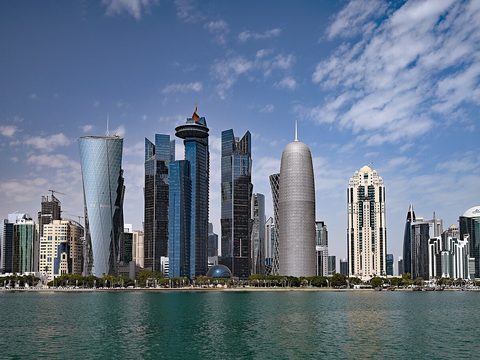
The first of those firsts was the place. In 21 editions, the World Cup had visited 17 different countries, but never the Middle East. The 22nd edition would be the first.
Because of that, the dates changed too. The Arabian summer is far too hot for soccer, so the tournament moved from June to the end of the year: the first winter World Cup ever.
A winter tournament meant a different soccer calendar. In November, the domestic leagues are normally playing, so in 2022 they had to take a back seat while the World Cup was on.
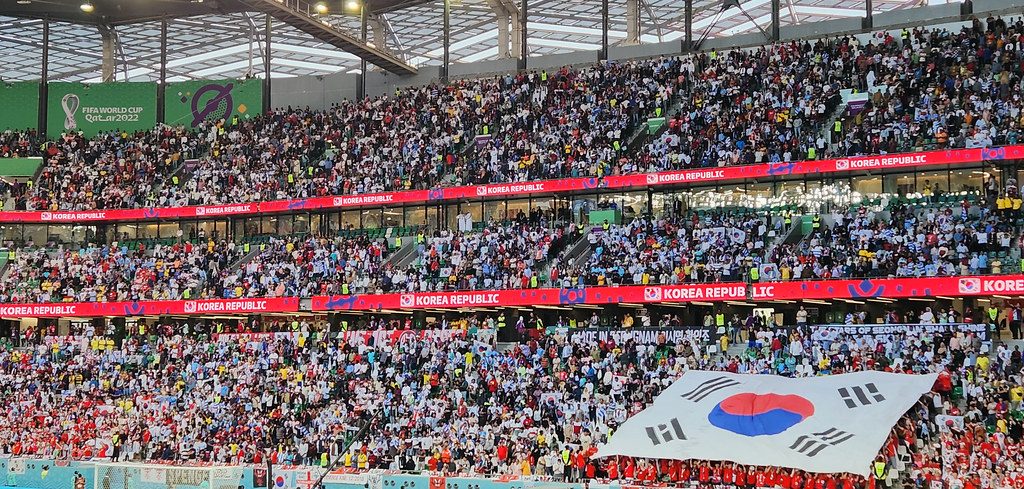
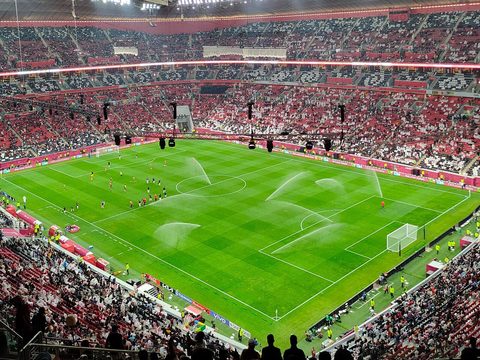
The host was another first: Qatar was the smallest nation ever to hold a World Cup, and it had only eight stadiums. Seven of them, however, were brand-new, sustainable and state-of-the-art.
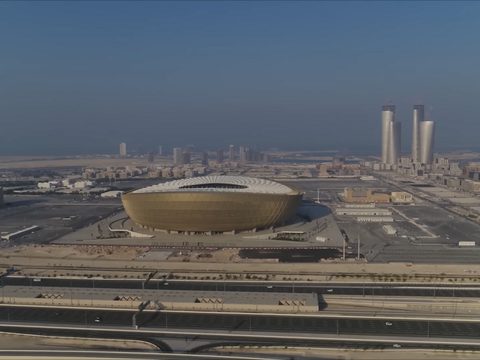
The eighth, Khalifa International Stadium, already existed and was refurbished. The new seven cost an estimated six billion dollars, and the channel promised world-class stadiums for the world-class players of all 64 matches.
On top of that, all eight stadiums stood within a 30-mile radius of Doha, the capital, one hour apart at most. Fans could watch two matches in a single day, fuss-free.
Despite all the firsts, the format of the month-long tournament did not change. Thirty-two nations from six confederations were drawn into eight groups of four, exactly as before.
The host nation would open the party on November 21, in the curtain-raiser at Al Bayt Stadium. Twelve days of non-stop group games later, the top two of each group would enter the knockout stage.
Sixteen teams would then play knockout soccer, dark horses against favorites, until two met at Lusail Stadium on December 18. There, a generation of stars would chase the trophy, perhaps for the last time.
Multiple choice
The stamp shows the moment in the video. Click an answer and read why.

-
Before Qatar, how many World Cups had there been, and how many different champions? 00:18
Twenty-one tournaments since 1930, and only eight nations had lifted the trophy: Brazil, Germany, Italy, Argentina, France, Uruguay, England and Spain. Qatar 2022 was the 22nd edition, and 17 is the number of host countries, not champions.
-
What did the channel promise about Qatar 2022? 00:35
Bigger, bolder and better, and "unlike any other": the list of firsts is the whole first half of the video. The number of matches, 64, stayed the same, and the video says nothing about crowds.
-
What was the first of the firsts? 00:46
Seventeen different countries all around the globe, says the narrator, but never one in the Middle East. Qatar was the first, and that one decision caused the next first on the list: the date.
-
Why did the tournament take place at the end of the year instead of June? 00:58
In June and July, temperatures in Qatar go well above 40 °C. Because of that, and for the first time ever, the World Cup became a winter tournament: November and December instead of June and July.
-
What did the winter date mean for the soccer calendar? 01:08
To take a back seat is to become less important for a while. In November the club leagues in Europe are normally in full swing; in 2022 they stopped for the whole tournament so that the World Cup could take the front seat.
-
What was special about Qatar as a host? 01:18
The smallest host nation in World Cup history, and the first with only eight stadiums. Fewer stadiums sounds like a weakness, but the narrator turns it around in the same sentence: they are "second to none", which means nobody's are better.
-
Why were the eight stadiums "second to none"? 01:27
Seven brand-new arenas at an estimated cost of six billion dollars, and the eighth, Khalifa International Stadium, refurbished. Their size is never mentioned.
-
Why could fans watch more than one match in a single day? 01:52
At other World Cups, fans fly between host cities. In Qatar every stadium was within a short ride of the capital, one hour at most: quick and fuss-free travel, as the narrator says, for anyone who wished to see two matches in one day.
-
Despite all the firsts, what remained unchanged? 02:11
Thirty-two nations from six confederations, eight groups of four, then the knockout rounds: the same format as in 2018. The month did change, and the number of stadiums was smaller than usual.
-
What happens after the twelve days of group games? 02:31
Eight groups, two teams from each: sixteen teams in the "roulette" of knockout soccer, where one defeat sends you home. The curtain-raiser is the opening match, on the first day. The video was made a year early: that match was later moved one day forward, to November 20, so that Qatar could play alone on the opening day.
-
Where and when would the final be played? 02:52
Al Bayt Stadium and November 21 belong to the opening match, and Khalifa is the refurbished stadium. The final did take place at Lusail on December 18, 2022: Argentina beat France on penalties, and Lionel Messi, 35, lifted the trophy. He was one of the stars fans had in mind when the narrator talked, at 03:07, about a generation playing "for one final time".
-
Which sentence best summarizes the story?
Every first in the video changes something about where, when and in which stadiums the tournament happens; the last sentence of that list, "the tournament's format remains unchanged", is the turn of the story. The winter date is one first, not the whole story, and six billion was the cost of all seven new arenas, not of each one.
Ask with the compound words
Complete the eight questions with the words from Exercise 02. Click a word in the bank, then click a gap. Then ask and answer the questions with a partner, or with me.
- Do you think that using a cell phone is simple and _____?
- Would you like to go on a _____ trip?
- Do you ever feel like you work _____ the entire week?
- Who are the _____ soccer players of our time?
- What are some examples of _____ architecture?
- Which team was the _____ of the last tournament you watched?
- At a music festival, do you arrive for the _____ or only for the main act?
- When work gets busy, what takes a _____ in your life?
Useful language
Listen for the connectors
Watch the first part again, from 00:46 to 02:15, and complete the sentences with the seven connectors the narrator uses. Click a connector in the bank, then click a gap. The stamp shows where to listen.

- _____, the World Cup had been held in 17 different countries, but never in the Middle East. 00:46
- The 22nd edition would be in Qatar, and _____ it would take place at the end of the year _____ June, to avoid the Arabian summer. 00:58
- _____ Qatar may be the first host with only eight stadiums, they are second to none. 01:21
- _____, all the action would happen within a 30-mile radius of Doha. 01:52
- Fans could travel quickly between stadiums _____ they wished to watch more than one match in a day. 02:04
- _____ the many firsts, the format of the tournament remained unchanged. 02:11
Connectors: five families
Read the table, then answer. Questions 1 to 7 ask which family each connector from the video belongs to; questions 8 to 12 ask you to choose the right connector for a new sentence.

Connectors are the road signs of a text. They tell the reader what comes next: one more point, a surprise, a reason, a condition. The narrator uses seven of them in two minutes, and each one changes what you expect from the next sentence. Learn the family, then the grammar: what comes after the connector, a noun or a whole clause.
- Time and sequence: first, second… finally; before; after; for starters (informal: the first point of a list): For starters, the flights are cheap.
- Contrast: but; however; on the other hand; while + clause: While the country is small, its ambitions are big. · despite + noun or -ing (never "despite of", and never a full clause): Despite the cold, the fans stayed. Despite losing, the captain smiled. · instead of + noun or -ing (one thing in the place of another): tea instead of coffee; we walked instead of driving.
- Addition: and; also; moreover; furthermore; not only… but also; on top of that (one more point, often the strongest): The tickets are expensive. On top of that, the hotels are full.
- Cause and effect: so; because + clause; due to + noun; as a result; because of that (= as a result of what I just said): It was too hot in June. Because of that, the final moved to December.
- Condition: if + condition, result: If you book early, you pay less. A condition is a cause that may or may not happen, so tables with five columns put if with cause and effect.
- Illustration: for example; for instance; such as: Small hosts, such as Qatar and Switzerland, …
-
"For starters, the World Cup has been held in 17 different countries." Which family?
It opens a list: the first point, said informally. First, for starters and to begin with do the same job.
-
"Despite the many firsts, the tournament's format remains unchanged." Which family?
Two ideas that pull in opposite directions: many changes, but no change in the format. Note the grammar: despite + a noun, "the many firsts".
-
"While it may be the first host with only eight stadiums, they are second to none." Which family?
While can mean "at the same time", but here it means "although": only eight, and yet the best. When while opens the sentence and the second half is a surprise, it is contrast.
-
"On top of that, all the action will be held within a 30-mile radius of Doha." Which family?
One more advantage on the pile: new stadiums, and also close together. Moreover and furthermore are its formal cousins.
-
"And because of that, it will take place at the end of the year." Which family?
That is the Middle East location, the cause; the end-of-year date is the effect. Because of takes a noun or that; because alone takes a clause.
-
"…at the end of the year instead of June." Which family?
One option replaces the other, and the two are set against each other, so it goes with the contrast words. It is followed by a noun or an -ing form.
-
"…fuss-free travel between stadiums if they wish to watch more than one match in a single day." Which family?
A condition and its result: the wish is the cause, the quick travel is the effect. Some books give if a family of its own, condition; in the five-column table it goes with cause and effect.
-
___ the rain, the match went ahead.
Rain and a match that goes ahead: contrast, and before a noun, despite. While needs a whole clause with a verb.
-
The stadium is small and old. ___, it is far from the city.
A third problem added to two: addition. For starters would open the list, not close it, and instead of needs a noun after it.
-
We took the train ___ driving, to avoid the traffic.
The train replaces the car: one thing in the place of another, and the -ing form after it.
-
___ you buy your ticket before March, you pay half price.
A condition with a result. While would contrast two clauses, and despite cannot be followed by a clause at all.
-
___ the old stadium had 40,000 seats, the new one has 80,000.
Two clauses compared: while. Despite and instead of take a noun, not a sentence with a verb.
Say it again with the connector
Write a new sentence with the same meaning. Use the connector on the left and start as the gray text suggests.
-
DESPITEIt was very hot, but they played the whole match.
-
INSTEAD OFWe didn't fly. We took the train.
-
WHILEThe stadium is small. It is very modern.
-
BECAUSE OF THATThe stadiums are close together. Fans can see two matches a day.
-
ON TOP OF THATThe hotel is expensive. It is far from the stadium.
-
FOR STARTERSWhy do I love this city? The food is amazing.
-
IFBuy the ticket early and you pay half price.
-
DESPITEHe was injured, but he played the final.
How the tournament works
Watch the second part of the video, from 02:13 to the end, and complete the sentences. Then use the groups below to explain to the class how a team gets from Group G to the final: how many matches it plays, and who it has to beat.

- The month-long event would see _____ nations from _____ confederations drawn into _____ groups of _____. 02:16
- The _____ would get the party started on November 21, in the curtain-raiser at Al Bayt Stadium. 02:23
- After _____ days of non-stop group games, the top _____ from each group would go into the knockout stage. 02:31
- The final _____ teams would do battle until two of them met at Lusail Stadium on _____. 02:40
- A: Qatar · Ecuador · Senegal · Netherlands
- B: England · Iran · United States · Wales
- C: Argentina · Saudi Arabia · Mexico · Poland
- D: France · Australia · Denmark · Tunisia
- E: Spain · Costa Rica · Germany · Japan
- F: Belgium · Canada · Morocco · Croatia
- G: Brazil · Serbia · Switzerland · Cameroon
- H: Portugal · Ghana · Uruguay · South Korea
- In the round of 16, the winner of each group meets the runner-up of its partner group: A with B, C with D, E with F, G with H.
Useful language for explaining
Talking points
Part A is about the video and the text. Part B is about your life. Part C is for opinions: give a reason and an example, and use at least one connector and one compound word in each answer.
Useful language
Big events in a non-Western country
120–160 words. Look again at the mind map about Qatar and its culture from the warm-up. Then write a short essay that answers this question: why is it important to have big events like the World Cup in a country with a non-Western culture? Give at least two reasons and one example, and use at least four of the seven connectors: for starters, on top of that, despite, while, instead of, because of that, if.

My results
Check your score, then copy it and send it to your teacher on WhatsApp.

One job for this week. Tell a friend about your week with three connectors: start with for starters, add something with on top of that, and finish with despite. Thirty seconds, in English.