Celebrate Star Wars Day
A famous line, a pun and a date: how "May the Force be with you" became May the Fourth, a holiday that fans built and a studio adopted. With the many sounds of -ough and the art of choosing the right word.
Warm-up
Talk with a partner, or with me. Tap a card when you have answered it. Then take the trivia quiz: click an answer and read why.

Say the date slowly: May the fourth. Today we find out how a joke about a date became a holiday, and why English spells so many different sounds with the same four letters.

Useful language
-
Who created Star Wars?
Lucas wrote and directed the first movie, in 1977. Mark Hamill and Harrison Ford are the actors who play Luke Skywalker and Han Solo.
-
In Star Wars, what do they call the invisible power that binds the galaxy together?
"May the Force be with you." The Empire is the enemy, and "the Fourth" is only a date. Keep that line in mind: it is the key to today's reading.
-
What is the name of Yoda's home?
Dagobah is the swamp planet where Luke finds Yoda and trains with him. Tatooine is Luke's desert home, and Alderaan is Princess Leia's planet.
-
How old is Yoda when he dies?
Nine hundred. Yoda even jokes about it with Luke: when you are nine hundred years old, he says, you will not look so good.
-
Who is the young Jedi who becomes Darth Vader?
Anakin, the father. Luke is his son, which gives us the most famous line of the series: "No, I am your father." Han Solo is a pilot, not a Jedi.
-
Which character does Princess Leia fall in love with?
Han Solo, the pilot. Luke, as the story later reveals, is her twin brother, which makes the kiss she gives him in the second movie very awkward to watch today.
Match the words
All eight appear in the reading. Click a word, then click its definition. Correct pairs turn green. The audio button says the word.
Complete the sentences
Click a word in the bank, then click a gap. Click a filled gap to clear it. Read the whole sentence first: the second half is the clue.

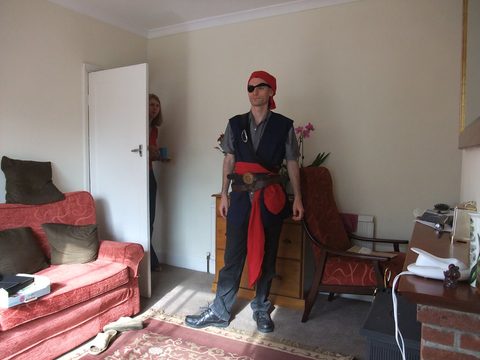 For the party, he wore a pirate
_____: a hat, an eye patch and a plastic sword.
 From the plane, the forest looked
_____: green in every direction, for hours, with no roads and no cities.
 The band will
_____ its new song at the concert on Friday; nobody has heard it before.
 Snow in this city is very
_____: the last time it fell, my grandmother was a little girl.
 "I used to be a banker, but I lost interest" is a
_____: "interest" means two different things at the same time.
 We
_____ the whole season in one weekend: ten episodes, two nights and a lot of popcorn.
 Our city will
_____ the next games: the stadiums are ready and the hotels are already full.
 She is a
_____ fan: she has every album, goes to every concert and even named her cat after the singer.
May the Fourth: the joke that became a holiday
Before you read, scan the title and answer: when is Star Wars Day celebrated? Then read the whole story. Dotted words have a definition; the audio button reads each paragraph aloud.
In 1977, George Lucas finally released a movie that had taken years to sell. Studios were slow to fund a "space epic" based on the Saturday-morning adventure serials he loved as a boy.


The payoff was immense. Within months, "Star Wars: A New Hope" had earned more money than any movie before it, and by 2021 the series had eleven live-action movies.
The movie showed who Lucas was. Unusual among the directors of his generation, he cared little about the world around him: his stories celebrated carefree youth and science fiction where the good guys win.
Fans loved that simple world, and one line above all: "May the Force be with you." Say it fast, and "Force" sounds like "Fourth": a pun and a date, waiting to be celebrated.
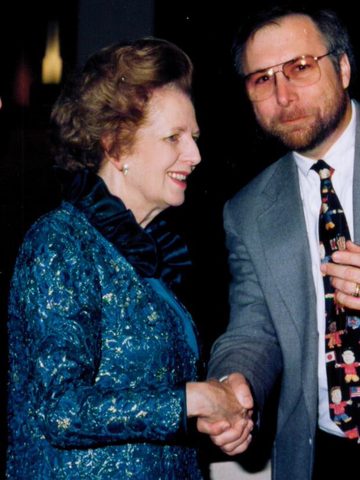
Nobody knows when the pun became a holiday. A Danish newspaper points to a 1979 ad in which Britain's Conservative Party congratulated its new prime minister, Margaret Thatcher: "May the Fourth Be with You, Maggie."
Whatever the origin, the pun was ready. Around 2011, a Toronto theater hosted a marathon of the movies, with parodies, trivia quizzes and a costume contest, and called it "Star Wars Day."
From Toronto, Star Wars Day spread throughout geekdom. A devoted fan base kept it alive every year, until the big studio behind the series noticed a holiday it had not needed to invent.
When Disney bought Lucasfilm in 2012, it took over the holiday. In 2020, the company chose May 4 for the last episode of "The Clone Wars," an animated series on Disney+.
In 2021, the date got a new job: Disney+ debuted the series "The Bad Batch" that day. Its heroes, a band of space warriors, must decide: join the Empire's army or escape it? A cliff-hanger.
For fans stuck at home in the pandemic, the date meant escapism: binge-watching movies from a galaxy far, far away felt just right. A joke had become a real holiday for true fans.
Multiple choice
Click an answer and you get the result right away, with the why.

-
Why did it take years for the first Star Wars movie to reach the screen?
The money and the studio support took years to come together. The serials Lucas loved were short adventure episodes shown in theaters on Saturday mornings, and a studio in the 1970s did not see a hit in that.
-
What happened within a few months of the movie's release?
The payoff was immense and fast: within months, no movie had ever earned more. The text says nothing about awards, and the series went on to eleven live-action movies by 2021.
-
How was Lucas different from the other filmmakers of his generation?
While other directors of the 1970s looked at the world around them, Lucas looked back: carefree youth, as in his 1973 movie "American Graffiti," and science fiction where the good guys win.
-
Where does the pun "May the Fourth" come from?
Said fast, "Force" and "Fourth" sound almost the same, and "May" is also the name of a month. The first movie is called Episode IV, but that is a coincidence the text never uses.
-
What does the Danish newspaper say about the origin of the holiday?
Thatcher became prime minister on May 4, 1979, and the ad played with the date. It is only a theory: the text says nobody knows exactly when the pun became a holiday, and the Queen has nothing to do with it.
-
Who was behind the ad "May the Fourth Be with You, Maggie"?
Thatcher's own party placed the ad to congratulate her, "Maggie," on becoming prime minister. The Danish newspaper only reported the theory, decades later.
-
What happened in Toronto around 2011?
A marathon of the movies, with parodies, trivia quizzes and a costume contest, all under the name "Star Wars Day." No actors and no stores are part of it. The article, from 2021, says it happened ten years before.
-
Why did the studio behind the series notice the holiday?
The fans did the work first, for years; the companies only noticed a holiday that already existed. Nobody sold anything, and the text never says that Lucas asked for it.
-
What did Disney do after buying Lucasfilm in 2012?
Disney took the fans' holiday and made it part of its own calendar, for example to mark the finale of "The Clone Wars" in 2020. The text mentions no re-releases and no cancellations.
-
What was "The Bad Batch," which debuted on May 4, 2021?
A series on Disney+, not a movie: its heroes are a band of space warriors, and the story ends in a cliff-hanger, so the audience waits for the next episode.
-
Why did May 4 feel "just right" for fans during the pandemic?
Escapism: binge-watching stories from a galaxy far, far away helped people forget difficult days at home. Star Wars Day is a fan holiday, not a public one, and the text says nothing about theaters reopening.
-
Which sentence best summarizes the story?
The line came first, then the pun, then the fans in Toronto and everywhere, and only then Disney. Lucas made the movies, not the holiday, and Disney adopted the day; it did not invent it.
Choose the right word
The three options are close in meaning, but only one sounds natural in the sentence. Read the text again if you need to, click an answer and read why.
-
Given the series' ___ popularity, it is hard to believe the first movie took years to find money.
Immense means extremely great and goes naturally with abstract nouns: immense popularity, immense pressure, an immense success. Big and large describe a size or a number you can measure: a big house, a large crowd.
-
Lucas was ___ among the filmmakers of his generation: he cared little about the news of his time.
The second half of the sentence says he was different from the others. Ordinary and common say the opposite: like everybody else.
-
___-watching movies set in a galaxy far, far away is great pandemic escapism.
Binge-watch is a fixed verb: to eat, drink or watch a lot in one go. Marathon is a noun that stands alone (a movie marathon), and intense is an adjective; neither joins -watching.
-
Thanks to the efforts of a ___ fan base, May 4 became a holiday.
A fan base that makes efforts, year after year, is devoted: it gives love and time. Careful fans avoid mistakes and hopeful fans wait for good news; neither builds a holiday.
-
A Toronto theater ___ a big-screen marathon of the movies.
Events are hosted: organized, with guests received. Housed is for keeping people or things inside a building (the museum houses a collection), and placed is for putting an object somewhere.
-
This year, the channel is ___ the new series on the holiday: May 4 is the first day anyone can watch it.
To debut a series is to show it to the public for the first time, which is what "the first day anyone can watch it" tells you. A series is recorded long before anyone can watch it, and a channel advertises it before it starts, to make people wait for it.
The sounds of -ough
The article says the celebration spread "throughout geekdom." Listen to each word with the audio button, then match it with its transcription. The mark ˈ shows where the stress is. Then say the sentences, answer the questions and try the tongue twisters.

Four letters, many sounds. Nobody can guess how -ough is pronounced from the spelling; you learn each word by ear. The good news: there are only a few of them, and today you meet the most common ones.
- /uː/ as in too: through, throughout
- /oʊ/ as in go: though, although, dough, and the end of thorough
- /ʌf/ as in stuff: tough, rough, enough
- /ɑː/ as in hot (before t): thought, bought
- /ɑːf/ as in off: cough
- Two accents: Americans say thorough /ˈθɝː.oʊ/ and thought /θɑːt/; in Britain you hear /ˈθʌr.ə/ and /θɔːt/. Both are correct; this course uses the American forms.
- She walked through the doorway into the living room.
- Her first name was Rose, though no one called her that.
- These toys are made from tough plastic.
- They did a thorough search of the area but found nothing.
- Yes, English can be weird. It can be understood through tough thorough thought, though.
-
How do you pronounce throughout?
"Through" plus "out," with the stress on out: throo-OUT. The first part keeps the /uː/ of through; there is no "f" and no "oh" in it.
-
In the first tongue twister below, the wookiee sought (the past of seek) a self-help book. Which word rhymes with sought?
Before a t, -ough usually sounds like the vowel of hot: /sɑːt/ and /θɑːt/, like bought, brought and fought. Though ends in /oʊ/ and tough in /ʌf/.
-
Which word starts with the soft /ð/ of this, not the /θ/ of think?
/ðoʊ/: the tongue touches the teeth and the voice is on, as in this, that and the. Thought /θɑːt/ and through /θruː/ start with the voiceless /θ/ of think: only air, no voice.
-
How many syllables does thorough have, and where is the stress?
/ˈθɝː.oʊ/: THUR-oh. The mark ˈ before the first syllable tells you where the stress is. It does not rhyme with through, even though the spelling is almost the same.
-
New York City is made up of five boroughs, like Brooklyn and Queens. Which word rhymes with borough?
Borough ends like thorough: /ˈbɝː.oʊ/ and /ˈθɝː.oʊ/, BUR-oh and THUR-oh, two syllables each. Through has /uː/ and tough has /ʌf/: the same four letters, three different sounds.
-
Why does "May the Fourth be with you" work as a pun on "May the Force be with you"?
/fɔːrs/ and /fɔːrθ/ differ only in the last sound, /s/ against /θ/, and the verb may ("may it be with you") is spelled and pronounced like the month. Two puns in one short sentence. Practice the difference: put your tongue between your teeth for Fourth, keep it behind them for Force.
- The crooked wookiee hooked on cookies sought a self-help book. And in its pages by age-old sages, Yoda's wise advice he took.
- To see to R2-D2 as R2-D2 sees to you would be a degree too hard to agree to due to R2-D2's attitude.
- Super-duper storm troopers whoop it up at Death Star groupers: helmet thrashing, rebel bashing, laser blasting at party poopers.
Talking points
Part A is about the article, Part B about you, Part C for your opinions. Use the words from Exercise 02 whenever you can, and mind your -ough sounds.
Useful language
Your own fan holiday
80–120 words. Invent a day for something you love: a series, a band, a food, a sport. Give it a date and explain the pun or the reason behind it, say who hosts the events and what devoted fans do on that day. Use at least four words from Exercise 02.

My results
Check your score, then copy it and send it to your teacher on WhatsApp.

May the Fourth be with you. One job for this week: say the mug sentence out loud once a day, a little faster each time, until through, tough, thorough, thought and though come out as five different words.