What Are You Wearing Today?
Every tense so far talked about your life in general. This one talks about this exact minute — what is on your body right now, what the baby is doing in the next room. Two parts: be and a verb with -ing.
Warm-up
Short answers. Tap a card when you have answered it.

Look down at yourself right now. Whatever you can name in English, you can already describe. Whatever you can't name, we learn in the next ten minutes.

Useful language
Clothes
Click a word, then click its meaning. Correct pairs turn green. The audio button says the word.
More clothes
Click a word in the bank, then click a gap. Click a filled gap to clear it.

Some clothes are always plural. We say a coat, because it is one thing. But jeans, shorts and pants have two legs, so the word is plural: my jeans are new.
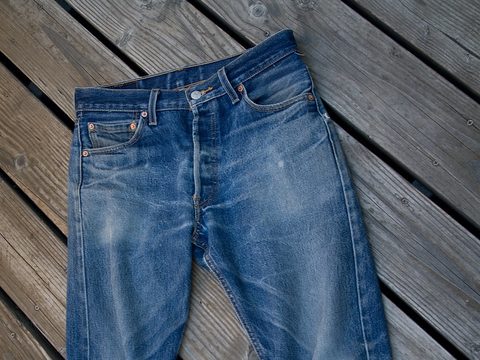 Long blue pants made of strong cotton, with two legs:
_____.
Long blue pants made of strong cotton, with two legs:
_____.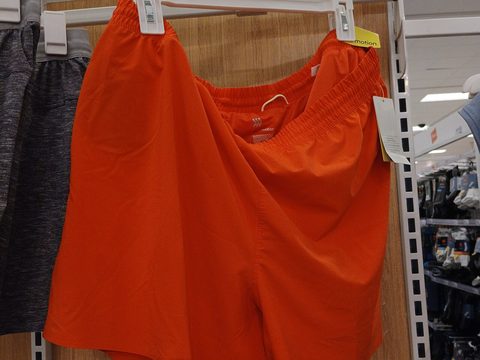 Short pants you wear when it is hot:
_____.
Short pants you wear when it is hot:
_____.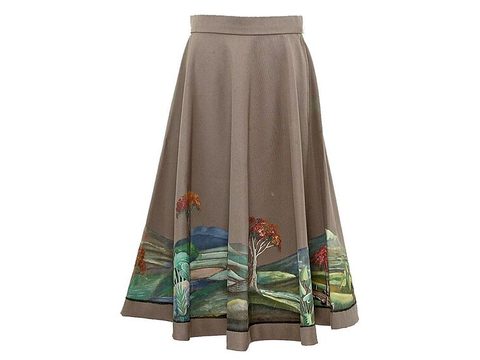 One piece of clothing for the bottom half, with no legs: a
_____.
One piece of clothing for the bottom half, with no legs: a
_____.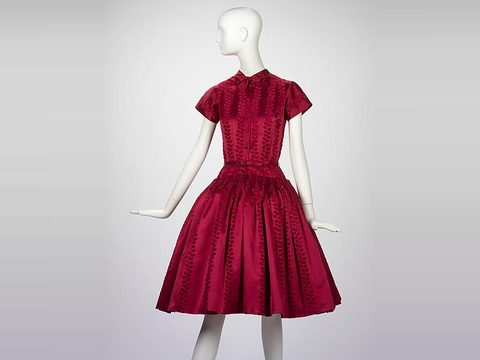 One piece for the top and the bottom together: a
_____.
One piece for the top and the bottom together: a
_____.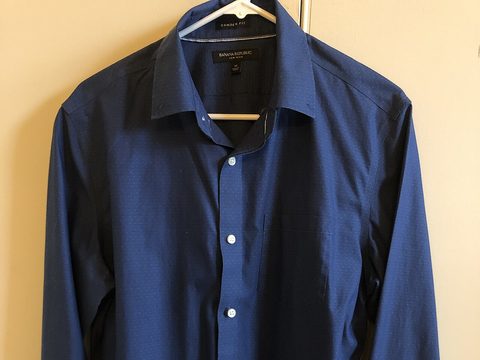 A top with buttons and a collar, for the office: a
_____.
A top with buttons and a collar, for the office: a
_____. A top with no buttons and short arms, often with a picture on it: a
_____.
A top with no buttons and short arms, often with a picture on it: a
_____.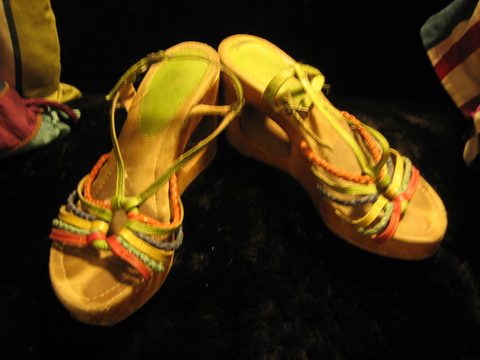 Open summer shoes that stay on with straps:
_____.
Open summer shoes that stay on with straps:
_____.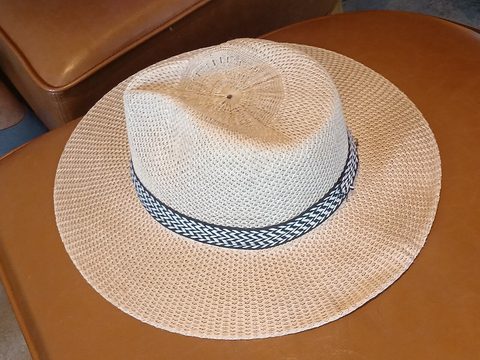 You wear it on your head, in the sun or in the cold: a
_____.
You wear it on your head, in the sun or in the cold: a
_____.
What are people wearing in New York?
Five people on the street, five answers. The audio button reads each one aloud.
In October 2022, a YouTube channel walked around New York City and asked people one question: what are you wearing today? Every person with cool style gets two dollars. This is episode 28.

"Hi! I'm wearing this large jacket, black boots, pants, and my dad's sweater. And my bag! I get my inspiration from walking and sitting in coffee shops. I'm a model, from Germany."
"I'm wearing a sweatsuit and a t-shirt from Russia. That's funny, but this is my girlfriend's jacket. She is a model and I learn about fashion with her. I'm a DJ."
"I'm wearing what I like to wear. I'm an artist. I do sculpture and painting."
"Shoes and skirt by Mango. The jacket is my brand, Alchemist. I get my inspiration from the streets."
"I'm wearing a coat, an old sweater, a pair of sneakers, and a hat."
Five people, five styles, one street. Nobody in the video is wearing a uniform and nobody is copying anybody. That is what street fashion means.
Multiple choice
Click an answer and you get the result right away, with the reason.

-
What are people wearing in New York? is:
Episode 28 of a channel, not a program on television.
-
Which city is it in?
It is in the title of the video.
-
What is the video about?
Street fashion: normal people in the street, not models on a runway — although one of the five is a model, and another one's girlfriend is.
-
How much money do people get?
Two dollars. The money is a joke, not a payment.
-
The first person is:
A model, from Germany.
-
Whose sweater is she wearing?
"My dad's sweater."
-
Where does she get her inspiration?
Which is a nice answer: she gets it from watching people.
-
The second person's jacket is:
The t-shirt is the one from Russia. Read that line again.
-
What is his job?
His girlfriend is the model, and he learns about fashion with her.
-
What does the third person do?
And his rule for clothes is one line long: he wears what he likes.
-
The fourth person's jacket is from:
Mango made the shoes and the skirt. The jacket is Alchemist, and Alchemist is hers.
-
How many things does the last person name?
A coat, a sweater, sneakers and a hat.
Present continuous

Everybody forgets the first half. Students write I wearing a jacket all the time. The -ing is easy to remember because you can see it. The am / is / are disappears — and without it the sentence is broken.
- I am wearing a jacket today. → I'm wearing a jacket today.
- You are wearing a skirt. → You're wearing a skirt.
- He is wearing a sweatsuit now. → He's wearing a sweatsuit now.
- We are / They are wearing t-shirts. → We're / They're wearing t-shirts.
- The two tenses side by side: I wear a suit to work (every day) · I'm wearing jeans today (this minute).
-
We use the present continuous to talk about:
Now, today, at the moment, right now are its words.
-
We form the present continuous with:
Two parts, always. The first one is the one people drop.
-
Which sentence is correct?
The first has no be; the third has no -ing.
-
Complete: "She ______ jeans."
Same rule as the verb to be in Class 04. Nothing new here.
-
Complete: "They ______ pajamas right now."
They takes are, like we and you.
-
"He's wearing a coat." What is he's here?
With -ing after it, 's is always is.
-
"I work in a bank." This sentence is about:
No -ing, so it is my job, not what I am doing at three o'clock.
-
Your friend calls and you are eating. You say:
It is happening while you speak, so it needs both parts.
How to spell the -ing

- Most verbs: just add -ing. wear → wearing · cry → crying · read → reading
- Verb ends in -e: take the e away. dance → dancing · drive → driving · write → writing
- One vowel + one consonant at the end: double the consonant. shop → shopping · get → getting · run → running
- Careful: read has two vowels together, so nothing doubles: reading, not readding.
- The sound is /ɪŋ/, soft at the end. Say play-ing, not play-inG with a hard g.
-
dance becomes:
The e goes away first.
-
shop becomes:
One vowel, one consonant, so the p doubles.
-
read becomes:
Two vowels together — ea — so no doubling.
-
write becomes:
It ends in e, so it belongs to group two, not group three.
-
sit becomes:
And with one t it would look like site.
-
cry becomes:
The y never changes before -ing. That happens in other tenses, not this one.
-
Which verb doubles its last letter?
Plan ends in one vowel and one consonant: planning. The other two have two vowels together.
-
How do we say the end of playing?
Portuguese speakers often add the hard g. Let it go soft and it is done.
Write the -ing form
Example: eat → eating. Decide the group first: add, take away the e, or double the consonant.

Say the verb out loud before you write it. If you hear one short vowel and then one consonant — run, sit, plan — the consonant doubles.
cook
dance
write
shop
run
swim
read
sit
plan
Write the whole sentence
Use the present continuous and a contraction. Example: He / wear / jeans today. → He's wearing jeans today.

-
aHe / wear / jeans and a t-shirt today.
-
bI / study / at the moment.
-
cLucy / sleep / with the cat.
-
dBe quiet! The baby / get up / now!
-
eCarla and Jane / shop / today.
-
fMy dog / run / outside.
-
gThe teacher / write / on the board.
-
hThey / drive / to work today.
You are in the video
I stop you in the street with a camera. Answer in full sentences, and I give you two dollars.
Useful language
My answer for the camera
60–100 words. Write your own interview for the video: what you are wearing today, where your style comes from, and what you do. Use the present continuous five times, and one verb from each of the three spelling groups.

My results
Check your score, then copy it and send it to your teacher on WhatsApp.

This week, narrate yourself. Three times a day, stop and say out loud what you are doing at that second: I'm waiting for the bus. I'm making coffee. I'm answering an email. Nobody has to hear you.