A Beginner's Guide to American Football
The rules of American football in under eighty seconds: one hundred yards, eleven players and four plays to move ten yards. Then three small verbs, play, do and go, and the difference between what you like and what you'd like to do.
Warm-up
First, unscramble the five sports. Then ask and answer with a partner, or with me. Click a card when you have answered it.

Five sports, mixed up. Put the letters in order, and then tell me which of them you do, which you would like to do, and which you don't like at all.
-
aE A L Y B V O L L L
-
bE C C R S O
-
cA L S T E K B L A B
-
dG N I N N U R
-
eK I S N I G
Useful language
American football words
Click a word, then click its meaning. Correct pairs turn green. The audio button says the word.
Complete the sentences
Click a word in the bank, then click a gap. Click a filled gap to clear it. Read the whole sentence first: it tells you which word fits.

 Please don't all talk at the same time. Let's
_____: first you, then your partner, then me.
 It rained all night, so the grass on the
_____ is too wet for a game today.
 The whole
_____ travels together on the same bus: forty players, all in the same shirts.
 Our
_____ has a strong arm: he throws the ball, and the other players run to catch it.
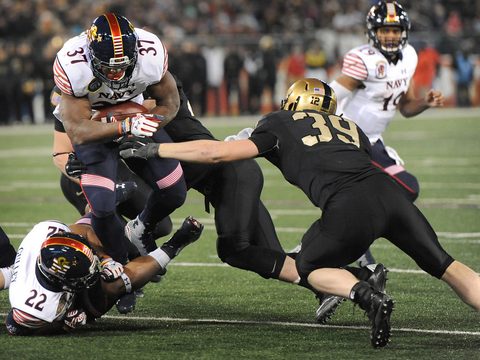 We get a lot of points in every game, but our
_____ is weak, so the other team gets a lot of points too.
 We ran up and down all afternoon, but we didn't
_____ a single point.
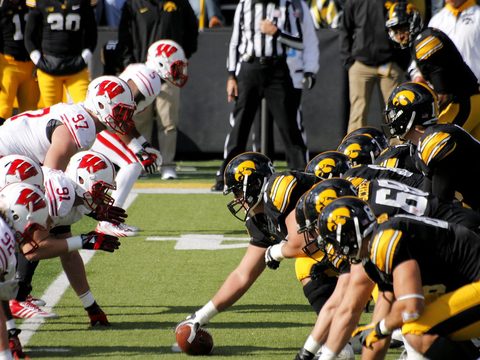 Only some of our players play when we have the ball. They are our
_____, and their job is to score.
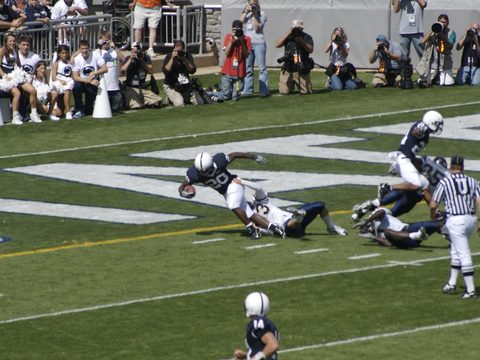 Nobody can stop him: he runs across the goal line with the ball and scores a
_____.
Your first game
Watch the video first: seventy-eight seconds, with captions. Then read the story. The words from Exercise 02 are in bold. Click a dotted word to see what it means.
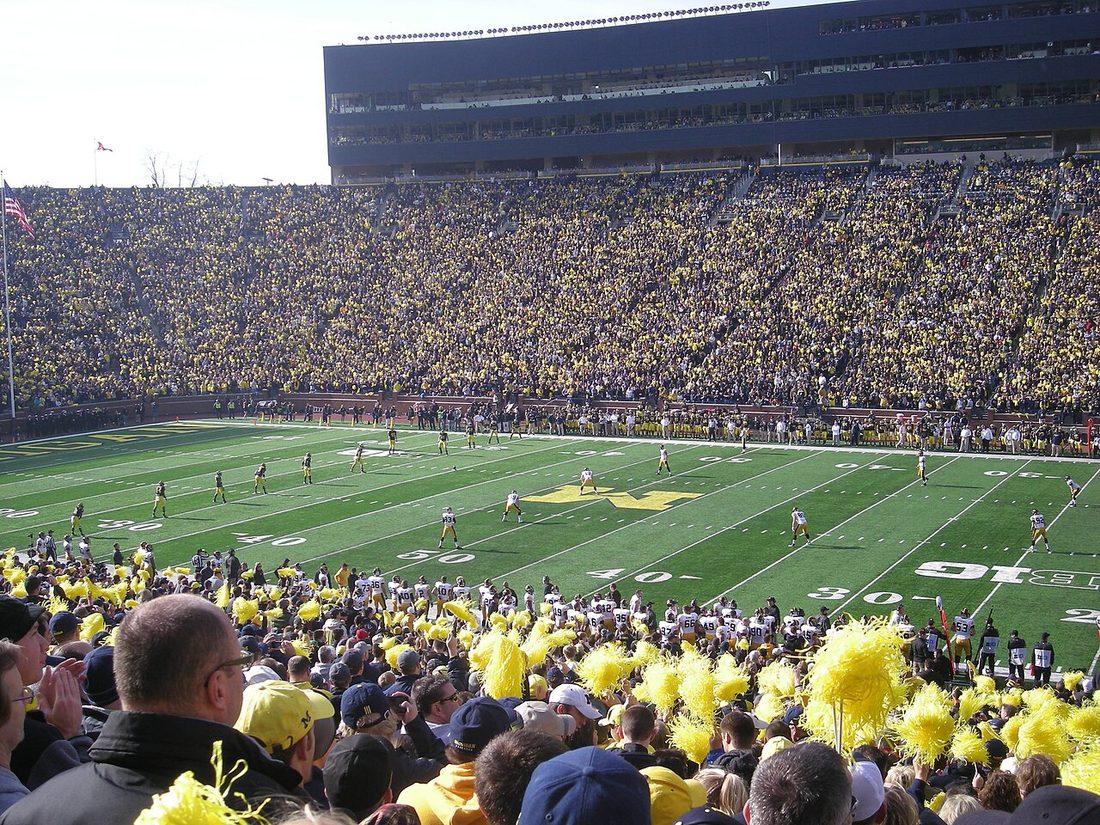
It is your first American football game. The field is one hundred yards long, and two teams of eleven players walk onto it.
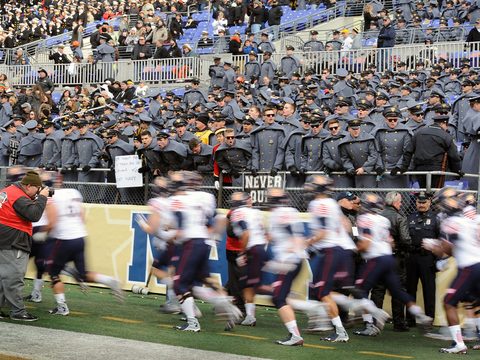
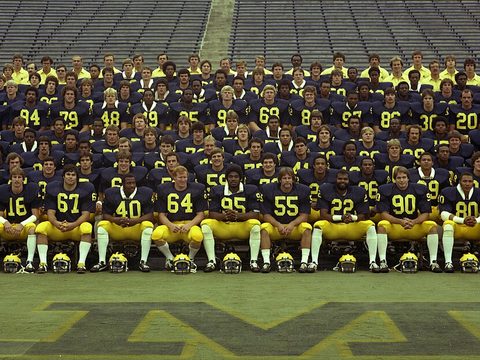
Eleven is only the number on the field. In the NFL, each side has a squad of fifty-three players, so most of them wait on the bench.
A squad this big works in three units: the offense, the defense and the special teams. They take turns on the field.
The unit with the ball is the offense, and its aim is simple: to move the ball into the opponent's end zone and score a touchdown.
A touchdown does not happen in one long run. The offense moves the ball down the field in a series of plays, called downs.
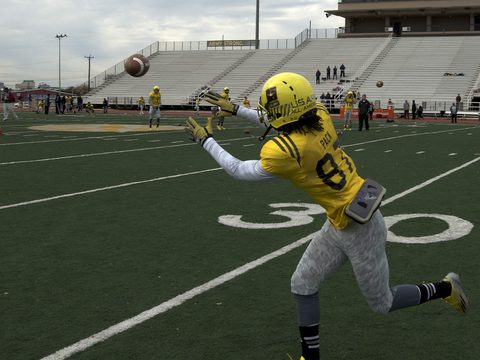
On each play, there are two options: the quarterback passes the ball to a receiver, or a running back carries it along the ground.
But there is a limit: every four plays, the offense must move the ball at least ten yards. If it does, it gets four more plays.
The defense does everything it can to stop those ten yards. If the offense fails, it has to give the ball to the other team.
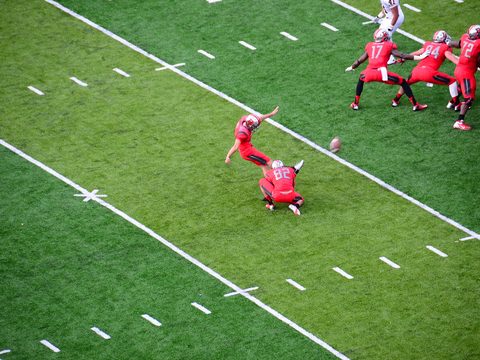
But a team that fails near the end zone has one more option: it can kick the ball between the upright posts for a field goal.
All this happens again and again for four quarters of fifteen minutes. The team with the most points at the end wins, and your first game is over.
Multiple choice
The stamp shows the moment in the video. Click an answer and read why.

-
How long is the field? 00:02
The first fact in the video: a 100-yard field. A yard is a little less than a meter, so the field is about ninety meters long.
-
How many players from each team are on the field? 00:05
Two teams of eleven, the same number as in soccer. Fifty-three is the size of the squad, not the number on the field.
-
How many players does an NFL squad have? 00:08
Fifty-three players on each side, but only eleven on the field at the same time. That is why the squad works in units.
-
What do the offense, the defense and the special teams do? 00:12
Three units, one field: when the team has the ball, the offense plays; when it loses the ball, the defense comes on. The special teams play the kicks.
-
What is the aim of the game? 00:15
Ball in the end zone means a touchdown, and the video says "touchdown and extra point": after a touchdown, the team can try for one more point. A kick between the posts comes later in the video, as a second option.
-
What are the two ways to move the ball on a play? 00:32
A pass from the quarterback to a receiver, or a running back "rushing the ball along the ground". Each play is one of these two.
-
What must the offense do every four plays? 00:43
"At least ten yards downfield every four plays." Ten yards, not a touchdown: a touchdown can take many groups of four plays.
-
What happens if the offense moves the ten yards? 00:50
It keeps the ball and "earns another four downs" to move toward the end zone. Ten yards, four more plays, ten more yards: that is how a team moves down the field.
-
And if the defense stops them before the ten yards? 00:55
No ten yards, no ball: the team has to give the ball to the other team. Four more plays come only after ten yards. "Usually", because there is one more option, in the next question.
-
When can the team try a field goal instead? 01:02
"If close enough", the team can kick the ball between the upright posts. It is worth fewer points than a touchdown, but it is better than nothing.
-
How long is the game? 01:09
Four quarters of fifteen minutes each, and the team with the most points at the end wins. Two halves of forty-five minutes is soccer.
-
Which sentence best summarizes the video?
The title says it: a guide for beginners. The field, the teams, the aim, the four plays, the field goal and the clock, in seventy-eight seconds, and no famous game or player.
Put the video in order
Watch the video again. These seven ideas are in the wrong order. Write 1 for the first thing the video explains, 2 for the second, and so on to 7.
-
aThe defense tries to stop them from making those ten yards.
-
bEach team wants to take the ball into the other team's end zone for a touchdown.
-
cTo get there, the offense moves the ball forward one play at a time. These plays are called downs.
-
dThe game has four quarters of fifteen minutes, and at the end, the team with more points wins.
-
eWhen the team is near the posts, it can try to kick the ball between them for a field goal.
-
fTo keep the ball, the offense has to go at least ten yards in four plays.
-
gIf the defense wins, the team with the ball must give it to the other team.
Play, do or go?
Read the rule, then write the verb for each sport or activity.

Three verbs, and the sport tells you which one. Is there a ball? Is it a martial art? Does the name end in -ing? Answer those three questions and you choose right almost every time.
- play + games with a ball: play baseball · play golf · play rugby. A team game with a goal takes play too, even without a ball.
- do + martial arts and activities you practice alone, without a ball: do kung fu · do pilates · do aerobics.
- go + activities that end in -ing: go hiking · go fishing · go dancing. Go says you leave the house to do it. The -ing wins: if the name ends in -ing, use go even when there is a ball.
- The forms change with the tense: play – plays – played · do – does – did · go – goes – went. She goes hiking on Sundays. They went fishing yesterday.
- Two ways for some sports: go cycling or cycle, go dancing or dance. Both are correct.
-
a___ surfing
-
b___ running
-
c___ bowling
-
d___ taekwondo
-
e___ basketball
-
f___ soccer
-
g___ yoga
-
h___ volleyball
-
i___ judo
-
j___ hockey
-
k___ tennis
-
l___ gymnastics
-
m___ ice skating
-
n___ swimming
-
o___ ballet
Play, do and go in sentences
Write the verb in the correct form and the activity on the left. The time words tell you the tense: last summer, every morning, when she was a child.
-
skiingMy parents traveled to Switzerland because they wanted to ___.
-
karateI started to ___ last week, and my legs still hurt.
-
American footballAfter watching the video, I want to learn to ___.
-
yogaMy sister ___ at the gym on Tuesdays and Thursdays.
-
swimmingLast summer we ___ in the river near my grandmother's house every day.
-
runningHe ___ every morning before work, rain or shine.
-
tennisDo you want to ___ with us tomorrow? We have a court for one hour.
-
gymnasticsShe ___ when she was a child, but she stopped at twelve.
Like or would like?
Read the rule, then choose the correct form in each conversation.

One word changes everything. I like swimming is about you, always. I'd like to go swimming is about one day, soon. The first is a preference; the second is a wish, or an invitation.
- like + -ing or a noun: I like swimming. · She likes tennis. · Do you like surfing? — Yes, I do. / Not really.
- would like + to + verb, or a noun: I'd like to go surfing next summer. · Would you like a coffee? Never
would like dancing. - 'd = would: I'd, you'd, she'd, we'd. I'd like is softer and more polite than I want.
- Would you like to…? is an invitation or an offer. Say yes with I'd love to! or Sure!, not
Yes, I would like. Say no with Sorry, I can't. - The model conversation: A: Do you like surfing? B: Yes, I do. A: Would you like to go surfing at the beach next summer? B: I'd love to.
- In American English, like + to + verb is common too: I like to cook on the weekend. Both like cooking and like to cook are correct, for a general preference.
-
Would you like…
Would like needs to + verb, and tonight makes it a plan, not a general preference.
-
Do you like…
Do you like asks about a general preference: like + -ing. Tonight is one plan, not a preference, so it goes with Would you like. The answer is Yes, I do or Not really.
-
A: ___ swimming? B: I love it. I always go swimming.
The answer is about a general preference: I love it, I always go. Would you like swimming is not possible anyway: would like takes to + verb.
-
A: ___ to go to the new swimming pool in town? B: Sure!
An invitation for now or soon, and Sure! says yes to it. Do you like…? gets the answer Yes, I do. Do you would like mixes the two questions.
-
I ___ to play soccer with my classmates tonight, but they don't know if they can.
A wish for tonight: would like to. I like to play soccer would mean "I enjoy playing", in general.
-
I ___ running early in the morning, when it is not so hot.
A habit and a preference: like + -ing. Would like running is impossible, and would like to running is worse.
-
A: ___ something to drink? B: Yes, please. A glass of water.
An offer: Would you like + noun, no to. Do you like something to drink asks about a general taste, which is strange here.
-
My brother ___ basketball, but he never plays: he only watches it on TV.
A general preference, third person: likes. He would like basketball says he wants basketball as a thing, which makes no sense.
-
Somebody asks, "Would you like to go bowling on Saturday?" You want to go. What do you say?
The natural yes to Would you like to…? is I'd love to, or Sure!. Yes, I do answers Do you like…?
-
Which sentence is WRONG?
Would like never takes -ing. Like + to + verb is fine, especially in American English.
Do you like it? Would you like to try it?
Part A is about the video. In Part B, interview a partner (or me) with the model conversation from Exercise 09: Do you like…? Would you like to…? Answer with play, do or go and one more detail. Part C is for your opinions.
Useful language
My sports
40–60 words. Write about two sports you play, do or go now, one sport you don't like, and one you would like to try. Use play, do and go, and like and would like.

My results
Check your score, then copy it and send it to your teacher on WhatsApp.

One job for this week. Every day, say three sentences out loud: one sport you play, one you do and one you go. Then one more: something you'd like to try this year. Thirty seconds, in English.