Ordering in a Restaurant
A phone call to Mario's Pizza: two large pies and one question the caller can't answer alone. Then food and drinks, two menus, and the small words that make an order polite.
Warm-up
Ask and answer with a partner, or with me. Click a card when you have answered it.

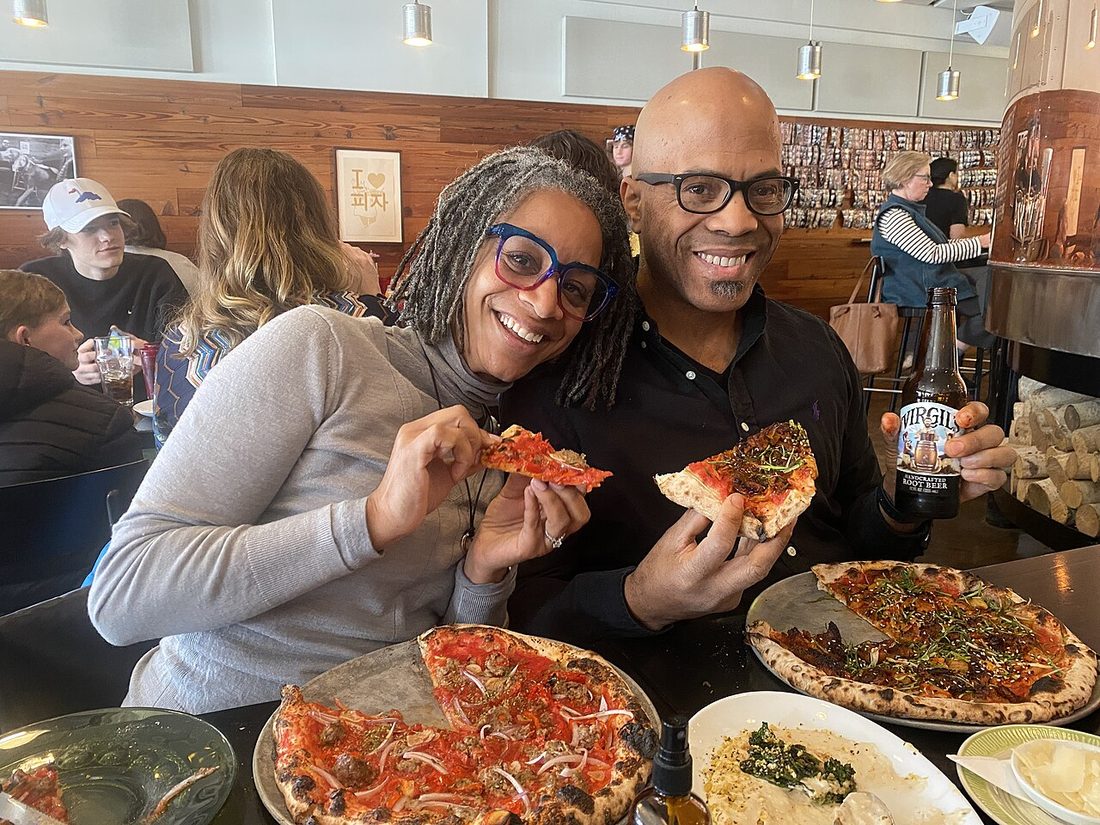
Food first. Tell me what you love to eat and where you go to eat it. Then we learn to order it in English, politely, from the first word to the check.
Useful language
Food, drinks and the restaurant
Click a word, then click its meaning. Correct pairs turn green. The audio button says the word.
Complete the sentences
Click a word in the bank, then click a gap. Click a filled gap to clear it. Read the whole sentence first: it tells you which word fits.

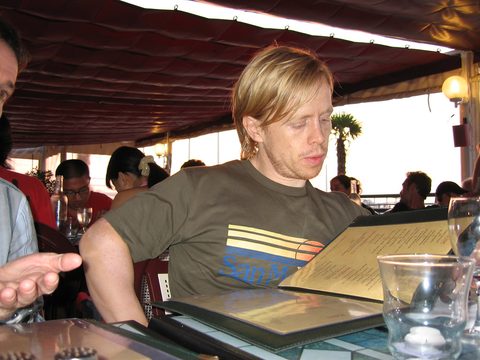 Could I read the
_____ again? I want to see all the desserts and their prices.
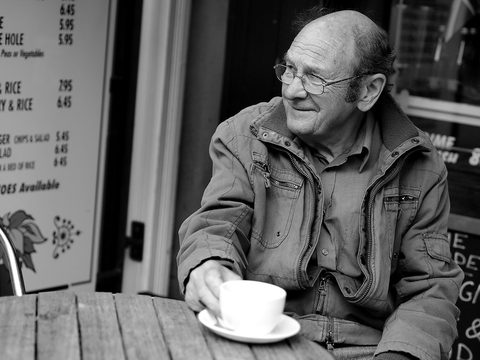 My dad drinks his
_____ black, with no milk and no sugar. He buys the best beans in town.
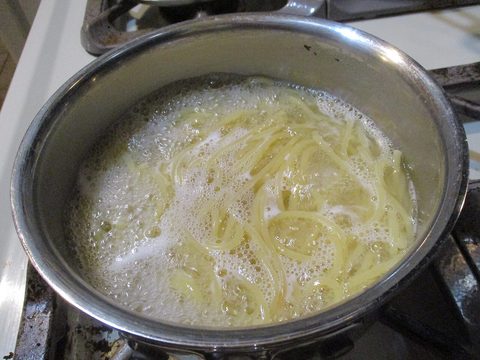 Boil the water, add some salt and cook the
_____ for ten minutes. Then add the tomato sauce.
 Our
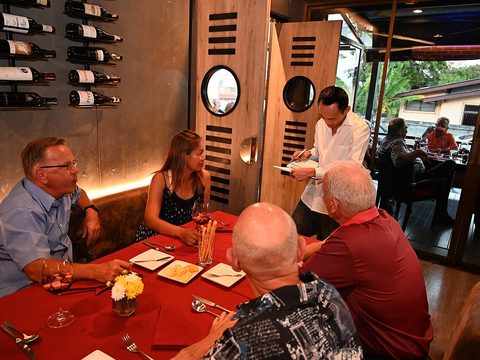
_____ is very friendly. He takes our order, and five minutes later he brings the drinks.
 There are six oranges in this glass of
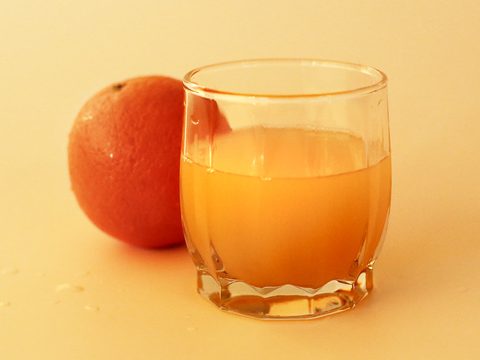
_____, and no sugar at all.
 I don't need lunch today: this morning I had a full
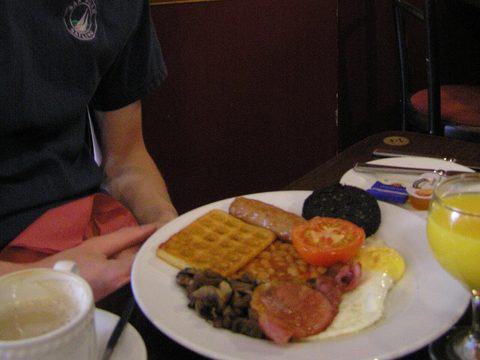
_____ with eggs, sausages, beans and toast.
 Put the chamomile
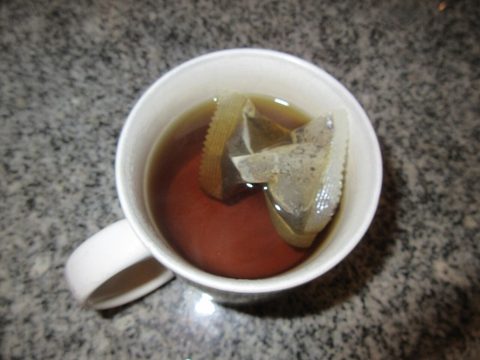
_____ bag in hot water, wait three minutes and then add a little honey.
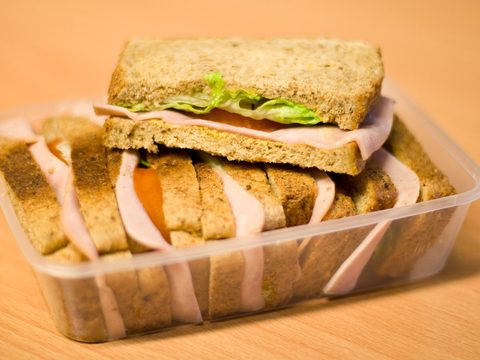 I have no time for lunch, so I'm taking a
_____ to work: wheat bread with chicken and lettuce inside.
Two large pies
Watch the video first: we watch only the first 34 seconds, and the player stops there. Then read the story. Would like is in bold. Click a dotted word to see what it means.
The phone rings at a pizza place called Mario's Pizza, and a worker picks it up. He thanks the caller and gives his name: Carlos.
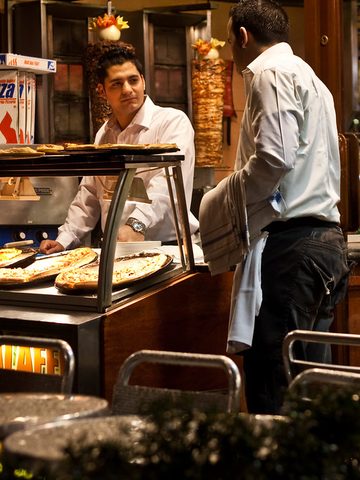
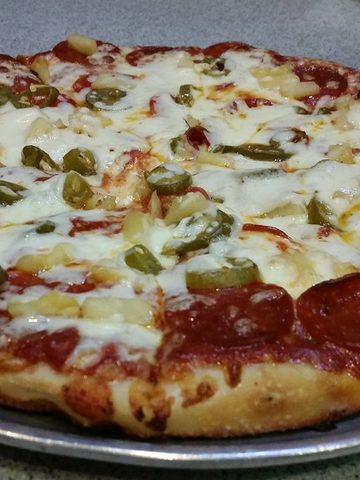

The caller says hello and starts his order at once. He speaks for more people than himself: he says "we would like", not "I want".
His first choice is a large pie with pepperoni and pineapple on top. He also asks for a cheesy crust.
Carlos repeats the whole order back to him, to make sure it is right: a large pepperoni with pineapple and cheesy crust.
The first pie is ordered, so the caller moves on: they would also like a second large pie, with pineapple again but bacon instead of pepperoni.
Before the last part of the second pie, he stops for a moment. Then he chooses the same crust as before: cheesy crust again.
Carlos repeats the second order too and asks a new question: is that the complete order? He calls the caller "sir", a polite word for customers.
The caller isn't sure of the answer. Before he says yes or no, he wants to find out what the people in the room think.
So he talks to the guys around him, with Carlos still on the line, and asks them if they are going to want another pizza.
Now Carlos can only wait for their answer. Two large pies are in the order, maybe a third one is coming, and the order is still open.
Multiple choice
The stamp shows the moment in the video. Click an answer and read why.

-
What is the name of the pizza place? 00:02
The worker answers with the name of the place: "Thanks for calling Mario's Pizza." Mario's is the place; Carlos is the man who works there.
-
Who answers the phone? 00:04
"This is Carlos speaking" is a very common way to say your name on the phone. You hear it again in Exercise 06.
-
How big is the first pizza? 00:07
"A large pie." In the US, pie is a common word for a whole pizza, not only for a dessert.
-
What does he want on the first pizza? 00:11
Pepperoni is a spicy sausage, cut into thin circles. The bacon comes later, on the second pizza. And the crust? Cheesy.
-
Why does Carlos say the order again? 00:14
Nobody asks him to. Repeating the order is normal on the phone and in restaurants: if something is wrong, the customer can say so now, not when the pizza arrives.
-
How does the caller order the second pizza? 00:18
Would like is polite and very common when you order, and he uses it for both pizzas. We want… is correct English, but it sounds too direct: more about this in Exercise 09.
-
How is the second pizza different from the first? 00:22
Same size, same pineapple and, after a short stop at 00:24, the same cheesy crust. Only one thing changes: bacon instead of pepperoni.
-
What does Carlos ask at the end of the second order? 00:28
"Is that gonna complete your order, sir?" Gonna is fast, informal English for going to. In a restaurant, waiters ask the same thing with Anything else?
-
Why does Carlos call the man "sir"? 00:28
Sir (for a man) and ma'am (for a woman) are polite words for customers in the US. Carlos doesn't know the caller: he only knows his order.
-
What does the caller do after Carlos's question? 00:30
"Let me gauge the room" means "let me find out what the people here think". He isn't sure the order is complete, so he doesn't say yes.
-
What does he ask the guys around him? 00:32
"Guys, are we gonna want another pizza?" So maybe the order isn't complete: two pies, and perhaps a third.
-
Which sentence best summarizes the story?
The whole scene is one phone order: two large pies, and then a question the caller can't answer alone. Carlos makes no mistakes, and nobody complains.
Complete the phone call
Watch the first 34 seconds of the video again and complete the call with the six words. Click a word, then click a gap. Gonna is fast, informal English for going to.
- Carlos: Hello? Thanks for calling Mario's Pizza. This is Carlos _____.
- Caller: We would like a _____ pie with pepperoni, pineapple, and cheesy crust.
- Carlos: Large _____ with pineapple and cheesy crust.
- Caller: We would also like a large pie with _____, pineapple, and cheesy crust.
- Carlos: Large bacon, pineapple, with cheesy _____. Okay. Is that gonna complete your _____, sir?
Waiter and customer
Read the two lists, then choose what the other person says next.

Two sides of the table. The waiter asks and offers; the customer asks for things. Learn both lists: in a restaurant, you hear one and you say the other.
- Waiter, asking: Are you ready to order? · What would you like? · Anything else?
- Waiter, offering: Would you like something to drink? · …a dessert? · …a tea? · …a coffee?
- Waiter, giving you something: Here you are!
- Customer, ordering: Could I have a/an …? · Can I have a/an …? · I would like… / I'd like a/an…
- Customer, about money: How much is …? · Could I have the check, please? (in British English, the bill)
- Ask and answer: Could I have a large Coke, please? — Yes, of course. · Can I have a slice of apple pie, please? — Yes, certainly. · I'd like a glass of orange juice, please. — I'm sorry, we're out of fresh juice today.
- Could or can? Both are fine in a restaurant, and could is a little more polite. The verb after I has no to: Could I have…?
-
Waiter: Are you ready to order? Customer: ___
The customer orders with Could I have…? Here you are and Anything else? are the waiter's words.
-
Customer: Could I have a glass of water, please? Waiter: ___
The waiter says yes (Sure, Of course, Certainly) and asks a small question. Yes, you could is not a natural answer to a request.
-
Waiter: Anything else? Customer: ___
Anything else? asks if you want more. No, thanks is the answer when your order is complete. Yes, of course is how the waiter answers a request.
-
Customer: How much is the carbonara? Waiter: ___
How much…? asks for the price, so the answer is a number. You can check it on the Borcelle menu in Exercise 08.
-
Waiter: Would you like a dessert? Customer: ___
Answer an offer with Yes, please or No, thank you. I'd like needs something after it: I'd like the apple pie.
-
Customer: Can I have some ketchup for my fries, please? Waiter: ___
The customer asks for something, and the waiter says Yes, certainly or Of course. Yes, I can answers a question about you, like Can you swim?
-
Customer: We're finished. Could we have the check, please? Waiter: ___
Here you are is what you say when you give something to somebody. The customers want to pay, so the waiter brings the check.
-
Waiter: I'm sorry, we don't have any pasta tonight. Customer: ___
When something isn't available, you choose something else. Then at the end means "in that case".
Polite, not direct
Read the rule, then answer the questions about the man in the picture and about polite requests.

"I want a sandwich" is correct English. But to a waiter it sounds rude. Change the first words, add please, and let your voice go up at the end: same sandwich, much nicer.
- Too direct: I want… · Give me… The grammar is correct, but to a waiter or a stranger it sounds rude.
- Polite: I'd like…, please. · Could I have…, please? · Can I have…, please?
- Very common in American cafes: Can I get…? — Can I get a chocolate muffin, please?
- Where does please go? At the end, after a comma, or after I: Could I please have…?
- The waiter's offers: Do you want…? becomes Would you like…?
- Your voice: in a request, the voice usually goes up at the end. A low, heavy voice can make even please sound rude.
-
The man says, "I want a sandwich." Is he polite?
Normally, English speakers are not so direct. It is more polite to start with Can I…? or Could I…?
-
How can he make his sentence more polite?
I'd like + please. Could I have a sandwich, please? is polite too.
-
How can your voice help you to be polite in a request?
In requests, English speakers usually use a rising tone: the voice goes up at the end. Try it: Could I have a sandwich, please?
-
Which request is the most polite?
Could + please is the most polite. Can I have the check? is OK, but without please it is less friendly. Give me… is too direct.
-
You are at a cafe counter in the US. Which order is natural and polite?
Can I get…? is very common in American cafes, and please makes it friendly. The other two sound like orders, not requests, and I want medium latte has no a.
-
Which sentence is WRONG?
No to after could or can: Could I have…?
-
The waiter asks, "Would you like something to drink?" Which answer is correct and polite?
Start with Yes, please, then make your request. Yes, I would like is not complete: like what?
Complete the dialogues
Write one word in each gap. Dialogue 1 (lines a–e) is at Borcelle, the Italian restaurant; dialogue 2 (lines f–j) is at the Coffee Shop. In some gaps, two words are correct.
-
aWaiter: Are you ready to order? Customer: Yes! I ___ like a vegetarian pizza, please.
-
bCustomer: … like a vegetarian pizza, ___.
-
cWaiter: Would you like something to drink? Customer: Yes! ___ I have a mineral water?
-
dWaiter: Still or sparkling? Customer: Sparkling. Could I ___ lime and ice too, please?
-
eWaiter: Of course. Anything ___? Customer: No, thank you. That's all.
-
fWaiter: Hi! What ___ you like today? Customer: A caramel macchiato, please.
-
gWaiter: I'm sorry, we're ___ of caramel today. Customer: No problem. A medium cappuccino, then.
-
hCustomer: How ___ is it? Waiter: It's three dollars and ten cents.
-
iWaiter: Would you like ___ else? A cookie, maybe? Customer: No, thanks. Just the cappuccino.
-
jCustomer: Here you ___: three dollars and ten cents. Waiter: Thank you! Have a nice day.
Make it polite
Each line is too direct. Rewrite it as a polite request or offer. Start with the words on the left, and use please in the requests. Example: I want a pizza. (I'd like) → I'd like a pizza, please.

-
Could IGive me the menu.
-
I'd likeI want two coffees.
-
Can IBring me a glass of water.
-
Could weWe want the check.
-
I'd likeGive me a slice of chocolate cake.
-
Can weWe want a table for four.
-
Could IMore ice in my juice!
-
Would you likeWaiter: Do you want a dessert?
-
Would you likeWaiter: Do you want something to drink?
At the restaurant
Work in pairs: one is the waiter or waitress, one is the customer. Use the menus from Exercise 08 and the language from Exercises 07 and 09. Swap roles every time, and click the card when it's done.
- Waiter: Good evening! Are you ready to order?
- Customer: Yes. Could I have the carbonara with spaghetti, please?
- Waiter: Of course. Would you like something to drink?
- Customer: I'd like a mineral water, please. How much is it?
- Waiter: It's one dollar. Anything else?
- Customer: No, thank you. That's all.
Useful language
Let's talk about food
Part A is about the video. In Part B, interview a partner (or me), and answer with one more detail: when, where or with whom. Part C is for your opinions.

Useful language
My restaurant dialogue
40–70 words. Write your own dialogue between a waiter and a customer at Borcelle or at the Coffee Shop. Use two expressions for the waiter, two for the customer, one Could I…? or Can I…? request and please.
My results
Check your score, then copy it and send it to your teacher on WhatsApp.

One job for this week. The next time you order a coffee or a meal, in any language, listen to your first words. Then say the same order in English, out loud: Could I have…, please? Thirty seconds.