Top 5 Things To Do in Bahia
Samba, moqueca, an Afro-Brazilian ceremony and a warm golden lake: four of a travel host's top five experiences in Bahia. And the question every traveler hears: Have you ever been there?
Warm-up
Ask and answer with a partner, or with me. Tap a card when you have answered it.

Pack your bags: today we go to Bahia. Capoeira, samba, moqueca and a lot more. And you learn the question every traveler hears: Have you ever been…?

Useful language
Things to do in Bahia
Click a word, then click its meaning. Correct pairs turn green. The audio button says the word.
Complete the sentences
Click a word in the bank, then click a gap. Click a filled gap to clear it.

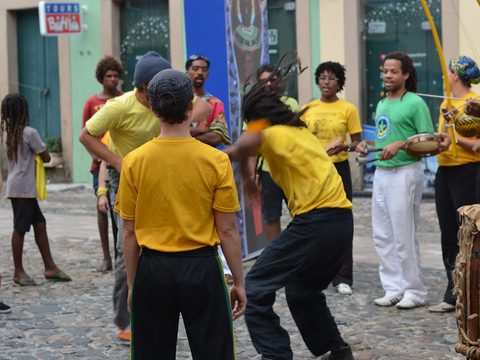 In a circle, two men kicked, jumped and turned upside down to the music, but they never hit each other. It was a game of
_____.
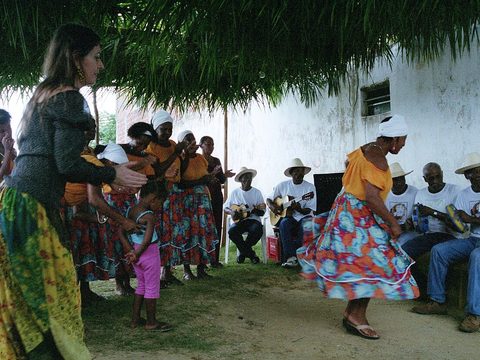 My cousin is learning to dance
_____. The music is fast and happy, and she practices her steps every night.
 My uncle's favorite dish is
_____: fish cooked slowly in a clay pot with tomatoes, onions and coconut milk.
 Before you cook the
_____, take off their heads, their shells and their tiny legs.
 Don't wear high heels in the old town. The streets are made of
_____, and your heels can get stuck between them.
 The wedding
_____ was short: twenty minutes in a small church. After it, there was a long party.
 We bought tickets for tonight's
_____ at the theater: two hours of music and dance by a famous ballet company.
 Every evening at six, we sit on the beach and watch the
_____. The sky turns orange and pink, and then it gets dark.
Mark's list
Watch the video first: about five minutes, by the travel host Elton. It has no captions, so just enjoy Bahia and listen for the names of the food and the places. Then read the story. Mark and Bia are not real people, but Mark follows the experiences from Elton's video. The present perfect is in bold. Tap a dotted word to see what it means.
Mark lives in Chicago and loves to travel. One day at lunch, his Brazilian coworker, Bia, asks him, "Have you ever been to Bahia?"
Mark has visited Mexico, but he has never been to Brazil. "No, I haven't," he says. So Bia shows him a travel video.
In the video, a travel host, Elton, shows the five best things to experience in Bahia. Mark loves the idea, so he books a trip.
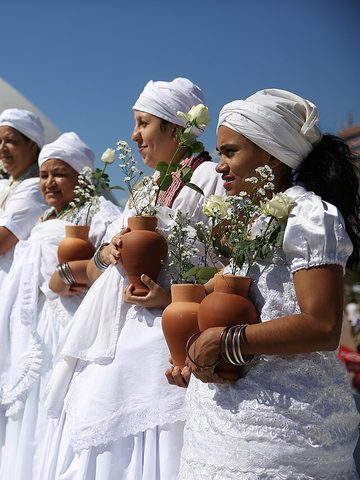
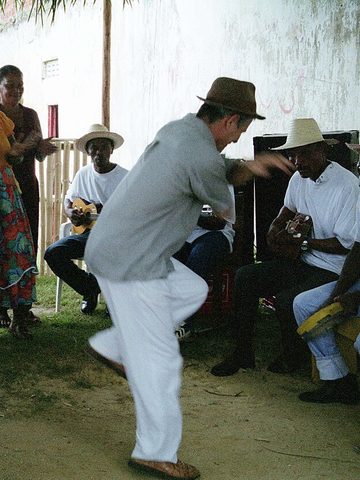
He lands in Salvador, Bahia's capital, with Elton's list on his phone. To understand the local culture, he starts with a Candomblé ceremony.
At the ceremony, the people explain each part to visitors. Mark listens quietly and learns a lot about Afro-Brazilian religion and culture.
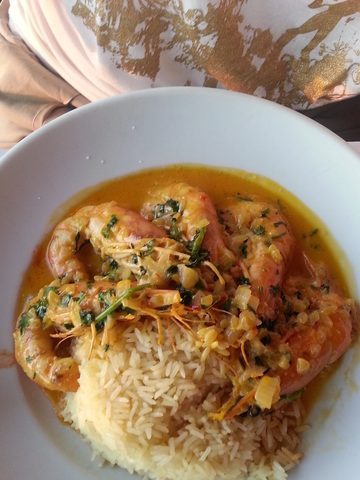
After the ceremony, Mark is hungry, so he tries another idea from the list: moqueca, seafood, mostly shrimp, in a rich sauce over rice.
Samba is on the list too, so Mark asks the waiter where to dance. The waiter smiles and tells him about a party that night.
Mark has never danced samba before. The drums are fast and his feet are slow, but people help him, and he dances until two in the morning.
The next morning, his legs hurt, so he picks the calmest idea on the list: a lake with warm, golden-brown water, where he just floats and relaxes.
Back home, Bia asks, "So, have you been to Bahia?" "Yes, I have!" says Mark. "I've eaten moqueca, danced samba and swum in a golden lake!"
Multiple choice
All the answers are in the story. Click an answer and read why.

-
What does Bia ask Mark at lunch?
"Have you ever been to Bahia?" Ever means "at any time in your life". Bia asks about his experience, not about a date.
-
Why does Mark answer, "No, I haven't"?
His short answer means "No, I haven't been to Bahia." He knows Mexico, but Brazil is new for him.
-
What does Bia do after Mark's answer?
"So Bia shows him a travel video." His "no" is the reason: she wants him to see Bahia.
-
Why does Mark book a trip?
"Mark loves the idea, so he books a trip." One short video, and now he has a plan.
-
Why does Mark start with a Candomblé ceremony?
Candomblé is an Afro-Brazilian religion, and Mark wants to understand the culture of Bahia first.
-
What do the people at the ceremony do for visitors?
So Mark can listen quietly and learn a lot about Afro-Brazilian religion and culture.
-
Why does Mark try moqueca?
The ceremony ends, and he is hungry. Moqueca is one more idea from Elton's list, so it's the perfect meal.
-
What is in Mark's moqueca?
Moqueca is a famous dish in Bahia: seafood in a sauce. Mark's has mostly shrimp, and it comes over rice.
-
Why does Mark talk to the waiter?
Samba is on the list too, and local people know the best places. The waiter tells him about a party that night.
-
How is Mark's first night of samba?
The drums are fast and his feet are slow, but he dances until two in the morning. Not bad for a first time!
-
Why does Mark go to the lake the next morning?
After hours of samba, he needs the calmest idea on the list: warm water, where he can just float and relax.
-
Which sentence best summarizes the story?
The story starts with "Have you ever been to Bahia?" and ends with "Yes, I have!" Between the two questions, there is a whole trip.
Elton's list
Watch Elton's video again. Which of these experiences does he recommend? Tap a card when you hear it. The video has no captions, so listen carefully, then compare with a partner.
What does it mean? These four sentences are from Elton's video. Read each one and choose what it is. The words around it tell you.
-
a · "It's like this sauce with usually seafood in it, mainly shrimp, and it's served over rice."
A sauce with seafood, served over rice, is food. Only one of the four is a dish: moqueca.
-
b · "And they just take you through the ceremony where you just learn so much about their religion and their culture. And it really taps you into what Afro-Brazilian culture is really about."
The sentence before talks about the ceremony. Taps you into means "connects you with": the Candomblé ceremony shows you Afro-Brazilian culture.
-
c · "It separates two bodies of water."
A body of water is a sea, a river or a lake. Only a place with water fits here, so it is the lake.
-
d · "So it's warm. You can just chill in it."
Chill means "relax". Moqueca is warm too, but you can't relax in a dish! You can relax in warm water.
The present perfect for experiences

Ever, never, been: three small words for a whole life. Use the present perfect for your experiences when the time is not important. When you say when, change to the past simple.
- Look at these sentences: She has been to Paris. · He has climbed Mount Everest. · We've watched the sunset together. · I have never read a book in English. · He's tried milk with tea. · Have you ever been to London? Yes, I have!
- Experiences: things that happened at any time in your life until now. We don't say when.
- Questions: Have / Has + person + ever + past participle? Short answers: Yes, I have. · No, I haven't. · Yes, she has. · No, she hasn't.
- Negatives: never (= not at any time) or haven't / hasn't: My dad has never flown in a plane. · We haven't tried that restaurant.
- Short forms: I've, you've, we've, they've · he's, she's, it's (here 's = has).
- Say when? Use the past simple: I've been to Recife. but I went to Recife last year.
- Past participles: regular verbs end in -ed (climbed, watched, tried); irregular verbs change: be → been · eat → eaten · see → seen · read → read (say "red").
Watch and listen. Two short clips. In the first, somebody asks Donald Duck a question; most of the clip is music. In the second, from the series Emily in Paris, listen for a question about McDonald's. Neither clip has English captions, so all the answers below come from the sentences.
-
"Have you ever been to Bahia?" "No, I haven't." Which words are the verbs?
Have + been (the past participle of be) make the question, and haven't answers it. Ever is not a verb: it means "at any time".
-
We use the present perfect to talk about a ___ action.
The experience happened before now, at some time in your life. What matters is the experience, not the date.
-
We use the present perfect for experiences in our life when we ___ the exact time.
No date, no yesterday, no in 2019. When you say the exact time, use the past simple.
-
The question in the Emily in Paris clip: "___ ___ ever been to a McDonald's in Paris?"
Ever + been: a present perfect question. Have comes first, then the person.
-
We make the present perfect with ___ + the past participle of the verb.
Has goes with he, she and it; have goes with I, you, we and they.
-
After have / has, we use the ___ of the verb.
With regular verbs, the two forms are the same (danced). With many irregular verbs, they are different: ate, but have eaten.
-
In questions about experiences, we often use ___.
Ever = at any time in your life. It goes before the past participle: Have you ever tried…?
-
In negative sentences, we can use ___.
Never = not at any time. It is already negative, so no not: I have never…, not
I haven't never… -
"She's flown in a helicopter." Here, 's means…
Flown is a past participle, so 's is has: She has flown.
-
Which question is correct?
Have + past participle: eaten. Ate is the past simple, and did never goes with a past participle.
-
"I ___ to Salvador in 2019."
In 2019 says when, so we need the past simple. Without a date: I have been to Salvador.
The verb pattern: past participles
Write the past participle of the verb on the left. One word in each gap. Most of these verbs are irregular.
-
rideMy little brother has never ___ a bike.
-
swimHave you ever ___ with sharks?
-
writeMy grandfather has ___ two books about his life.
-
meetShe works at a TV station, so she has ___ a lot of famous people.
-
runMy sister loves long races. She has ___ three marathons!
-
goWe have never ___ bungee jumping. We're too scared!
-
takeI have never ___ a taxi in New York. I always walk or use the subway.
-
singHave you ever ___ in front of a big crowd?
-
spendThey have ___ a night in an old castle, and they didn't sleep at all!
-
buyMy parents have finally ___ a house near the beach.
-
getHe loves art on his skin. He has ___ three tattoos this year.
-
learnI have ___ three songs on the guitar this month.
Put the words in order
Write the whole sentence. Find have or has and the past participle first: the rest goes around them.

-
athree / have / Paris / visited / times / I
-
bnever / to / has / she / Asia / been
-
ctried / pizza / traditional / they / have / Italian
-
dseen / not / has / he / Eiffel / the / Tower / yet
-
ein / ridden / has / a / desert / camel / the / never / she
-
featen / times / many / have / sushi / we
-
gall / world / famous / he / visited / over / museums / the / has
Things to do, true for you
First, the verbs. Write the verb that goes with each activity. Use these: play · dance · eat · walk · experience · see · watch · read.
-
a___ capoeira
-
b___ samba
-
c___ moqueca
-
d___ the cobblestone streets of Pelourinho
-
e___ a Candomblé ceremony
-
f___ a performance at the Bahian Folklore Ballet
-
g___ the sunset at Ponta do Humaitá
-
h___ a book by Jorge Amado
Now, true for you. Write a true sentence about you with the present perfect: I have… / I've… / I have never… / I haven't… Write only the sentence, with no extra words. Example: go to Salvador → I have never been to Salvador. or I have been to Salvador.
-
aplay capoeira
-
bdance samba
-
ceat moqueca
-
dexperience a different religious ceremony
-
esee a ballet / a concert
-
fwatch the sunset
The game: Have you ever…?
Choose a letter and a number, like C4. Ask your partner (or me) if they have ever done that. If the answer is yes, ask for details: when, where, how was it? If it is no, ask if they would like to try. Tap a square when you have played it.

Useful language
Have you ever…?
Part A is about the video and the story. In Part B, answer with the present perfect (Yes, I have. / No, I haven't.), then add one detail in the past simple: when, where or who with. Part C is for your opinions. Tap a card when you have answered it.
Useful language
My experiences
40–70 words. Write about five experiences: three things you have done (no dates!) and two things you have never done, but would like to try. Then choose one of your experiences and add a detail in the past simple, like this: I went there in 2019.

My results
Check your score, then copy it and send it to your teacher on WhatsApp.

One job for this week. Ask three people a Have you ever…? question: a friend, a coworker and someone at home. When they say yes, ask one more question in the past simple: When? Where? How was it?