Saint Patrick's Day
A rich boy, a group of pirates, six years with the sheep, and a small plant with three leaves. The story behind the greenest day of the year, told in the simple past, with the pronouns that keep a story moving.
Warm-up
Ask and answer with a partner, or with me. Tap a card when you have answered it.

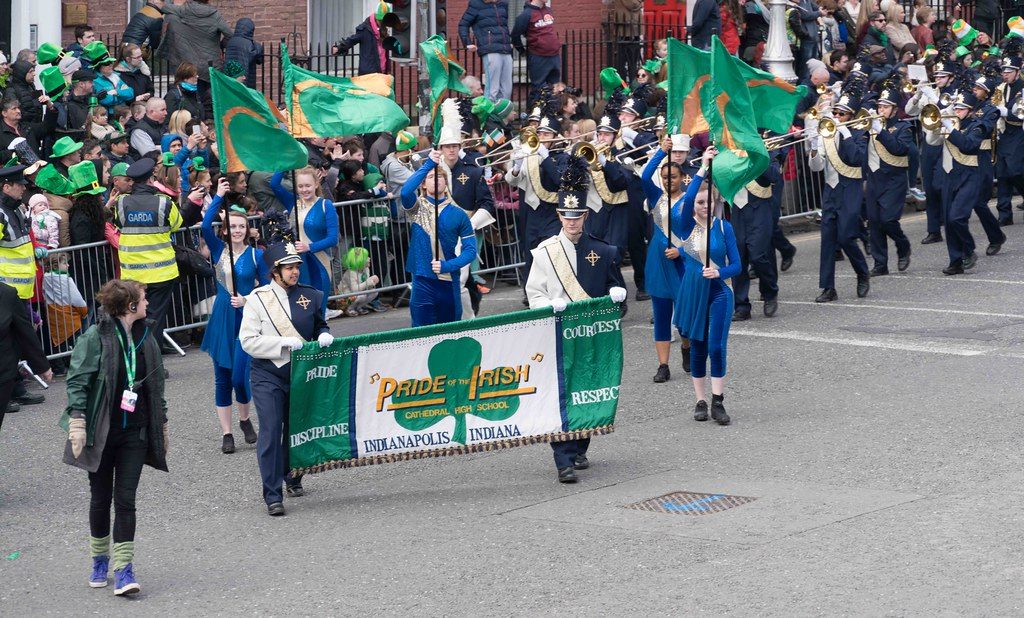
One day, one story. Saint Patrick's Day is on March 17, and millions of people wear green for it. But who was Patrick? Today you learn his story, and the past verbs and the pronouns that tell it.
Useful language
Words of the story
Click a word, then click its meaning. Correct pairs turn green. The audio button says the word.
Complete the sentences
Click a word in the bank, then click a gap. Click a filled gap to clear it. Read the whole sentence first: the clue is always inside it.

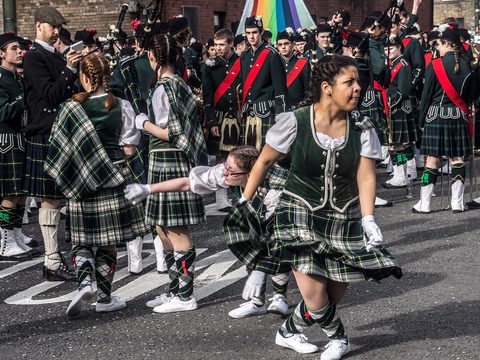 The street was closed all morning because of the
_____: bands, dancers and a thousand people walking together.
 My neighbor grows a tiny
_____ in a pot by her kitchen window, and she waters its little green leaves every morning.
 Nobody can catch a
_____: in the old stories, this tiny man in green clothes always runs away and hides his pot of gold.
 The captain of that ship was a
_____: he stopped other ships at sea and stole their money.
 Every evening the
_____ counted her sheep: two hundred animals, and not one was missing.
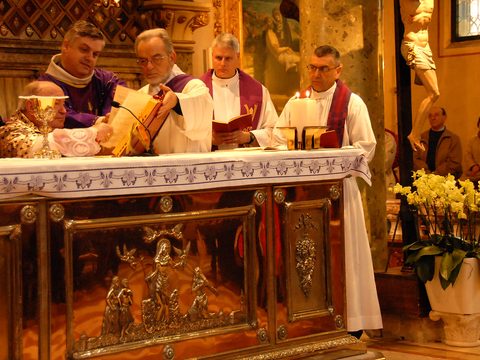 The
_____ in our town is very busy on Sundays: he leads three services in the old church before lunch.
 Don't put your hand in that hole! A long, thin
_____ lives there, and it bites.
 Every night before bed, my grandmother likes to
_____ for her family.
The story of Saint Patrick
Watch the video first: three minutes, with captions. Then read the story and listen to it. Tap a dotted word to see what it means.
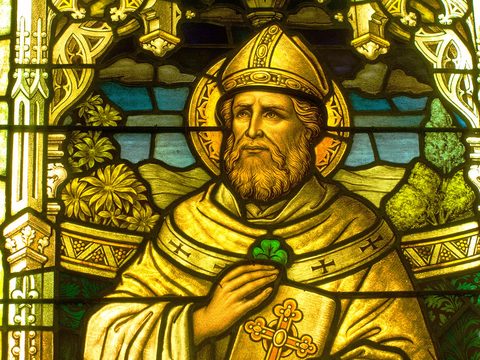
Patrick lived in Britain with his very rich family. But when he was only sixteen years old, a terrible thing happened at his home.


A group of pirates attacked the house. They kidnapped Patrick, and they crossed the sea with him to Ireland, far from everyone he loved.
In Ireland, the pirates sold Patrick as a slave. He spent six long years there, and he worked as a shepherd.
Life so far from his family made Patrick sad and lonely. But every day he prayed, and little by little his faith grew much stronger.
Then, one day, Patrick heard a voice, and the voice told him to run away. So Patrick listened. He escaped from Ireland and went to France.
In France, Patrick became a priest. Many years later, he wanted to share his faith with the Irish, so he went back to Ireland at about sixty.
This time he was a free man. He taught people about God with a shamrock, a small clover with three leaves, and almost everybody loved him.
People still tell a legend about him: he sent all the snakes away from Ireland. Snakes meant evil, everything bad, and he wanted a land without evil.
When Patrick died, all of Ireland was sad. The people decided to honor him every year, and that is how Saint Patrick's Day began.
Patrick died in the spring, the season of green leaves and grass. So today, on March 17, people all over the world wear green to honor him.
Multiple choice
The stamp shows the moment in the video. Click an answer and read why.

-
Where did Patrick live, and what was his family like? 00:20
The video says it at 00:20: he was born in Britain, not in Ireland, and his family was very rich. The saint of Ireland was not Irish.
-
What happened when Patrick was sixteen years old? 00:32
First the pirates attack his home (00:32), then they kidnap him and take him across the sea to Ireland (00:36). In one day, his life changes.
-
What happened to Patrick in Ireland? 00:40
Sold as a slave (00:40): now he belongs to another person and works for no money. Six years as a slave (00:46), with the sheep (00:50). Six years, not sixteen: sixteen was his age when the pirates came.
-
Why did Patrick feel sad and lonely? 00:51
Being far away from his family made him sad and lonely (00:51). Lonely means unhappy because you are alone. The story says nothing about food.
-
What did Patrick do every day in Ireland? 01:00
He prayed every day (01:00), and little by little his faith grew much stronger. That faith is the start of everything that happens next.
-
What did the voice tell Patrick to do? 01:05
One day he hears a voice telling him to run away (01:05). He listens (01:10), and he escapes. He becomes a priest later, in France.
-
Where did Patrick go, and what did he become there? 01:13
He escaped and went to France (01:13), and in France he became a priest (01:15). He did not go back home to his family.
-
Why did Patrick go back to Ireland when he was about sixty? 01:22
At about sixty he goes back to Ireland (01:22), because he wants to share his faith with the Irish (01:27). The same island, but now he is a free man, not a slave.
-
What did Patrick use when he taught people about God? 01:36
He carried a shamrock with him (01:36), a clover with three leaves (01:38), and it helped him teach people about God (01:40). That is why the shamrock is a symbol of the day.
-
According to the legend, what did Patrick do with the snakes? 01:48
The video says he "drove out" all the snakes (01:48): he made them leave Ireland. For people then, snakes were a sign of evil (01:53).
-
Why do people wear green on Saint Patrick's Day? 02:19
Green is the color of spring, and Patrick died in the spring (02:19), so people wear green to honor him. The leprechaun asks the question at 02:16.
-
Which sentence best summarizes the story?
The story has one line: a rich boy in Britain, a slave in Ireland, a priest in France, and back to Ireland to teach. When he died, the people decided to honor him every year. The leprechaun and the clover are only the frame of the video.
Saint Patrick's Day today: true or false?
Now you know the story. What about the celebration? Decide with a partner, then click and read why.
-
In Ireland, Saint Patrick's Day is a national holiday: banks, schools and many businesses close for the day.
March 17 has been an official day off in Ireland since 1903. Banks, schools and offices close, and a big parade fills the center of Dublin.
-
Leprechauns really existed in Ireland a long time ago.
Leprechauns are little men from Irish stories, like the one in the video. They are not real, and they never were.
-
One of the first Saint Patrick's Day celebrations in America was in Boston, in 1737.
Irish immigrants in Boston celebrated the day in 1737, almost forty years before the United States was born. Today New York has one of the biggest parades in the world.
-
The most popular Saint Patrick's Day food is apple pie.
In the United States, many families eat corned beef and cabbage on this day. Apple pie is not part of the tradition.
-
The shamrock is a national symbol of Ireland.
The shamrock and the harp are two famous symbols of Ireland. On March 17, many people wear a shamrock on their jacket.
-
The original color of Saint Patrick's Day was blue, not green.
For a long time, a light blue called "Saint Patrick's blue" was the color of the saint. Green became the color of the day later, with the shamrock.
-
People have to wear something white on Saint Patrick's Day.
Green, not white. The leprechaun explains it at 02:19: green is the color of spring, and Patrick died in the spring, so people wear green to honor him.
-
The beer Guinness is one of the most popular drinks on Saint Patrick's Day.
Guinness, the famous dark beer from Dublin, is the drink of the day in pubs all over the world.
-
The real Saint Patrick wasn't Irish. He was born in Britain, around the year 390.
You heard it at 00:20: born in Britain. He only came to Ireland as a slave, at sixteen.
-
On Saint Patrick's Day, it is prohibited to dance in pubs.
No rule like that exists: on March 17, the pubs are full of Irish music, and many people dance. But here is a surprise: from 1927 to 1961, a law in Ireland did not let pubs sell alcohol on this day!
-
In the popular tradition, each leaf of a four-leaf clover has a meaning: hope, faith, love and luck.
Four leaves, four meanings. A shamrock has only three leaves: Patrick used it in his lessons (01:40). A clover with four leaves is very hard to find, so it means good luck (02:33).
-
You have to hug three people to have good luck on Saint Patrick's Day.
No hugs necessary. The lucky thing of the day is a four-leaf clover, as the leprechaun says at 02:33.
-
A small Irish village had the world's shortest Saint Patrick's Day parade: it went from one pub to the other.
The village of Dripsey, in County Cork, is in the Guinness World Records for it: only 23 meters, from the door of one pub to the door of the other. The parade ended in 2007, when one of the two pubs closed.
Simple past: regular or irregular?
The story is full of verbs in the past. For each verb, say how it is formed. Then read why.

Two kinds of past. Regular verbs follow a rule: you build them with -ed or -d. Irregular verbs change: eat → ate, take → took. There is no rule for them, but this story gives you nine to remember.
- Verb + -ed: walk → walked · cook → cooked
- Verb ending in -e, + -d: live → lived · dance → danced
- Consonant + -y → -ied: study → studied · but vowel + -y stays: play → played
- Irregular: have → had · see → saw · eat → ate
- Careful: an irregular past can end in -d too: tell → told · find → found. Look at the infinitive, not only the end.
- Same form for every person: I walked, she walked, they walked.
- Negative and question, with did: He didn't walk. · Did he walk?
-
happened — A terrible thing happened at his home.
happen + -ed. The infinitive is happen.
-
attacked — A group of pirates attacked the house.
attack + -ed. After -k, the -ed sounds like a t: attackt, with no extra syllable.
-
sold — The pirates sold Patrick as a slave.
sell → sold. It ends in -d, but it is not sell + -d: the vowel changes. Irregular.
-
worked — He worked as a shepherd.
work + -ed. The infinitive is work.
-
prayed — Every day he prayed.
pray + -ed. Not -ied: the -y comes after a vowel (a), so it stays.
-
heard — One day, Patrick heard a voice.
hear → heard. It looks like hear + -d, but the sound changes: hear sounds like "here", heard sounds like "bird". Irregular.
-
listened — So Patrick listened.
listen + -ed. The t in listen is silent, in the past too.
-
escaped — He escaped from Ireland.
escape already ends in -e, so we only add -d.
-
made — Life so far from his family made him sad.
make → made. The -d at the end is a trap: the k disappears, so it is irregular.
-
wanted — He wanted to share his faith with the Irish.
want + -ed. After -t, we say the -ed as an extra syllable: want-ed.
-
decided — The people decided to honor him.
decide already ends in -e, so we only add -d. After -d, the ending is an extra syllable: decid-ed.
Nine irregular verbs: write the infinitive
Every verb in bold is irregular, so no rule helps you: write its infinitive. Then find the nine verbs in the story. Last, close the lesson and test a partner: one says the infinitive, the other says the past.
-
aPatrick was sixteen years old when the pirates came.
-
bThe pirates sold Patrick as a slave.
-
cHe spent six long years in Ireland.
-
dLife so far from his family made him sad and lonely.
-
eLittle by little, his faith grew much stronger.
-
fOne day he heard a voice.
-
gHe escaped and went to France.
-
hIn France, he became a priest.
-
iThat is how Saint Patrick's Day began.
Subject pronouns, object pronouns, possessive adjectives
First complete the three rules. Then choose the correct word in each sentence.

Three small tables, one rule each. Before the verb: he, she, they. After the verb: him, her, them. Before a noun: his, her, their. Patrick, Patrick, Patrick… pronouns save you from saying his name ten times.
- Subject pronouns (before the verb, the person who does the action): I, you, he, she, it, we, you, they
- Object pronouns (after the verb or after a preposition, the person who receives the action): me, you, him, her, it, us, you, them
- Possessive adjectives (before a noun, to say whose it is, for people and things): my, your, his, her, its, our, your, their
- Careful: its (possessive) has no apostrophe. It's = it is.
-
We use ___ when the noun is the object of a verb: the person who receives the action.
Object pronouns come after the verb: The pirates took him. Patrick receives the action.
-
We use ___ when the noun is the subject of a verb: the person who does the action.
Subject pronouns come before the verb: He escaped. Patrick does the action.
-
We use ___ before a noun, to say who something belongs to, for people and things.
A possessive adjective always needs a noun after it: his family, its leaves, their parade.
-
Patrick's family was rich, but the pirates took ___ far away from home.
Took is the verb, and Patrick receives the action, so we need the object pronoun: took him.
-
Almost everybody loved Patrick, and ___ loved ___ too.
Before the verb loved we need a subject (he); after it, an object (them = the Irish people).
-
A shamrock has three leaves. ___ leaves are small and green.
Its with no apostrophe is the possessive: the leaves of the shamrock. It's means it is. Their is for plural owners, and a shamrock is one plant.
-
My sister and I love parades. ___ favorite one is on March 17.
Favorite one is a noun phrase, so we need a possessive adjective: our favorite parade. My sister and I = we, and the possessive of we is our.
-
Can you tell ___ the story again? I want to write it down.
Tell is the verb, and I receive the story: tell me. My needs a noun after it, and I only works before a verb.
Say it with a pronoun
Write the sentence again. Replace every word in bold with a subject pronoun, an object pronoun or a possessive adjective. Keep the rest of the sentence.
-
aSo Saint Patrick listened to the voice.
-
bWhen Saint Patrick was sixteen years old, something terrible happened.
-
cSnakes were a symbol of evil.
-
dSaint Patrick used a shamrock to teach people about God.
-
eThe pirates sold Patrick as a slave.
-
fPatrick wanted to tell the Irish about Patrick's faith.
-
gThe voice told Patrick to run away.
-
hThe pirates attacked Patrick's home.
Legends, holidays and luck
Part A is about the video and the story. In Part B, talk about your country and your life. Part C is for your opinions. Tap a card when you have talked about it.

Useful language
A legend from your country
40–70 words. Tell a legend, or the story of a holiday, from your country. Use the simple past: at least six past verbs, three of them irregular. Use pronouns (he, she, they, him, her, them, his, her, their) instead of repeating names. Example start: A long time ago, a girl lived near a river. She…
My results
Check your score, then copy it and send it to your teacher on WhatsApp.

One job for this week. Tell the story of Patrick out loud in five sentences: kidnapped, sold, escaped, returned, died. Then tell it again with pronouns only: he, him, his. Thirty seconds, in English.