Why Do People Make New Year's Resolutions?
A Roman god with two faces, a promise for the year ahead, and seven tips to keep it. Eight words for good and bad habits, and the small words that make a resolution: going to, start and stop.
Warm-up
Ask and answer with a partner, or with me. Tap a card when you have answered it.

A new year, a new start. Today you find out where New Year's resolutions come from, you hear seven tips to keep them, and you learn the words to make your own.

Useful language
Habits and resolutions
Click a word, then click its meaning. Correct pairs turn green. The audio button says the word.
Complete the sentences
Click a word in the bank, then click a gap. Click a filled gap to clear it. Read the whole sentence first: the clue is always inside it.

 My sister checks her phone at the dinner table every night. It's a
_____, and our mom hates it.
 Every morning, Lucy drinks a big glass of water and goes for a short walk. It's a
_____ that makes her feel great.
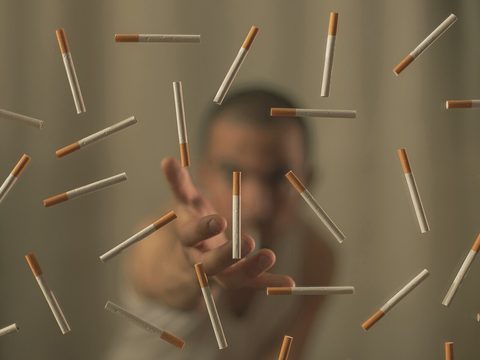 Dad threw his last pack of cigarettes in the trash. After twenty years, he finally decided to
_____.
 Burgers, fries and soda every day? That's too much
_____ for your heart.
 My trainer wrote me a new
_____: running on Mondays, weights on Wednesdays and swimming on Fridays.
 My aunt doesn't get any money for her work at the animal shelter. She just loves to
_____ there on weekends.
 Don't throw those glass bottles in the trash! Put them in the green box for
_____.
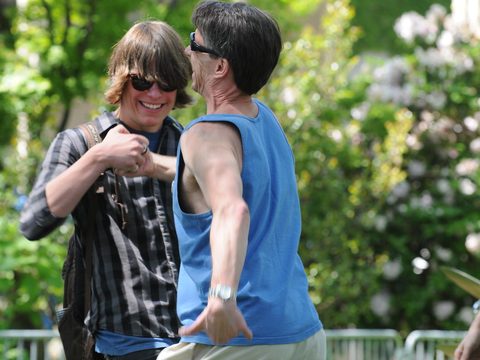 The two neighbors didn't talk to each other for years. They were
_____, but now they are good friends again.
Two faces, one promise
Read the story and listen to it. Tap a dotted word to see what it means. The video comes later, in Exercise 08.
It was December 31 in ancient Rome, over two thousand years ago. The old year was almost over, and the Romans were thinking about a god called Janus.



Janus was special because he had two faces. One face looked backward at the past, and the other looked forward toward the future.
His two faces allowed him to see the old year and the new one at the same time. The month of January is named after him.
On that night, the Romans imagined Janus looking back at the old year and forward to the new one, and they wanted to do the same.
Looking back, they remembered their troubles with their enemies. So they decided to forgive those enemies and leave the troubles in the old year.
The Romans also had their own wrongdoings from that year, and they believed that Janus could forgive them too.
So they gave Janus gifts and made promises for the new year. They believed Janus was watching and would bless them in the months ahead.
And that is how the New Year's resolution was born. This tradition goes all the way back to 153 B.C.
Today, people still make these promises at the end of every year. Regardless of the resolution they commit to, they all want to improve their lives.
For some people, the promise is about a bad habit: quitting smoking or eating less junk food. Others choose a positive habit: an exercise program, volunteering or recycling.
Multiple choice
Every answer is in the story. Click an answer and read why.

-
Who was Janus?
Janus was a god from the old stories of Rome, not a real person. The month of January is named after him.
-
What was special about Janus?
One face looked backward at the past, and the other looked forward toward the future. So he could see both, not only the future.
-
Which month is named after Janus?
Janus, January: you can hear his name in the month. It is the first month of the new year, a good month for a god who sees the old year and the new one.
-
On December 31, what did the Romans imagine?
Not their families: on that night, they thought about Janus and his two faces. Then they wanted to do the same: look back and look forward.
-
What did the Romans decide to do about their enemies?
They remembered their troubles with their enemies and forgave them. The gifts in the story were for Janus, not for their enemies.
-
What did the Romans believe Janus could do for them?
They had their own wrongdoings, and they believed Janus could forgive them. Careful: the story doesn't say they did a lot of wrong things. It doesn't say how many.
-
What did the Romans do for Janus?
Gifts and promises for the new year. Those promises were the beginning of the New Year's resolution.
-
Why did they give gifts and make promises?
They believed Janus would see the gifts and the promises and bless them in the year ahead: protect them and bring them good things.
-
When did the tradition of New Year's resolutions start?
153 B.C. is the time of ancient Rome, more than two thousand years ago. The Middle Ages came much later.
-
What is the goal of a New Year's resolution?
A resolution is a promise for the new year. Whatever the promise is, the goal is the same: a better life in the year ahead.
-
Which of these resolutions changes a bad habit?
Eating less junk food changes a bad habit. An exercise program and recycling are positive habits. So resolutions are not only about bad habits.
-
The best title for this story would be:
The story goes from one night in ancient Rome to the promises people make today. The enemies are only one part of it, and the seven tips are in the video, not in the story.
Find it in the story
Find a word in the story for each meaning. The paragraph number is in parentheses. Write it exactly as it is in the story.
-
ato a position ahead; toward the front (paragraph 2)
-
bto make better (paragraph 9)
-
cbad acts; things that are wrong to do (paragraph 6)
-
dnot affected by other things; it doesn't matter what (paragraph 9)
-
eto promise or give your time or money to a plan, a person or an idea (paragraph 9)
-
fmade it possible for someone to do something; gave permission (paragraph 3)
-
gto stop being angry with a person because of something he or she did (paragraph 5)
Use the words
Complete each sentence with one word from Exercise 06: forward, improve, wrongdoing, regardless, commit, allow, forgive. Sometimes you need to change the form, for example to the past.

-
aI am using this app on my phone to ___ my English.
-
bIt is important to remember our ___ so we don't repeat them.
-
cSarah didn't invite Jane to her party, but Jane wasn't angry for long: she ___ her a week later.
-
dIf you ___ to this language course, you will make good progress.
-
eShe moved a piece ___ when she was playing chess.
-
fYesterday, the teacher ___ us to stay on the patio the whole morning.
-
g___ of what you think, I will go to the party tonight!
Seven tips for a good resolution
First, with a partner, guess the missing words. Then watch the video (four minutes, with captions) and check. The tips come in order, and the time shows where each one starts.
-
1Don't make a resolution based on what you ___ to do. 00:15
-
2Focus on ___. 01:08
-
3Be ___ about what you want. 01:31
-
4Focus on the ___ and not the outcome (the final result). 01:49
-
5Don't try to do things ___. 02:16
-
6Reward ___. 02:54
-
7Be ___ to yourself. 03:17
More about each tip
Watch the video again. The stamp shows the moment in the video. Click an answer and read why.
-
When did he make this video? 00:01
"2015 is almost here," he says at the start. And at the end: "I'll see you in 2015" (04:13).
-
Tip 1. "I hate exercising. I guess I should start doing it this year." What is the problem with a resolution like this? 00:40
Willpower is the strength to make yourself do something. It's hard to find it for something you don't want. Make it something you really want: "I really want to start exercising because it will make me healthier" (01:00).
-
Tip 2. Instead of "I will stop eating junk food," what should you say? 01:21
Focus on positivity: say what you will start, not what you will stop. You practice this in Exercise 11.
-
Tip 3. You want to get a job. What does the video tell you to do? 01:40
"I'll get a job" is too vague. Be specific, and see it in your head: visualization is "one of the keys" to getting what you want (01:46).
-
Tip 4. You want to lose weight. What happens if you look only at a target number? 01:54
Focus on the process: the things you do every day, like eating healthier and exercising more. Then you appreciate yourself and don't blame yourself.
-
Tip 5. Why is it better to exercise with a friend or a family member? 02:27
In his example, you feel lazy, and your brother, sister or friend says, "Aren't we going on a morning run now?" That person gives you the push you need.
-
Tip 6. What reward does the video give as an example? 03:00
Do the task first, then enjoy the reward. But the reward must not go against your goal: no cake after the gym if your goal is to eat healthier!
-
Tip 7. According to the video, what helps you more? 03:19
Being kind to yourself works better than criticizing yourself. Shaming yourself only makes you run away from your task and leave it for later (03:38).
Making a resolution
Read the box. Then choose the answer and read why.

Plans and promises. A resolution is a plan or a promise for the new year. Use going to or will. And after start, stop and quit, put the next verb in -ing.
- be going to + verb — a plan: I'm going to join a gym in January. · She's going to learn Spanish.
- will ('ll) + verb — a promise: I'll call my grandmother every Sunday. · I won't (= will not) be late again.
- start / stop / quit + verb-ing: start exercising · stop eating junk food · quit biting your nails. After start, to + verb is OK too: start to exercise.
- Spelling of -ing: make → making · swim → swimming · quit → quitting.
- Make it positive (tip 2 in the video): not I will stop eating junk food, but I'll start eating healthier.
- Be specific (tip 3): not I'll get fit, but I'm going to swim twice a week.
-
My sister wants to quit ___ coffee at night.
After quit, the next verb takes -ing: quit drinking, quit smoking.
-
I'm going ___ a new exercise program in January.
Be going to + verb: I'm going to start. Don't forget the to.
-
This year, I'll stop ___ to bed so late.
After stop, use -ing: stop going to bed late = no more late nights.
-
Last year, my uncle ___ smoking. Now he runs every weekend.
Last year asks for the past. In American English, the past of quit is quit: no change.
-
We're going to start ___ every morning before work.
Short verbs that end in one vowel + one consonant double the last letter: run → running, like swim → swimming.
-
Which resolution is the most specific?
It says what, how long and when. The other two are vague: what exactly will you do?
-
Which resolution follows tip 2, "focus on positivity"?
It says what you will start, not what you will stop. The other two talk about what you don't like about yourself.
-
Which sentence is correct?
You need all three parts: be ('s) + going to + verb. The first sentence has no be, and the third has no to.
Make it positive
Tip 2 from the video: focus on positivity. Change each resolution from stop to start, with the word on the left. Keep I'll or I'm going to from the sentence.
-
EARLYI'm going to stop going to bed late.
-
WATERI'll stop drinking so much soda.
-
STAIRSI'll stop taking the elevator.
-
FRUITI'm going to stop eating candy after lunch.
-
SAVEI'm going to stop spending all my money.
-
RECYCLEI'll stop throwing everything in the trash.
-
READI'm going to stop watching TV in bed.
-
ON TIMEI'll stop arriving late for work.
Old habits, new year
Part A is about the story and the video. Part B is about you and your life. Part C is for your opinions. Tap a card when you have talked about it.

Useful language
My New Year's resolutions
40–70 words. Follow the advice from the video and write three or four New Year's resolutions. Make them positive and specific, with I'm going to or I'll and start + -ing. Then say who can help you and what your reward will be.
My results
Check your score, then copy it and send it to your teacher on WhatsApp.

One job for this week. Choose one resolution from your writing and start it today, not on January 1. Every evening, say out loud what you did: Today I started … Thirty seconds, in English.