Wednesday Addams' New Home
A principal who feels like an outcast too, a school that is more than 200 years old and some very strange subjects. Watch the welcome video of Nevermore Academy, review the question words and ask: Have you ever…?
Warm-up
Ask and answer with a partner, or with me. Tap a card when you have answered it. Then find the eleven school subjects below.

Back to school! Today you visit a very strange school, a school for outcasts. First, tell me about your own school days: the subjects you loved, the ones you didn't, and what you did after class.
Useful language
Eleven school subjects, with their letters mixed up. Read the clue, put the letters in order and write the subject. Can you add more subjects to the list?
-
H T A Mnumbers, shapes and problems to solve
-
T R Adrawing, painting and making beautiful things
-
Y R O T S I Hkings, queens, wars and other events of the past
-
C E N S I E Cexperiments in a lab; biology, chemistry and physics are parts of it
-
G O L O N H C E T Ycomputers, machines, and how people make and use them
-
Y G O L O I Bplants, animals and the human body
-
S H I L G N Ethe language of this lesson
-
C I S U Msongs, singing and instruments like the piano
-
P A R G O E H G Ymaps, countries, rivers and mountains
-
G E U A N G A La foreign ___, like Spanish, French or Chinese
-
T R E U L A T I R Efamous books, poems and stories, and the people who wrote them
Words of the story
Click a word, then click its meaning. Correct pairs turn green. The audio button says the word.
Complete the sentences
Click a word in the bank, then click a gap. Click a filled gap to clear it. Read the whole sentence first: the clue is always inside it.

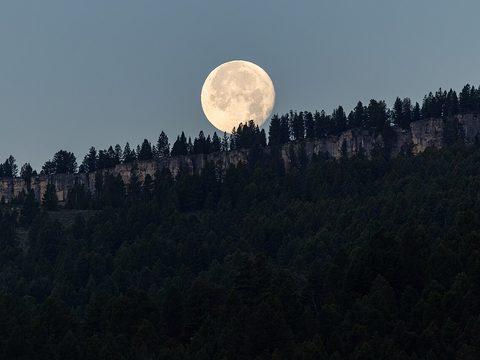 In the old horror movie, the man turns into a
_____ every time there is a full moon, and he runs into the forest.
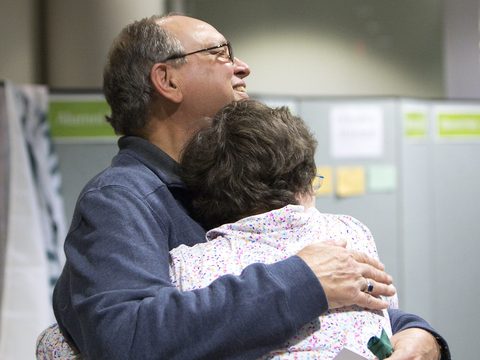 Every year, the university invites its
_____ back for a big party, so people who graduated thirty years ago can meet again.
 In
_____ class, you hold a bow, pull the string back and try to hit the center of the target.
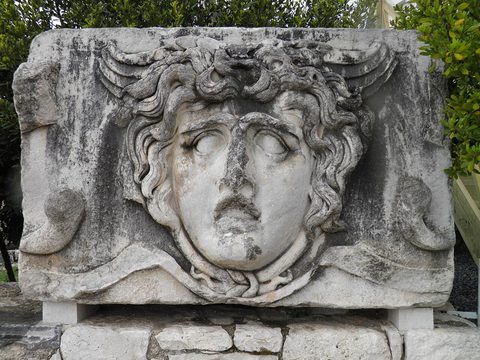 A
_____ from the old Greek stories has snakes on her head, and anyone who looks into her eyes turns to stone.
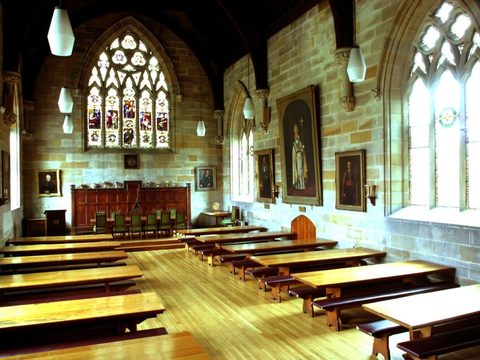 We ate lunch in the big dining
_____, at long wooden tables with two hundred other students.
 The firefighters saved the whole family from the burning house, and now the town calls them
_____.
 My brother only reads
_____ stories about ghosts, graveyards and dead bodies, so our little sister is afraid of his books.
 The course starts in March, so you need to
_____ before the end of February.
A school for outcasts
Before you watch: three names from the video. Who are they? Guess if you don't know. Then watch the video (less than two minutes, with captions) and read the story. The words in bold are the present perfect: you study it in Exercise 07. Tap a dotted word to see what it means.
-
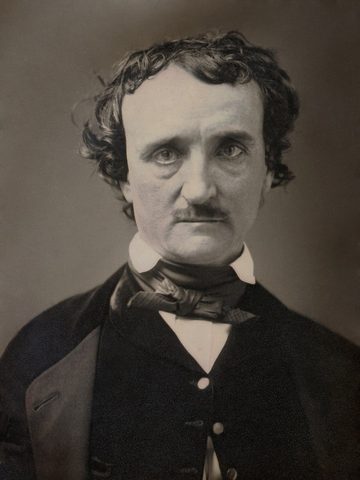
Edgar Allan Poe was…
Poe wrote short stories and poems, and they are dark and scary: macabre is the perfect word for them. Listen for his name in the video.
-
Ignatius Itt, or Cousin Itt, is…
His name says it: Cousin Itt. In the Addams family stories, he is famous for his very, very long hair.
-
Morticia and Gomez Addams are…
They are the parents of the Addams family. In the video, you find out where they went to school.
Now watch the video. The first time, try it without sound: where are they, and who is this school for? Then watch again with sound and read.
The principal of Nevermore Academy is making a video for new students. She looks into the camera and asks: has anyone ever told you that you're different?
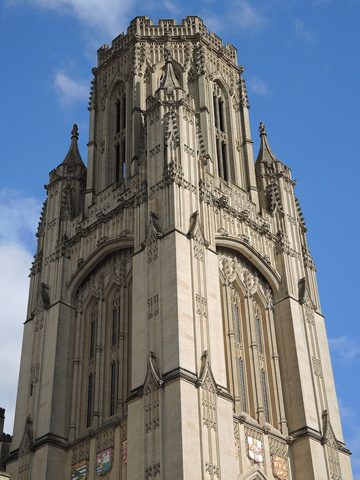
Maybe you live in a world full of normies, and you feel like an outcast. The principal understands you, because she feels like an outcast too.
That is why she has good news for people like her: there is a very special place for them, and its name is Nevermore Academy.
She explains that the school opened over 200 years ago to teach outcasts. Its students come from all walks of life, and even from death!
Because every outcast has a different talent, the school has a clear mission: to help each student learn to use their own special abilities.
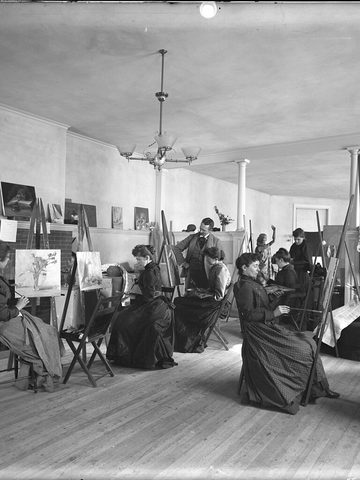
To do that, Nevermore offers a lot of extracurricular activities. The video shows two very different ones: painting and archery.
Many outcasts have studied there before you, and the principal is very proud of them. For centuries, famous alumni have walked through its beautiful halls.
Among them are Edgar Allan Poe, the master of macabre stories, Cousin Itt, one of her personal heroes, and Morticia and Gomez Addams.
Now Morticia and Gomez's daughter, Wednesday, has a new home there. She will learn from highly trained teachers, who teach strange subjects like Gorgon anatomy.
If you are an outcast too, the principal has an invitation for you: visit the school's website and apply today. She simply can't wait to meet you!
Multiple choice
The stamp shows the moment in the video. Click an answer and read why.

-
Where does the story happen?
The name says it: Nevermore Academy. An academy is a school, and the principal is the person who runs it.
-
What does the principal ask at the start of her video? 00:01
Her words are "Have you ever been told you're different, odd, or simply don't belong?" It is a present perfect question, and you study it in Exercise 07.
-
"Me too," says the principal. What does she mean? 00:12
Just before, she asks: "Do you feel like an outcast?" Her answer is about herself: she is an outcast, like her future students.
-
Why did Nevermore open more than 200 years ago? 00:24
"Nevermore was founded over 200 years ago to educate outcasts." Founded means started, and educate means teach.
-
What is the school's mission? 00:33
She says each student has "unique abilities": special talents that nobody else has. The school helps each student control them.
-
Which two extracurricular activities does the video show? 00:41
"From painting… to archery." The two activities are very different: a calm one, and a sport with a bow and arrows.
-
Why does the principal talk about the school's alumni? 00:49
She calls them notable alumni: important people. A school talks about its famous old students to show how good it is.
-
What do the teachers at Nevermore teach? 01:02
"A wide range of subjects": many different ones. The two examples in the video are about monsters. Anatomy is the study of the body.
-
In "werewolf reproduction", what do the students learn? 01:09
Reproduction is how animals and people have babies. At a normal school, it is a biology class; at Nevermore, it is about werewolves.
-
What does the principal ask you to do at the end? 01:14
She asks you to visit the school's website "to apply today." Then she says she "can't wait to make your acquaintance": a very formal way to say "meet you".
-
In the video, people hold up signs for new students. What do the signs ask them to do?
The signs invite new students to enroll: to put their names on the school's list and become students. It is the same message as the principal's.
-
Which sentence best summarizes the story?
The whole video is an invitation: a school for outcasts, an old history, special activities, famous alumni and strange subjects, and at the end, "apply today".
Words from the video
Watch the video again. Click a word in the bank, then click the gap. Each word goes in one gap. The stamp shows the moment in the video.
- 00:01 The principal asks if anybody has ever told you that you're _____, odd, or that you don't belong.
- 00:07 She says that we live in a world full of _____.
- 00:07 Then she asks: do you feel like an _____?
- 00:33 The school's _____ is to help each student.
- 00:33 Each student can learn to control their unique _____.
- 00:37 So the school offers a full _____ of extracurricular activities.
- 00:49 For centuries, famous alumni have walked through its _____ halls: big, beautiful and very impressive.
- 01:11 The teachers teach unusual subjects, like werewolf reproduction and Gorgon _____.
Have you ever…?
Read the rules. Then answer the questions: click an answer and read why.

The principal's first question is a present perfect question. Have you ever…? asks about your whole life, from the day you were born until today. It doesn't ask when.
- The question: Have you ever visited another country? · Has your mom ever driven a truck?
- Short answers: Yes, I have. · No, I haven't. · No, never.
- Regular verbs: verb + -ed: visit → visited, play → played. Spelling: study → studied, stop → stopped.
- Irregular verbs have their own past participle: eat → eaten, fly → flown, swim → swum, make → made, go → been (for a visit).
- Say when? Use the past simple: Have you ever flown in a helicopter? — Yes, I have. I flew in one in 2022.
- From the video: Have you ever been told…? = Has anybody ever told you…? You only need to understand this form.
-
The principal asks, "Have you ever been told you're different?" She asks about… 00:01
Have you ever…? is about past experiences, at any moment of your life until now. It is not about the future.
-
In a Have you ever…? question, is the date important?
The question is only "yes or no, in your life?" If the date is important, we ask with the past simple: When did it happen?
-
"Have you ever eaten sushi?" — "Yes, I ___."
The question starts with have, so the short answer uses have too: Yes, I have. or No, I haven't.
-
Which question is correct?
See – saw – seen. After have, we need the past participle, seen. Saw is the past simple.
-
"Have you ever been to Mexico?" — "Yes. I ___ there last summer."
Last summer is an exact time, so we change to the past simple: I went there last summer.
-
"Has your brother ever ___ a horse?"
Ride – rode – ridden, like write – wrote – written. With has … ever, use the third form.
-
"My grandpa has never ___ an airplane."
Never = not at any time in his life. After has never, we need the past participle: take – took – taken.
Write the past participle
Write one word in each gap: the past participle of the verb on the left. Then choose four questions and ask a partner. Answer Yes, I have or No, I haven't, and add one detail with the past simple.
-
cheatHave you ever ___ on an exam?
-
pretendHave you ever ___ to be sick?
-
tellHave you ever ___ someone a secret?
-
cryHave you ever ___ for no reason?
-
fallHave you ever ___ in love at first sight?
-
singHave you ever ___ in public?
-
winHave you ever ___ a prize at school?
-
breakHave you ever ___ a bone?
Question words
Read the rules. Then look at each answer and choose the question word that asks for it.

The answer is your clue. A time, a person, a place, a reason: each one has its own question word. Look at the answer first, and the question word is easy to find.
- Where do you work? · What does your sister study?
- With be: question word + be + person or thing: Who is your best friend? · Why are you tired?
- Two-word question words: What time asks for a time on the clock. How often asks how many times: every day, twice a week, never.
- When who or what is the person or thing that does the action, there is no do: Who lives with you? (not Who does live…)
- Why asks for a reason. The answer often starts with Because…
-
"___ do you study?" — "At night."
At night is a time, but not a time on the clock, so the question word is When.
-
"___ time do you go to the gym?" — "At 6 o'clock."
What time asks for a time on the clock: at 6 o'clock, at 7:30.
-
"___ is your favorite teacher?" — "Ms. Bastiani."
The answer is a person, so the question word is Who.
-
"___ do you eat for breakfast?" — "Cereal."
The answer is a thing, so we ask with What. What is for things, objects and ideas.
-
"___ do you live?" — "In London."
In London is a place, and Where asks about places.
-
"___ are you today?" — "Great, thanks."
How asks about the way something is or happens. How are you? asks how you feel.
-
"___ often do you go to the gym?" — "Every other day."
How often asks how many times. Every other day means one day yes, one day no.
-
"___ do you like science?" — "Because it's fun."
Because gives a reason, and Why asks for one.
Ask about the schedule
Here is the class schedule of a Year 7 class (students of 11 and 12) in England. Write the question for each answer: start with the question word on the left and use the words given. Remember do or does, but not with be, and not when who does the action.
- Every day, 9:00–9:15: daily assembly, with the whole school.
- Classes: 9:15–9:55 and 9:55–10:45 · break, 10:45–11:05 · 11:05–11:55 and 11:55–12:45 · lunch, 12:45–1:45 · 1:45–2:35 and 2:35–3:25.
- Monday: literacy, English · math, ICT · PSCHE, geography
- Tuesday: English, art · French, science · design and technology (two classes)
- Wednesday: literacy, DT · art, drama · ICT, science
- Thursday: PE, math · RE, English · history, PSCHE
- Friday: literacy, math · art, science · PE (two classes)
- ICT = computers · PSCHE = health and life skills · DT = design and technology · RE = religion · PE = sports
-
What timethe first class / start → At 9:15.
-
How oftenthey / have / science → Three times a week.
-
Whenthe drama class → On Wednesday, before lunch.
-
Wherethe students / go / at 9:00 → To the daily assembly.
-
Whythey / stop / at 10:45 → Because it's break time.
-
Whatthey / have / on Monday afternoon → PSCHE and geography.
-
Howyou / feel / on Friday afternoon → Great! It's PE all afternoon!
-
Whosit / next to you / in art → My best friend, Ana.
Two school systems
Read the list: students of the same age in the United States and in England. Then answer the questions. Click an answer and read why.

- 11–12 · 6th grade (middle school) · Year 7
- 12–13 · 7th grade (middle school) · Year 8
- 13–14 · 8th grade (middle school) · Year 9
- 14–15 · 9th grade, freshman year (high school) · Year 10
- 15–16 · 10th grade, sophomore year (high school) · Year 11
- 16–17 · 11th grade, junior year (high school) · Year 12, Lower Sixth
- 17–18 · 12th grade, senior year (high school) · Year 13, Upper Sixth
- Years 7 to 11 are secondary school in England. Years 12 and 13 are called Sixth Form, and students can also do them at a college.
-
In the United States, middle school is…
Three years, from age 11 to age 14. After 8th grade, American students go to high school.
-
An American freshman is in…
Freshman = a student in the first year of high school. In college, first-year students are freshmen too.
-
A 10th grader in the US is a…
Freshman, sophomore, junior, senior: the four years of high school, in order. The 10th grade is the second one.
-
7th grade in the US is the same age as ___ in England.
Both are for students of 12 and 13. Careful: the numbers are not the same in the two countries.
-
In England, students of 16 to 18 can study in…
Year 12 (Lower Sixth) and Year 13 (Upper Sixth) are Sixth Form. In the US, the same students are juniors and seniors.
-
A student in Year 11 in England is the same age as an American student in…
Both are 15 or 16 years old. In England, Year 11 is the last year of secondary school; in the US, 10th grade is the sophomore year.
Schools, normies and outcasts
Part A is about the video and the story. In Part B, talk about your life: use question words, and ask Have you ever…? Part C is for your opinions. Tap a card when you have talked about it.
Useful language
Welcome to my school
40–70 words. Write a welcome message for your school (now or in the past), like the principal's video. Start with a Have you ever…? question. Then say what students study, when classes start, which activities there are and why the school is special. Example start: Have you ever wanted to play in a band? Welcome to …!

My results
Check your score, then copy it and send it to your teacher on WhatsApp.

One job for this week. Ask three people one Have you ever…? question in English, and when they say yes, ask one more: When? Where? Why? Small questions, real conversations.