Marta
From the streets of a small town in Brazil to the best player in the world, six times. Read her story twice: first fast, looking only for names and numbers, then slowly. And meet the six small words that tell you what to look for.
Warm-up
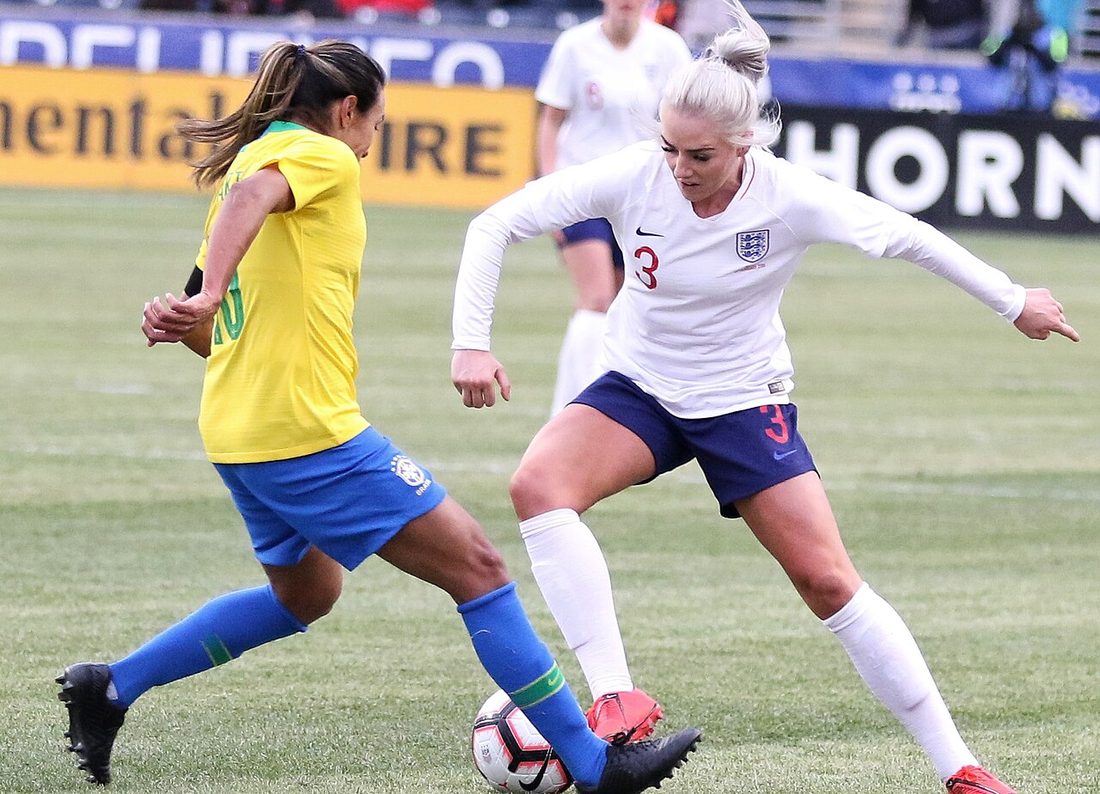
Ask and answer with a partner, or with me. Cards C to G describe five pictures of Marta's life: say what each one shows. Tap a card when you have answered it.

Do you know the Queen of soccer? In Brazil, many people call Marta a Rainha, the Queen. Today you read her story twice: first fast, looking only for names and numbers, then slowly. And you learn the six small words that start a question.
Useful language
Soccer words
Eight words from Marta's story. Click a word, then click its meaning. Correct pairs turn green. The audio button says the word.
Complete the sentences
Click a word in the bank, then click a gap. Click a filled gap to clear it. Read the whole sentence: the clues tell you which word it is.

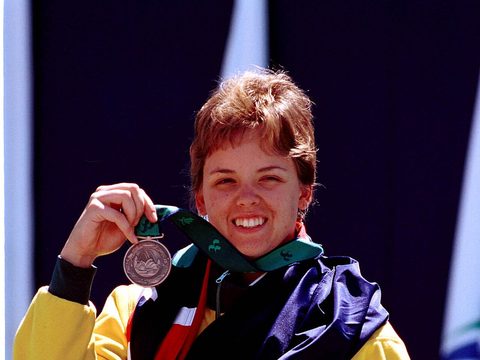 She finished third in the race, so she got a bronze
_____ to wear around her neck.
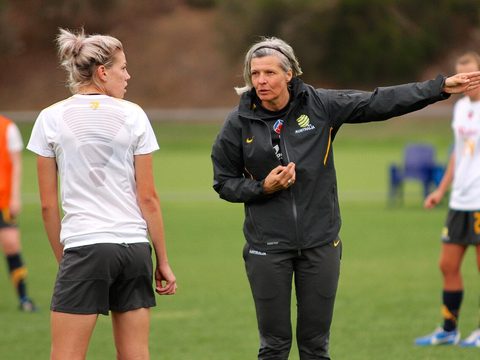 Our
_____ blows her whistle and tells the team to run around the field one more time.
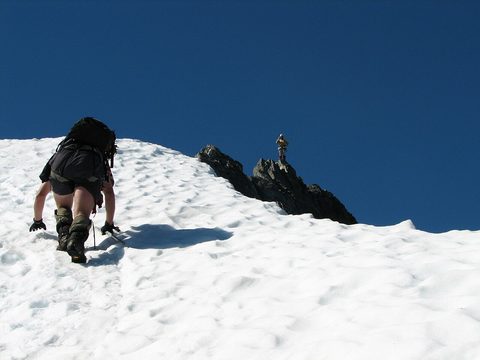 Last night we watched a
_____ on TV about real people who climb the highest mountains in the world.
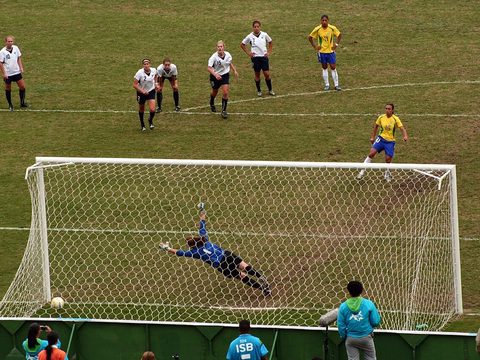 The ball hit the post and went into the net. What a beautiful
_____!
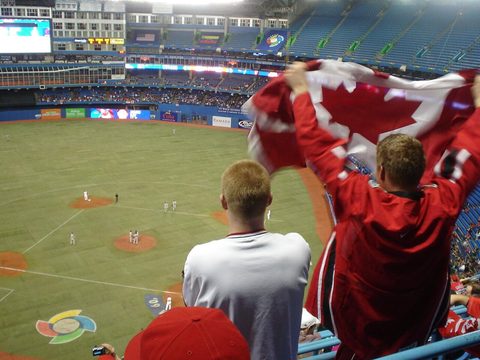 The fans waved their country's
_____, red and white, high in the air.
 He isn't a defender. He's a
_____, so he plays near the other team's goal and tries to score.
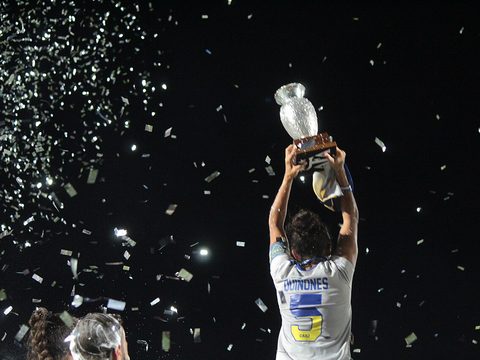 After the final, the captain lifted the
_____, a big silver cup, and the whole team sang and danced.
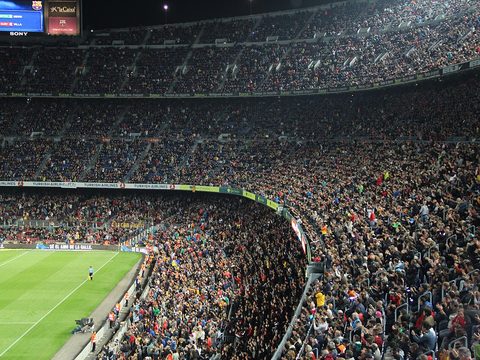 More than 60,000 fans watched the game in the city's huge new
_____.
Before you read
Read the description of the picture, then answer. Click an answer and read why.
-
What do you expect to find in this text?
The page has a woman's name, her photo, and the date and place she was born. So the text is about her life.
-
What is the genre of the text?
It has information about her life, and she is not the author: another person wrote it. In an autobiography, people write about their own life.
From the streets to the world
Two ways to read. First, don't read the story! Start the timer below the text and race to find the names and numbers. Then read the whole story slowly, for Exercise 06. Tap a dotted word to see what it means.
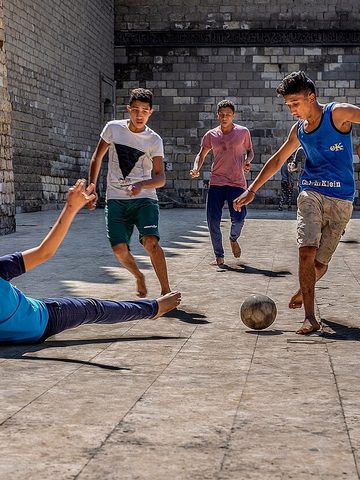
Marta was born in 1986 in a small town in northeast Brazil. As a girl, she played soccer in the streets with the boys.
She played so well that, at 14, a coach discovered her. So Marta left her family and moved to Rio de Janeiro to play.
Her talent took her far away. In 2004, she moved to Sweden to play for Umeå IK, and that year the team won the UEFA Women's Cup.
In Sweden, the young forward scored goal after goal, and she played for Brazil too. With her, Brazil won the Olympic silver medal in 2004 and 2008.
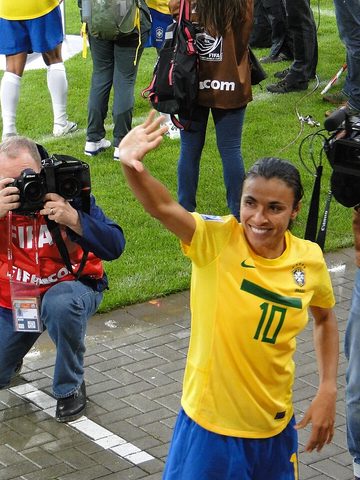
At the 2007 Women's World Cup, she was the best player and the top scorer. She led Brazil to the final, but Germany won the trophy.
Because of games like these, FIFA named her the best player in the world six times: from 2006 to 2010, and again in 2018.
Soon, everybody wanted Marta. In 2013, she became an ambassador of the 2014 World Cup in Brazil and was in a Swedish TV documentary, The Other Sport.
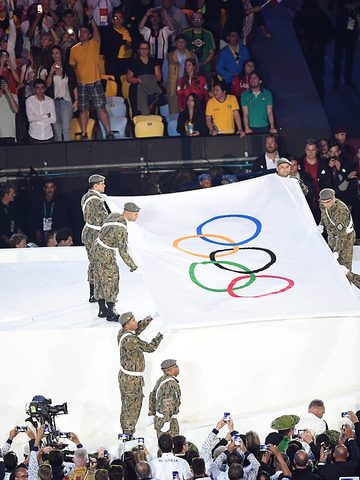
In 2016, the Olympic Games came to Rio, where her career began. Marta was one of eight people who carried the Olympic flag into the stadium.
Sweden was her home for years, so in 2017 she got Swedish citizenship. That year, she also moved to the US to play for the Orlando Pride.
She never stopped scoring: a record 17 goals at five World Cups, goals at five Olympics in a row, and 122 goals for Brazil by 2025.
Scanning race
Start the timer. Don't read every word: look only for names (they start with a capital letter) and numbers. The question word tells you what to look for: a year, a number or a name. Type short answers.

-
aWhen was Marta born?
-
bWhich club did Marta join in the US?
-
cHow many times did FIFA name Marta the best player in the world?
-
dHow many goals did Marta have for Brazil by 2025?
-
eHow many goals did Marta score at World Cups, a record?
-
fAt how many different World Cups did Marta score?
-
gAt how many Olympic Games in a row did Marta score?
-
hIn which competition did Marta and Brazil win a silver medal?
-
iIn what year did Marta become an ambassador of the 2014 World Cup?
-
jWhat TV documentary was Marta in, in 2013?
-
kIn which year did Marta get Swedish citizenship?
Multiple choice
Now read the whole story in Exercise 05 slowly. Twelve questions about what happened and why. Click an answer and read why.
-
Where did Marta learn to play soccer?
Her small town, Dois Riachos, is in the state of Alagoas. Her first field was the street, and her first teammates were boys.
-
Why did a coach discover Marta at 14?
She played so well that a coach noticed her. The coach was a woman, Helena Pacheco. Marta didn't live in Rio yet: she went there after.
-
What did Marta do after the coach discovered her?
She moved far from home at only 14. In Rio, she played for Vasco da Gama. Two years later, the club closed its women's team, and she moved to another Brazilian club, Santa Cruz, in the state of Minas Gerais.
-
Where did Marta go in 2004?
She went to play for Umeå IK, a club in the north of Sweden. The US came much later, in 2017.
-
What happened to her team in Sweden in 2004?
In the final, Umeå IK beat Frankfurt, from Germany, 8–0 in two games, and Marta scored three of the goals. In Sweden, she also won seven league championships.
-
Brazil won the Olympic silver medal in 2004 and 2008. What does that mean?
Gold is first place, silver is second and bronze is third. Brazil lost both finals to the United States. In 2024, Marta won a third Olympic silver medal.
-
What happened at the 2007 Women's World Cup?
She won the Golden Ball, for the best player, and the Golden Boot, for the top scorer, with seven goals. In the final, Germany won 2–0.
-
Why did FIFA name Marta the best player in the world?
The prize was called FIFA World Player of the Year, and she won it five years in a row. But she didn't score in the 2007 final: Germany won it.
-
Why was Marta a good choice as an ambassador of the 2014 World Cup?
The 2014 World Cup was in Brazil, so its six ambassadors were famous Brazilian players: Amarildo, Bebeto, Carlos Alberto Torres, Ronaldo, Mario Zagallo and Marta, the only woman.
-
Why was the Olympic flag in Rio special for Marta?
At 14, she moved to Rio to play, so her career began there. She was born in a small town in the northeast, and by 2016 she already had two Olympic medals. The flag went into the Maracanã, Rio's most famous stadium.
-
Why did Marta get Swedish citizenship in 2017?
Sweden was her home for years, so she became Swedish too. She kept her Brazilian citizenship, and she couldn't play for Sweden: she already played for Brazil.
-
Which sentence best summarizes the story?
From the streets of a small town to six awards as the best player in the world. Many people call her the greatest woman soccer player in history. She was also the first player, man or woman, to score at five World Cups. Later, Christine Sinclair, from Canada, did it in 2019, and Cristiano Ronaldo in 2022.
Question words

Look at the first word. Before you answer a question, or look for the answer in a text, read the question word. It tells you what you need: a person, a place, a time, a thing, a choice or a number.
- What → a thing or an action: What do you want for lunch? — A sandwich.
- Who → a person: Who is your best friend? — Nina.
- Where → a place: Where do your parents live? — In Belo Horizonte.
- When → a time, a day, a month or a year: When does the game start? — At eight.
- Which → a choice from a small group: Which shirt do you want, the blue one or the green one? — The green one.
- How many + plural noun → a number: How many cousins do you have? — Twelve.
- Word order: question word + do / does / did + person + verb: Where does your sister work? With be: question word + is / are / was + person or thing: Where is the bus station?
- Who as the subject needs no do: Who won the game? — Our team!
- Scanning tip: the question word tells you what to look for in a text. When → a date or a year · How many → a number · Who, Which and What → often a name.
Questions 1 to 6 describe six pictures. Choose the question word that goes with each picture.
-
Picture: an alarm clock, ringing. Which question word goes with it?
A clock tells the time, and When asks about time: When is the meeting?
-
Picture: eight green dinosaurs, in two rows of four. Which question word goes with it?
You can count them: one, two … eight. How many dinosaurs can you see? — Eight.
-
Picture: an open book with a pink bookmark. Which question word goes with it?
A book is a thing, and What asks about things and actions: What are you reading?
-
Picture: a red pin on a map. Which question word goes with it?
The pin shows a place on the map, and Where asks about places.
-
Picture: a woman's face in a pink circle. Which question word goes with it?
It's a person, and Who asks about people: Who is she?
-
Picture: a popsicle, the word "or", and an ice cream cone. Which question word goes with it?
There are two options, and you choose one. Which asks you to choose from a small group.
-
The answer is "In 2017." Which question is right?
A year answers When. Where needs a place, and the answer to Who is a person: Marta.
-
Which question is correct?
Question word + does + person + verb. The -s goes on does, so the verb stays live.
Complete the questions
Write the question word. Read the answer after the dash first: it tells you what the question asks for.
-
a___ is that girl? — She's my cousin, Bia.
-
b___ one do you prefer, the popsicle or the ice cream cone? — The ice cream cone!
-
c___ are you reading? — A book about soccer.
-
d___ are you from? — I'm from Recife.
-
e___ dinosaurs can you see? — Eight.
-
f___ is your birthday? — It's on May 3.
-
g___ did Marta move to in 2004? — Sweden.
-
h___ discovered Marta when she was 14? — A coach, Helena Pacheco.
Find someone who
First, complete the five questions with a question word. Then ask them to two classmates, or to me, and write the answers on paper. There's a card for it in Exercise 10.

-
1___ is your favorite player?
-
2___ one do you prefer: soccer or volleyball?
-
3___ do you play sports: at a gym, at school …?
-
4___ do you prefer to play sports: in the morning, in the afternoon …?
-
5___ teams do you support? Which ones?
Talking point
Part A is about the story, Part B is about you, and Part C asks for your opinion. After each answer, ask your partner one more question: Why? When? Where? Who? Tap a card when you have answered it.
Useful language
Questions for Marta
40–70 words. Imagine you can interview Marta. Write six questions for her, one with each question word: What, Who, Where, Which, When, How many. Don't copy the questions from this lesson. Then choose one question and write the answer you think she would give.

My results
Check your score, then copy it and send it to your teacher on WhatsApp.

One job for this week. Choose a famous person you like, open a page about him or her, and scan it for one minute: find three names and three numbers. Then write three questions about that person, with three different question words, and ask a friend.