A Message in a Bottle
Four boys, one bottle and a bayou in Texas — then a beach cleanup twenty-seven years later. The past continuous for what was happening, and the small words that put a story in order.
Four photos, one story
The story is about some men's childhood. Four photos from the story are described below in words. Guess what connects them, and click a card when you have answered it.

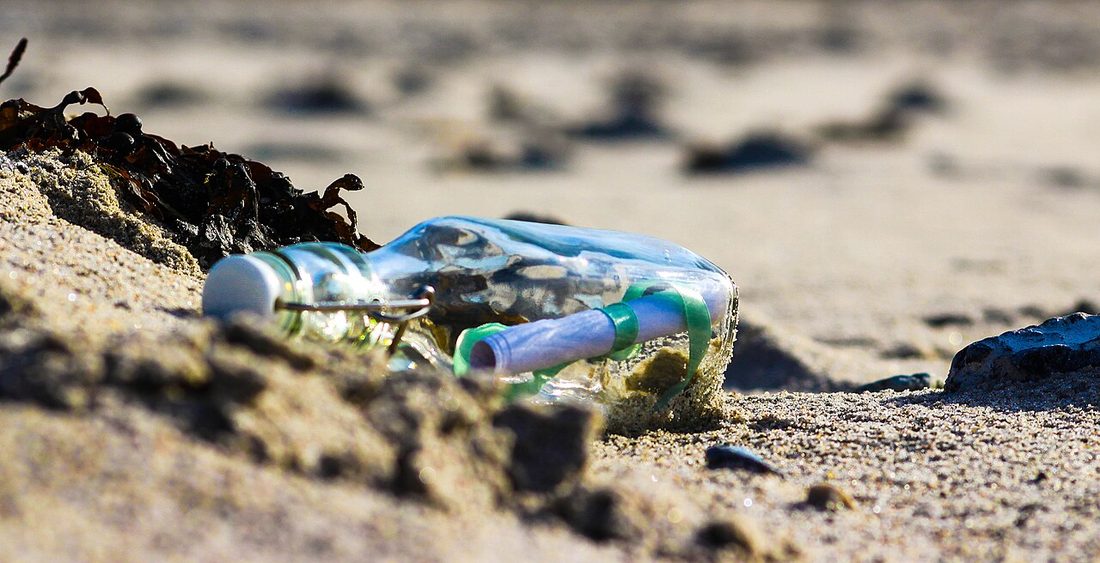
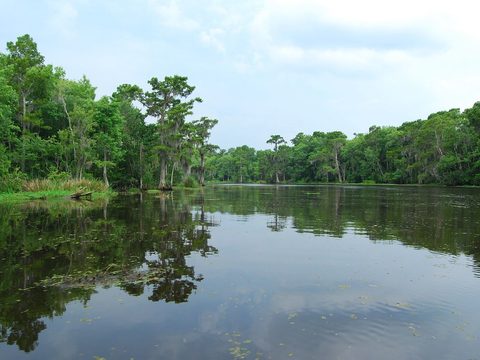
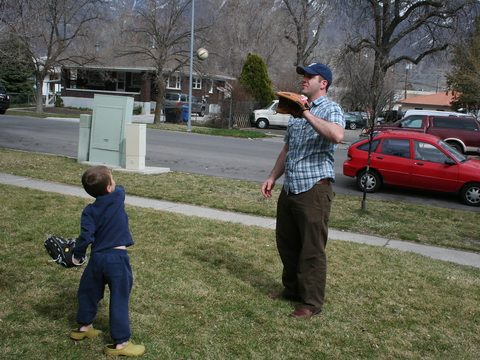
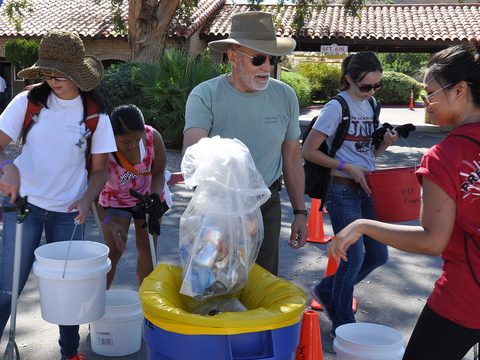
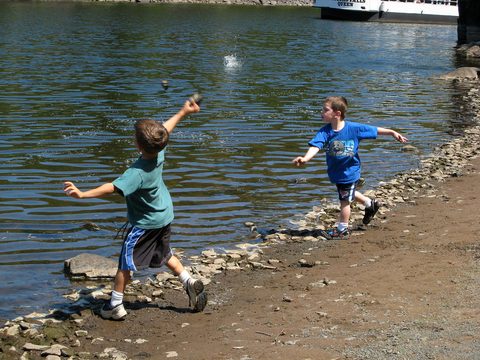
Guess first, watch later. A kids' baseball team, a beach, an old bottle and a lot of water. Something connects them, and it took twenty-seven years to happen. What do you think it is?
Useful language
Words from the story
Click a word, then click its meaning. Correct pairs turn green. The audio button says the word.
Complete the sentences
Click a word in the bank, then click a gap. Click a filled gap to clear it. The verbs in the bank are already in the past.

 You can see alligators in a
_____ near New Orleans.
 He
_____ the keys to his brother, and his brother caught them.
 Every Saturday,
_____ pick up trash in our park. Nobody pays them; they just want to help.
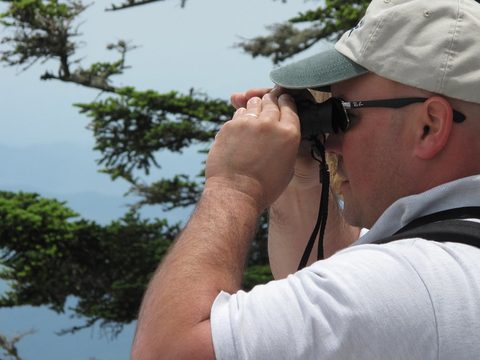 I was watching the birds with my binoculars when I finally
_____ a small owl and took a photo of it.
 We were best friends at school, but we
_____ each other after we moved to different cities.
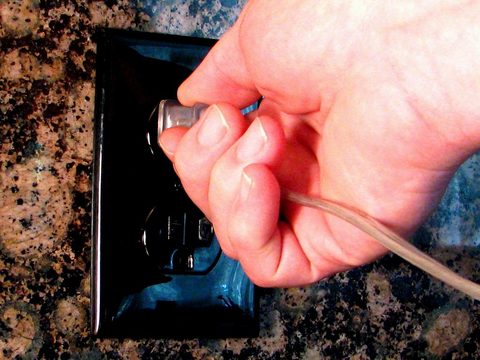 The TV didn't turn on because the cable was
_____. Somebody pulled it out of the wall.
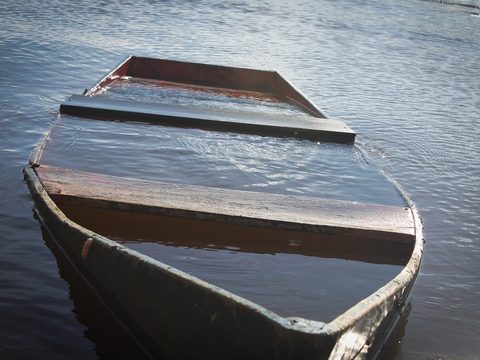 The old boat had a big hole in it, and after ten minutes it
_____ under the water.
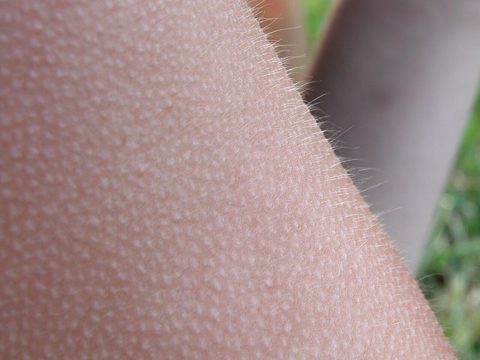 That sad song gives me
_____ every time I hear it.
A message in a bottle
Watch the video first — it is two minutes long. Then read the story, and look for the verbs with was or were + -ing.
One lazy day in 1995, four best friends near Houston, Texas, had an idea. Brian, Drew and Travis were ten, and Lance was even younger.
Their idea was a message in a bottle. They wrote a note with their phone numbers, put it in a bottle and tossed it into a bayou.
For a year or so, the boys thought about their note. But nobody called, and slowly they lost track of it. They grew up and forgot it.
Twenty-seven years later, in 2022, Terry Pettyjohn was cleaning a beach with a group of volunteers. Suddenly, he spotted something green in the sand.
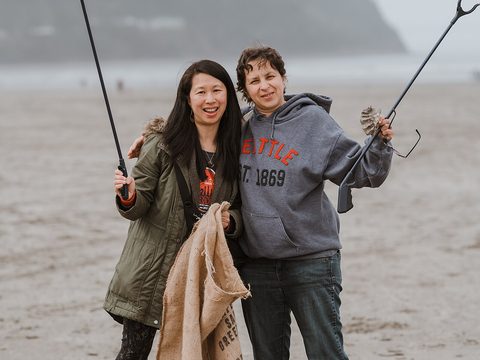
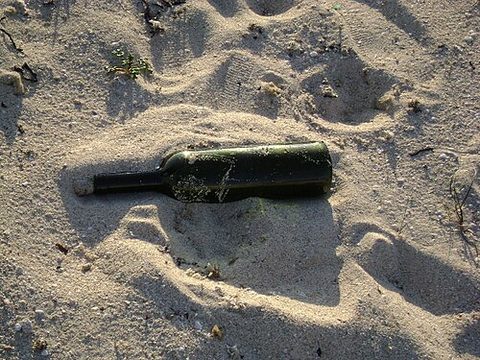
He dug the bottle out of the sand. It was sealed, with a note inside, so he had to break it to read the note.
The note said: "If you find this, please call." If nobody was home, the finder could leave a message on the answering machine. Travis's name came first.
Terry called the numbers, but they were all disconnected. So he tried Facebook instead, and there he found Brian.
Everybody wanted to know one thing: how far did the bottle travel? China, maybe? South America? No — in 27 years, it traveled only two miles.
Their theory: the bottle was too heavy to float, so it sank. For years, it was slowly rolling along the bottom toward the beach.
But Travis, the first name on the note, never saw it. He died suddenly two years earlier, and his friends feel he was sending them a message.
Multiple choice
Click an answer and you get the result right away, with the reason. The blue number is where to look in the video.

-
When did the boys write their message? 00:02
"One lazy day in 1995, when they were 10." But not all four of them: Lance, the youngest, was not even ten yet.
-
Where did they toss the bottle? 00:17
A bayou is slow, muddy water near the coast. This one was just outside Houston, Texas.
-
Did they think about the note over the years? 00:21
Maybe for a year, says one of the friends — then "we completely lost track of it."
-
What was Terry Pettyjohn doing when he found the bottle? 00:33
Twenty-seven years later, a group of volunteers was cleaning the beach, and the bottle was buried in the sand.
-
Why did Terry have to break the bottle? 00:48
He looked and saw it was sealed. "The only way to get the note was to break the bottle."
-
What did the note ask the finder to do? 00:56
"If you find this, please call." And if nobody was home, the finder could leave a message on the answering machine — this was 1995.
-
What happened when Terry called the numbers? 01:06
They were disconnected "a long time ago". Phone numbers from 1995 don't last twenty-seven years.
-
How did Terry find Brian in the end? 01:10
With no working numbers, he "turned to Facebook" — and found Brian.
-
How far did the bottle travel in 27 years? 01:27
The reporter asks about China and South America. Then: "Nope, not even close." Just two miles.
-
Why do they think it traveled so little? 01:33
The bottle was probably too heavy to float. It went down in shallow water, and even hurricanes and storms only moved it two miles.
-
What happened to Travis? 01:52
Travis — the first name on the note, their best friend — died unexpectedly two years before the bottle came back.
-
Which sentence best summarizes the story?
A note from their childhood came back after 27 years, just after they lost Travis. "A hundred percent," one friend says: it was a sign that he is okay. He gets goosebumps just talking about it. Nobody sold anything, and the bottle traveled only two miles.
The news report
Watch the first part of the video again (00:00–00:41) and put the four time expressions in the gaps. Look at the sentence in bold: it comes back in the next exercise.
- _____, when _____, Brian, Drew, Travis and his kid brother Lance thought of something. They wrote a message in a bottle and tossed it into the bayou just outside Houston.
- "Did you ever think about the note over the years?" "… We completely lost track of it. I never thought of it. I mean, we're talking _____."
- _____, Terry Pettyjohn was cleaning a beach with a bunch of volunteers when he found a thick green bottle.
The past continuous
Question 1 is the sentence in bold from Exercise 06. In questions 2 to 7, decide what the past continuous is doing in each sentence.

Two actions, one sentence. Terry was cleaning a beach — that is the long action, the background. He found a bottle — that is the short one, and it happens in the middle. Past continuous for the long action, past simple for the short one.
- An action in progress at a specific time in the past: At 10 p.m., my brother was taking a shower.
- A longer action interrupted by a shorter one (past simple): We were driving home when the car stopped.
- The background of a story — what was happening around the main events: The wind was blowing, and the dogs were barking.
- Form: I / he / she / it + was · you / we / they + were. Negative: wasn't / weren't — I wasn't listening.
- Questions: was / were before the subject — Were they laughing? · What was she doing at noon?
- Spelling: write → writing · swim → swimming · travel → traveling (one l in American English).
-
Terry Pettyjohn was cleaning a beach… The verb in this sentence talks about…
He was in the middle of the cleaning when he found the bottle — twenty-seven years after 1995, so in the past.
-
She was reading in her room when the phone rang.
Reading is the long action. The phone rang in the middle of it.
-
It was raining, and people were running quickly.
Nothing interrupts anything, and there is no clock time. It paints the picture, like the first lines of a story.
-
The children were playing outside at 6 p.m.
At 6 p.m. is a point on the clock, and the playing was in progress at that moment.
-
They were studying together that evening.
That evening is the time, and nothing interrupts them.
-
The dancers were dancing, and the crowd was watching with excitement.
Two things happening at the same time around us: the scene, before the main event.
-
He was crossing the street when he saw his friend.
Crossing the street takes time. Seeing his friend is short, and it happens in the middle.
-
Which sentence is correct?
You always takes were, in questions too. I takes was.
-
Which sentence is WRONG?
They takes were: They were talking at lunch.
Was or were + -ing
Write the verb in the past continuous. The gray word tells you the verb; if it says not, write the negative. In a question, write the first words too. Short forms like wasn't are fine.
-
writeThe children ___ a message while they were sitting near the river.
-
you / look___ for the bottle when you saw it in the sand?
-
not playThe boy ___ near the water when the bottle was thrown.
-
not lookShe ___ for the bottle; she found it by accident.
-
she / read___ the message when you arrived?
-
floatAt that moment, an old boat ___ slowly in the water.
-
not swimThey ___ in the bayou while the bottle was drifting away.
-
walkThe man ___ along the beach when he spotted the bottle.
Yesterday at 4:00 p.m.
Six photos taken yesterday at 4:00 p.m., described in words. What was happening? Write a short sentence with he, she, it or they and the verb in gray. Example: a man in a lawn chair with a book in his hands (read a book) → He was reading a book.

-
play soccerSome children are running after a ball on the grass in a park.
-
cookA grandmother and a little girl are in the kitchen, making food together.
-
workA woman is sitting at a white desk, writing, with her laptop open next to her.
-
sleepA big dog is lying on the couch with its eyes closed.
-
shopA man and a woman are in a supermarket aisle, with their phones in their hands.
-
not sleepThe man in the lawn chair from the example: his eyes are open, and he has a book in his hands.
Positive, negative, question
Write the whole sentence in the past continuous. (+) is positive, (–) is negative and (?) is a question. Short forms like weren't are fine.
-
–he / travel / last week
-
?they / work / at 9 a.m.
-
+she / watch / TV / in the evening
-
–we / talk / during the class
-
?the kids / sleep / at midnight
-
+I / wait / for you / at that moment
-
–she / study / for the test / last night
-
?they / have dinner / at 7 p.m.
-
+he / play / video games / in the afternoon
-
–we / eat / when he arrived
Time sequencers
Choose the word that fits. Question 1 is a sentence from the video — do you remember it?

- then / after that — the next action: We washed the car. Then / After that, we had lunch. Never after alone: not
After, we had lunch. - when brings in a short action; while goes with a long one: The lights went out when I was cooking. · I was cooking while my son was sleeping.
- the next day · years later · two years before — jumps in time, forward or back.
- again — one more time: I called, and then I called again.
-
Terry Pettyjohn was cleaning a beach with a group of volunteers ___ he spotted a thick green bottle.
Spotted is the short action, in the middle of the long one, so when. The video says found: "when he found a thick green bottle."
-
She finished school in June. ___, in July, she started working at a small company.
July comes right after June: the next step, so then. Years later can't be one month later.
-
I was walking home ___ it started to rain.
A long action (was walking) and a short one (started): when brings in the short one.
-
We visited the museum. ___ we went to the beach.
Museum first, beach one day later. Again means one more time — but there was no beach before.
-
He was cooking dinner ___ his sister was setting the table.
Two long actions at the same time: while.
-
They finished school in 2010 and met again ___, in 2025, when they were living in different cities.
From 2010 to 2025 is fifteen years: years later.
-
She lost her keys. ___, she called her friend for help.
First the problem, then the phone call for help: the next action, so after that.
-
We watched that movie last year, and we watched it ___ last weekend.
One more time: again. And the next day can't be a year later.
-
___ she moved to another country, she studied English every day.
She studied first, and then she moved. Two years before can join the two parts of the sentence; then and after that can't.
-
Which sentence is correct?
Two long actions at the same time, in one sentence: while. Then and after that start a new step, not a second action at the same moment.
-
Which sentence is WRONG?
After alone does not connect two actions. Use then or after that.
Join the sentences
Rewrite with the word in gray. Example: She was doing her homework. Her friends were playing chess at the same time. (while) → She was doing her homework while her friends were playing chess.
-
whenHe was waiting for the bus. He saw an old classmate.
-
thenThe movie finished. They talked about it for a long time.
-
years laterShe lived in another city. She moved back home.
-
whenThe baby was sleeping. The door opened.
-
after thatThey cleaned the house. They relaxed.
-
whileThe chef was preparing dinner. The guests were arriving.
-
two years beforeHe worked in a small shop. He studied at a local school.
Talking point
Part A is about the story, Part B about your life, Part C about what you think — always say why. Use was / were + -ing and at least one time sequencer in every answer.

Useful language
A night without lights
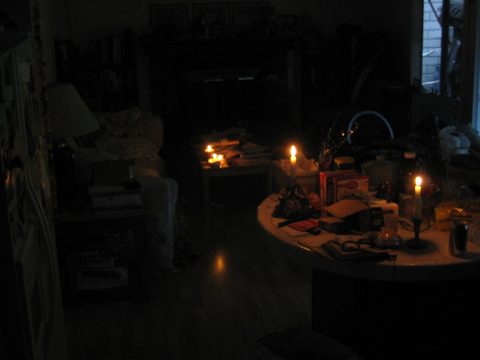
60–90 words. Four pictures, one night: a dark house on a stormy night; a woman and a little girl under a blanket with a flashlight; a family having dinner with candles on the table; a candle next to an open book. Tell the story in order. Use the past continuous for the background and at least four time sequencers. Start like this: It was dark when…
My results
Check your score, then copy it and send it to your teacher on WhatsApp.

One job for this week. Every night before you sleep, say three sentences in your head: what you were doing at 9 a.m., at 1 p.m. and at 6 p.m. Then add one sentence with when: I was driving home when…