









A2 COURSE · CLASS 21

The 99 Gold Coins

A poor man finds 99 gold coins at his door, and one missing coin changes his life. An old story about happiness, told in the past simple: regular verbs, irregular verbs, didn't and did.

A2 50–60 min Focus: past simple · regular and irregular verbs Home
EXERCISE 01Speaking

Are you a reader?

Ask and answer with a partner. Tap a card when you have answered it.

Teacher Alvaro

Before the story, a question about you: do you like to read? Listen to your answers. When you talk about the books you read as a child, the verbs go to the past: I read, I liked, I had. That is today's class.

A woman lies on a sunny pier by the sea and reads a book, next to her upside-down bicycle
Useful language
My favorite book is … because …I read about … books a year. When I was a child, I read …I prefer … because … It takes me about … to finish a book.
0 / 0
EXERCISE 02Vocabulary

Words in the story

Click a word, then click its meaning. Correct pairs turn green. The audio button says the word.

Word
Meaning
EXERCISE 03Vocabulary in context

Complete the sentences

Click a word in the bank, then click a gap. Click a filled gap to clear it. Two of the words are feelings: one is happy, one is not.

Teacher Alvaro
  • Being a nurse is a _____ job: long hours, little sleep and a lot of stress.
  • The mail carrier left the package on our _____ because nobody was home.
  • When our team scored in the last minute, the whole stadium screamed with _____.
  • Paul was sad and tired, but he couldn't lie still. All night, a feeling of _____ kept him moving in bed.
  • I don't spend all my salary. I try to _____ a little money every month.
  • The _____ lives in a quiet temple in the mountains and prays every morning.
  • My dog loves to _____ the ball in the park — he runs after it all day.
  • The old king had great _____: gold, land and three palaces.
EXERCISE 04Video & reading

One coin too few

Watch the video first: the whole story takes three and a half minutes. At 02:16 the monk says he has a secret. Pause the video there and guess the secret with your partner. Then watch the end and read the story.

Robbie was a poor man in a small village. His life was tough: he worked day and night just for a simple meal. But he always smiled.

One morning, Robbie woke up and found a bag on his doorstep. With trembling hands, he opened it. It was full of gold coins!

An old farmer in a straw hat carries a hoe on his shoulder in a green field
Hard work for a simple meal
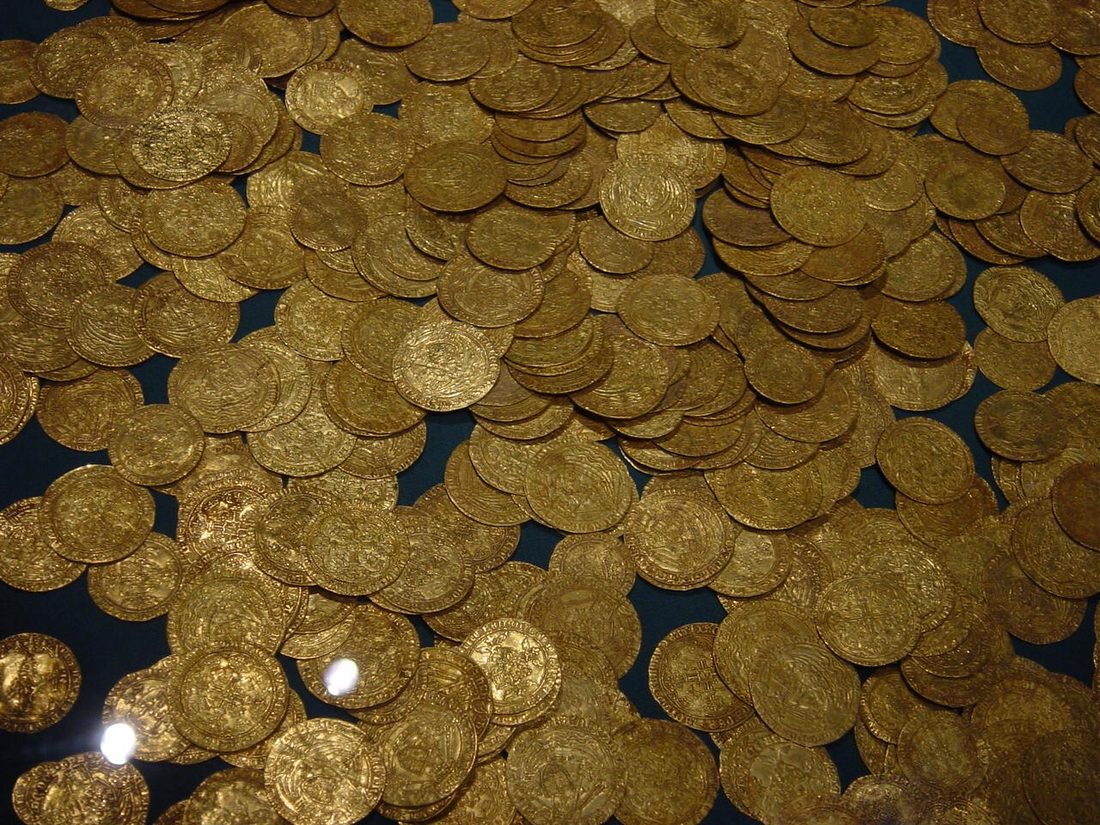
A big pile of old gold coins
A fortune in gold coins
A hand gives a green bowl of food to a hungry child
Sharing with people in need

He counted 99 gold coins, and his heart raced with excitement. For the first time, Robbie felt rich. He dreamed of a bigger house and better clothes.

But then a new thought came into his head: why 99, and not 100? The missing coin began to bother him.

His joy turned into restlessness, so Robbie decided to earn one more coin. He took extra jobs, stopped enjoying his meals and skipped sleep.

Weeks became months, but the money was never enough. Robbie saved only a few silver coins, so he grew angry and was rude to his neighbors.

His friends noticed the change. “What happened to the happy Robbie?” they asked. He only shook his head: first 100 coins, then happiness.

Soon, a wise old monk heard about Robbie's strange behavior and visited him. He found Robbie counting his coins again. “Why do you look so unhappy?” he asked.

Robbie said he needed one more coin, so the monk told him a secret: “Happiness is enjoying what you have. You have 99 coins, but you feel poor.”

The monk's words struck Robbie like lightning. He stopped chasing the hundredth coin, shared his wealth with people in need and was happy again.

EXERCISE 05Comprehension

Multiple choice

Click an answer and you get the result right away, with the reason. The blue number is where to look in the video.

Teacher Alvaro
  • Robbie worked day and night. Did he earn a lot of money? 00:07

    He was a poor laborer: his money paid for food and a home, nothing more. His life was tough, but he was kind and he always smiled.

  • What did Robbie find one morning? 00:15

    It was right at his doorstep when he woke up. The story never says who left it there.

  • For the first time in his life, Robbie felt… 00:32

    He dreamed of a bigger house, better clothes and delicious food. “I must be the luckiest man alive!” he thought.

  • Why did the coins start to bother Robbie? 00:44

    “Why 99? Why not 100?” For Robbie, a hundred was a complete number, so 99 felt like something was missing.

  • What did Robbie decide to do? 00:59

    His joy turned into restlessness. One coin was all he wanted, and it changed his whole life.

  • What happened to Robbie's life after that day? 01:03

    He stopped enjoying his meals and began to skip sleep. The gold was in his house, but the joy was gone.

  • After months of hard work, how was Robbie? 01:22

    He saved only a few silver coins, and it was never enough. He grew frustrated and forgot the small pleasures he once loved.

  • Who visited Robbie one day? 01:42

    First his friends saw the change. Then a monk came to the village, heard about Robbie's strange behavior and went to see him.

  • What did the monk ask Robbie? 01:54

    He found Robbie counting his coins again, with a tired face. Robbie answered that he had 99 coins but needed one more.

  • What was the monk's secret? 02:17

    In the monk's words, Robbie was once a joyful man, happy with very little. Now he has 99 gold coins, and he feels poor.

  • Why was Robbie happy at the end of the story? 03:19

    He never got coin number 100. He used his 99 coins to make his life better and to help people in need, and he found his old peace again. The 99 coins were more than enough.

  • Which sentence best summarizes the story?

    Robbie only dreamed of the bigger house; he never bought it. And the story never says who left the bag. The change came from the monk's words, not from more gold.

EXERCISE 06Phrases

Phrases in the story

The narrator uses some colorful phrases. Which one means each thing? The blue number is where you hear it in the video.

  • Which phrase means working very hard, all the time? 00:05

    To toil is to do hard, tiring work. Day and night means all the time.

  • Which phrase means having a place to live, a home? 00:09

    The roof is the top of a house. With a roof over your head, you have a home: nothing more, nothing less.

  • Which phrase means hands that shake because of fear, cold or a strong feeling? 00:21

    A bag of gold at his door! The surprise was so big that his hands shook as he opened it.

  • Which phrase means his heart beat faster because he was so happy? 00:27

    A heart that races goes very fast, like a car in a race. And the reason was a happy one: excitement.

  • Which phrase means the monk's words surprised Robbie, suddenly and strongly? 02:36

    Lightning is fast and strong. Struck is the past of strike, to hit. Crept into his mind is the opposite: a thought that comes in slowly and quietly.

  • Which phrase means people who are poor and need help? 03:03

    At the end, Robbie shares his wealth with those in need. In the reading, it is people in need.

EXERCISE 07Language point

The past simple: regular and irregular

A story from your homework, The Girl and the Magic Map, one sentence at a time. Choose the right past form. The last three questions look at the whole story.

Teacher Alvaro

Every story lives in the past simple. Most verbs just take -ed. Some have their own past form, and you learn those one by one. The good news: after didn't and did, every verb goes back to its base form, regular or not.

Regular verbs — add -ed.
  • Most verbs: want → wanted · play → played · live → lived
  • Spelling: ends in -e, add only -d: like → liked · short verb with one vowel + one consonant, double it: plan → planned · consonant + y, change to -ied: study → studied
Irregular verbs — a new form for each verb.
  • go → went · see → saw · come → came · eat → ate · buy → bought · write → wrote
  • Be and can: be → was / were · can → could. Negative: wasn't, weren't, couldn't. Question: turn them around — Was she there? Could you see the teacher?
Negatives and questions — the same for regular and irregular verbs.
  • Negative: didn't + base form — We didn't watch the game. · I didn't go out. Never didn't went.
  • Question: (question word) + did + subject + base form — Did you like the movie? · Where did you go last summer?
  • Once upon a time, a curious girl named Lila ___ an old map inside a dusty book.

    Find is irregular: find → found. It never takes -ed.

  • She packed some food, ___ a flashlight and left her house early in the morning.

    Take → took. In the same sentence, packed is regular and left is irregular (leave → left).

  • As she walked through the forest, she heard strange noises, but she ___.

    After didn't, the verb goes back to its base form. The past is already in didn't, so the verb doesn't need -ed too.

  • Soon, she ___ a friendly fox who helped her cross a small river.

    Meet → met, with one e. Helped, in the same sentence, is regular.

  • Lila ___ the golden door and went inside.

    Open is regular, and it keeps one n: opened. The double letter is for short verbs like stop → stopped.

  • The crystal glowed and ___ her a warm feeling.

    Give → gave. Glowed, just before it, is regular.

  • From that day on, she ___ the crystal and always remembered her brave adventure.

    Keep → kept. Feel → felt and sleep → slept change the same way.

  • Which verb from the story is irregular?

    Hear → heard: it ends in -d, but it is not base form + -ed. Look → looked and help → helped are regular.

  • Which question about the story is correct?

    Did + subject + base form. Did already carries the past, so find stays as it is.

  • Which sentence is WRONG?

    Go is irregular: go → went, never goed. Returned is the regular verb the story uses.

EXERCISE 08Writing practice

Robbie's story in the past

Write the verb in the past simple. Some are regular, some are irregular. Not sure? Many of them are in the reading.

  • workRobbie ___ day and night as a laborer.

  • wake upOne morning, he ___ to an unusual sight.

  • findHe ___ a bag of gold coins right at his doorstep.

  • think“I must be the luckiest man alive!” he ___.

  • feelFor the first time in his life, he ___ rich.

  • beginBut soon, the missing coin ___ to bother him.

  • haveHe wanted 100 coins, but he only ___ 99.

  • decideHe ___ to find one more coin to make 100.

  • stopHe ___ enjoying his meals.

  • visitOne day, a wise old monk ___ the village.

  • tellThe monk sat next to Robbie and ___ him a secret.

  • realizeRobbie ___ that 99 coins were more than enough.

  • smileHe looked at his 99 coins, and for the first time, he ___.

  • say“You're right,” Robbie ___ to the monk.

EXERCISE 09Writing practice

Make it negative

Write the whole sentence in the negative. Only the verb in bold changes: didn't + the base form. Sentences a–e are about Robbie; f–h come from other stories.

Teacher Alvaro
  • aRobbie earned a lot of money with his work.

  • bHe understood why he received 99 coins.

  • cHe wanted to relax and enjoy life.

  • dThe monk said Robbie felt rich.

  • eAfter the monk's advice, Robbie needed the last coin. (add anymore)

  • fThe hero broke the magic sword.

  • gThe travelers carried heavy bags.

  • hThe wizard caught a strange creature.

EXERCISE 10Word order

Questions in the past

a–d: put the words in order and add did. e–h: turn the sentence into a yes/no question. When you finish, answer a–d out loud: they are about Robbie.

  • awhat / Robbie / do

  • bwhere / he / find / the gold coins

  • chow / Robbie / feel / at first

  • dwhy / Robbie / stop / chasing the coin

  • eThe little girl sang a beautiful song.

  • fThe men built a bridge.

  • gThe dragon slept in the cave.

  • hThe prince drew a map.

EXERCISE 11Speaking

Talking point

Part A is about the story, Part B about your life, Part C about what you think — always say why. Tell your own stories in the past simple.

Teacher Alvaro
Useful language
I think the lesson is …When I was a child, I … Last week, I …I agree, because … I don't agree, because …Money can / can't …
EXERCISE 12Writing

A story with a moral

60–100 words. Choose one of the two stories below and write it in the past simple, like The 99 Gold Coins. Use at least five verbs from the magic box. Then check your story for mistakes and tell it to the class.

Choose your story.
  • The Lost Wallet. A young boy found a wallet full of money on the street. He decided what to do with it.
  • The Lazy Farmer. A farmer didn't work hard in the fields and just wanted to relax. When harvest time came, he learned a lesson.
  • Your story needs: the beginning · what happened after that · the most important scene · the end (with a moral, if you like).
  • The magic box: go · find · take · give · see · meet · make · travel · visit
0 words
ENDEnd of lesson

My results

Check your score, then copy it and send it to your teacher on WhatsApp.

Teacher Alvaro

One job for this week. Tonight, tell someone the story of the 99 gold coins in English, in six sentences: Robbie was…, he found…, he wanted… Then tell them about your own day the same way. Every story you tell makes the past simple a little easier.