What I Did Yesterday
Got up, had breakfast, went to work, talked on the phone, arrived home. Yesterday is a story, and today you learn to tell it: regular verbs take -ed, irregular verbs change, and didn't makes the negative.
Warm-up
Ask and answer with a partner, or with me. Click a card when you have answered it.

Yesterday is a story. You got up, you had coffee, maybe you went to work or stayed home. Today you learn to tell that story in English: some verbs just take -ed, and some change completely.

Useful language
Everyday activities
Click an activity, then click what it means. Correct pairs turn green. The audio button says the words.
Complete the sentences
The activities are in the past now. Click one in the bank, then click a gap. Click a filled gap to clear it. Read the whole sentence first: the details tell you the activity.

 There was nothing in the fridge, so after work I
_____ at the supermarket: bread, cheese, bananas and coffee.
 The bus was very slow, so I
_____ at ten at night. My family was already asleep.
 I
_____ with my mom for two hours last night. At the end, my ear was hot and my battery was almost empty.
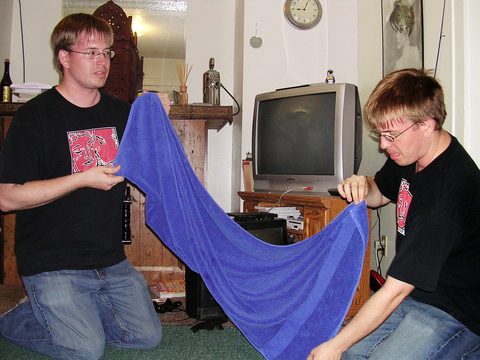 On Saturday morning I
_____. By lunchtime the kitchen and the bathroom were clean, and the clothes were dry.
 My sister
_____ to Chile last month. The flight was nine hours long, and she slept in her seat.
 I was alone and bored on Sunday, so I
_____. We had coffee at her house and talked for hours.
 Yesterday I
_____ for the first time. A trainer there showed me the machines and the weights, and today my arms really hurt!
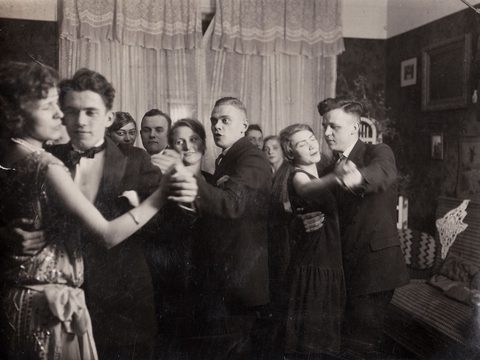 It was Marta's birthday on Saturday, so we
_____ until two in the morning. My feet hurt the next day!
The past simple: regular and irregular

Two kinds of verbs. Regular verbs are easy: add -ed and check the spelling. Irregular verbs change, and you learn them from a list. The good news: the past is the same for every person, and the negative and the question use did + the base form.
- Compare: I walk to work every day. → I walked to work yesterday.
- Regular verbs: base form + -ed: watch → watched · play → played
- Spelling 1: the verb ends in -e: add only -d. like → liked · arrive → arrived
- Spelling 2: consonant + y: the y goes, and -ied comes. study → studied · try → tried. With a vowel before the y, just add -ed: play → played.
- Spelling 3: a short verb that ends in consonant + vowel + consonant doubles the last letter: stop → stopped · rob → robbed. Longer verbs usually don't: visit → visited · listen → listened.
- Irregular verbs: a new form, with no rule. Learn them with a list: go → went · have → had · buy → bought · see → saw · do → did · get → got · sleep → slept · eat → ate · take → took · draw → drew
- The same for every person: I / you / he / she / it / we / they went to the beach. No -s for he or she.
- Negative: didn't (= did not) + base form: She didn't eat breakfast. · We didn't watch TV. Never
She didn't ate: didn't is already the past. - Questions: Did + person + base form: Did you call your mom? With a question word: question word + did + person + base form: Where did you have lunch? · What did they buy?
- Short answers: Did you call your mom? — Yes, I did. / No, I didn't.
Choose the right past form. Think first: regular or irregular? And if it's regular, which spelling rule?
-
The past of cry is…
Consonant (r) + y: the y goes and -ied comes, like study → studied.
-
The past of enjoy is…
There is a vowel (o) before the y, so the y stays: just add -ed, like play → played.
-
The past of plan is…
Plan is short and ends in consonant + vowel + consonant (l-a-n), so the n doubles, like stop → stopped.
-
The past of dance is…
Dance already ends in -e, so add only -d.
-
The past of fly is…
Fly is irregular, so the -ied rule doesn't work here. Flew is a new form: learn it from the list.
-
The past of wake up is…
Wake is irregular: wake → woke, with no -ed. Up doesn't change: I woke up at six.
-
Which sentence is correct?
Write is irregular: wrote. And the past is the same for every person, so no -s for she.
-
Which sentence is WRONG?
Come is irregular: came, for every person. Comed doesn't exist.
Regular or irregular?
Read the three sentences and look at the verbs. Regular verbs take -ed; irregular verbs have a new form. Choose the sentence the question asks for.
-
Which verb is irregular?
Sleep → slept is a new form. Danced and visited are regular: dance + -d, visit + -ed.
-
Which verb is regular?
Stay + -ed. The a before the y is a vowel, so the y stays. Get → got and buy → bought are irregular.
-
Which verb is irregular?
Go → went: nothing of go is left! Talked and arrived are regular.
-
Which verb is regular?
Study → studied is regular, with the spelling rule y → -ied. Do → did and have → had are irregular.
-
Which verb is irregular?
Hear → heard ends in d, but it's irregular: the vowel sound changes, and there is no -ed. Laugh and call just add -ed.
-
Which verb is regular?
Try → tried: regular, with y → -ied. Fly → flew and drink → drank are irregular.
-
Which sentence is correct?
Play has a vowel before the y, so the y stays: add -ed.
-
Which sentence is WRONG?
Sleep is irregular: slept. Watched and traveled are regular and correct (one l in American English).
Affirmative and negative
Items a–d: write the sentence in the past. Example: She / call her sister. → She called her sister. Items e–h: write the sentence in the negative. Example: He cooked dinner. → He didn't cook dinner.

-
aThey / eat lunch at the cafeteria.
-
bThomas / have a good time at the party.
-
cI / see you at the shopping mall on Saturday.
-
dHe / visit his grandparents on Friday.
-
eLucy met her friends last week.
-
fWe studied for the exam.
-
gYou did your homework.
-
hYou came to the party.
Now two quick checks.
-
Which sentence is correct?
After didn't, the base form: like. Didn't is already the past, so liked is one past too many.
-
Which sentence is WRONG?
Didn't + rain, not rained: the past is in didn't.
What happened yesterday?
Each sentence comes with a picture, in words. Guess what happened: click a verb in the bank, then click the gap.
- In the picture: a hand with a black pen, and a horse on a sheet of white paper. He _____ a horse.
- In the picture: two friends in a clothes store. One holds up a dress with black dots and smiles. She _____ a new dress.
- In the picture: two friends on a sofa, each with a game controller, and a game on the big TV. They _____ a video game together.
- In the picture: three people in a big, quiet room, looking at old paintings on the wall. They _____ a museum.
- In the picture: a hand holds a tiny blue dragon made of yarn. Under it is the title of the instructions to make it. I _____ to crochet a dragon.
- In the picture: two friends at home. One is in bed under a blanket, and the other brings him a cup of hot tea. They _____ at home all day.
Now two quick checks.
-
Which sentence is correct?
Consonant (r) + y: -ied, one time only.
-
Which sentence is WRONG?
Last summer is finished, so the verb needs the past: learned. With didn't, the base form learn is right.
Questions and short answers
Items a–f: Student A says the sentence; you are Student B. Write B's question with did. Example: She / travel yesterday. → Where? → Where did she go? Items g–h: write the short answer.

-
aI / buy a new car last week. → What car / you?
-
bHe / see his friend last Saturday. → Who?
-
cShe / talk to the teacher yesterday. → What / about?
-
dThe game / start late. → What time?
-
eI / travel on vacation. → Where / you?
-
fThey / go to the gym this week. → When?
-
gDid your parents call you yesterday? — No, ___.
-
hDid Ana like the movie? — Yes, ___.
Now two quick checks.
-
Which question is correct?
Question word + did + person + base form. Did carries the past, so go, not went.
-
Which sentence is WRONG?
The question has did, so the short answer has did or didn't too: Yes, he did. Does is for the present.
Choose the right form
Choose the words for the gap. Look for three things: a time word, the spelling of -ed, and did or didn't.
-
She ___ her friend yesterday.
Call + -ed, with the two l's of call. After didn't you need the base form, so didn't called is wrong.
-
They ___ when I wasn't in town.
Wasn't tells you the story is in the past. Arrive ends in -e, so add only -d.
-
He ___ to his dad, because he was angry.
Was says past, so didn't, not don't. After didn't, the base form: talk.
-
___ you ___ the soap opera last night?
Last night is the past, so did. After did, the base form: watch.
-
The car ___ at the red light.
Stop doubles the p (stopped), so stoped is wrong. After didn't, the base form: stop.
-
They ___ to the new songs in English.
Listen is a longer verb, so the n doesn't double: listen + -ed.
-
___ you ___ out the window to see the moon?
Did + person + base form: Did you look…? Only one past in the question, and it's did.
-
Which sentence is correct?
Breakfast is over, so did. After did, the base form: have.
-
Which sentence is WRONG?
Cry ends in consonant + y, so it's cried, like tried.
What did you do?
Part A is the pair practice from the class: ask and answer with a partner, or with me. Part B is about your life. Part C is for your opinions. Answer in the past, with one more detail: when, where or who with.

Useful language
My yesterday
40–70 words. Write about yesterday, from the morning to the night. Use at least three regular verbs, three irregular verbs and one sentence with didn't. Example: I got up at seven and had coffee.
My results
Check your score, then copy it and send it to your teacher on WhatsApp.

One job for this week. Every night, before you sleep, say five sentences about your day, in the past: two regular verbs, two irregular verbs, and one thing you didn't do. Thirty seconds, in English.