Kate Bush Says the World Has Gone Mad
In June 2022, a song from 1985 went to number one in the UK, and its singer said that the whole world had gone mad. The story of a comeback, the words for talking about music, and the difference between say and tell.
Warm-up
Watch the official 1985 video first: five minutes, captions on. Then talk with a partner, or with me. Tap a card when you have answered it.

A song can wait 37 years for its moment. Today we follow one that did, we learn how its singer talks when she is surprised, and we fix the two verbs everybody mixes up: say and tell.

Useful language
Words from the story
All eight appear in the reading. Click a word, then click its definition. Correct pairs turn green. The audio button says the word.
Two notes on American English
Complete the sentences
Click a word in the bank, then click a gap. Click a filled gap to clear it. Read the whole sentence: the clues are all there, and none of these sentences is about Kate Bush.

 She never plays a match without the small silver coin in her pocket: it is her
_____, and she believes it keeps her safe.
 A winter coat on the beach in August? You must be
_____!
 The store opens at nine every day, but from next Monday
_____ it will open at eight.
 The new app was slow at first, but downloads began to
_____ after a famous actor posted about it.
 If we keep walking at this speed, we will
_____ the top of the mountain before the sun goes down.
 Skip to
_____ number seven on the album: it is the only slow song, and my favorite.
 Next week's show will
_____ three guests from Brazil, and each one will talk for ten minutes.
 At age nine, she played her first concert in public, and the local newspaper called her
_____ extraordinary.
The song that came back
The BBC's story from June 2022, retold for this lesson. Said and told are highlighted. Dotted words have a definition: hover or tap them. The audio button reads each paragraph aloud.
In June 2022, Kate Bush gave a rare radio interview and could hardly believe the news: at 63, she was number one in the UK again. The whole world, she said, had gone mad.

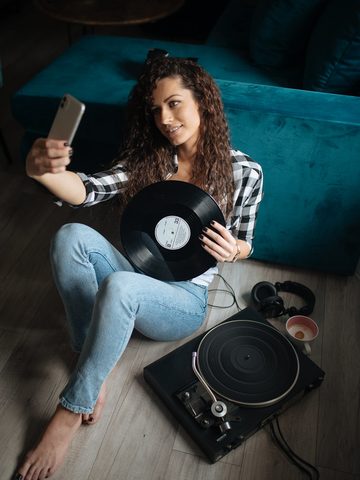
The song at the top was Running Up That Hill, a track she had released in 1985. Back then it reached number three in the UK, and after that it slowly went quiet.
For decades, Bush stayed away from the spotlight and rarely gave interviews. A whole generation grew up without ever hearing her name, and the song seemed to belong to the past.
Then, in 2022, Netflix's Stranger Things featured the song in its fourth season. It plays in several episodes and is crucial to the story of Max Mayfield, a teenager played by Sadie Sink.
In the story, the song works like a talisman for Max: it protects her. A new generation of viewers heard it for the first time in those scenes, and they wanted more.
So the song took off again, 37 years after its release. Young fans discovered it through the series, and it climbed the charts in one country after another.
Outside the UK, it went all the way to number one in Australia, Belgium and Sweden. In the United States it reached number four, and Bush had never been in the Billboard top five before.
In the UK, the song hit number one on a Friday in June, 44 years after her debut single, Wuthering Heights, had last taken her to the top of the chart, in 1978.
Bush told the BBC that she had expected some attention for the track, but nothing like this. It was exciting, she said, and quite shocking, but also very special.
She had watched the show from the first season onward, so she loved the way the song was used. What touched her most was the thought of young people hearing it for the first time.
Scan the text
Numbers and names only: do not read the text again, scan it. Start the timer, find the six answers as fast as you can, then check. Numbers can be written in figures.

-
yearsHow many years passed between the song's first release and its return to the charts?
-
nameMax's name in real life: the actress who plays her.
-
ageKate Bush's age at the time of the interview.
-
USThe song's position on the US Billboard chart.
-
1985The song's position in the UK chart when it first came out.
-
debutThe title of Bush's first single, her last UK number one before 2022.
Multiple choice
Click an answer and read why.
-
Why could Kate Bush hardly believe the news in June 2022?
The interview was the place where she reacted, not the news itself. The news was the chart: a song from 1985 at number one, which is why she said the whole world had gone mad.
-
What happened to the song when it first came out, in 1985?
Number three, not number one: the song was a hit, but it never reached the top in 1985. The number one came 37 years later.
-
Why did a whole generation grow up without hearing Bush's name?
She rarely gave interviews and avoided public attention, so young people simply never met her. The text says nothing about moving abroad or about the radio.
-
How did Stranger Things use the song in 2022?
Several episodes, one character: Max Mayfield, played by Sadie Sink. The series has its own theme music; this song belongs to Max's story.
-
What does the song do for Max in the story?
A talisman is an object you carry for protection. That was Bush's own word for the way the series used her song: something that keeps Max safe.
-
What happened because of the show?
Same song, same 1985 recording. What changed was the audience: young fans discovered it and pushed it up the charts.
-
Where did the song go to number one outside the UK?
Three countries are named in the text. In the US the song reached number four, not number one, and Canada is not mentioned.
-
What was special about number four in the US?
Bush had been in the US charts before (the same song entered the top 30 in 1985), but never as high as the top five. The text does not compare her with other British artists.
-
How long had it been since Bush's last UK number one?
Two different numbers in the story: 37 years since the song came out, 44 years since her last number one, her debut single Wuthering Heights.
-
What had Bush expected when she heard the song would be in the show?
She thought the series would bring the song some attention. The size of the reaction was the surprise: exciting, quite shocking, very special.
-
Why was Bush happy with the way the song was used?
She had watched the show from the first season onward, so she knew it well, and she liked the positive role the song plays for Max. Money and permission are not in the text.
-
Which sentence best summarizes the story?
No new song and no comeback tour: the same recording reached young people through Max's story, and the charts followed. That is the whole text in one line.
Say and tell
Two sentences from the BBC article, then the rules and eight sentences to decide. Look at what comes right after the verb.

Look at the next word. If a person comes right after the verb, it is tell: she told the interviewer. If what comes next is the message, it is say: she said it was extraordinary. Same meaning, different company.
- Tell + person: the person comes right after the verb, with no to: She told the interviewer (that) she was surprised. · He told me his name.
- Say + (that) + message: no person after the verb: She said (that) it was extraordinary. To add the person, use to: She said to the fans… (less common than told the fans).
- Tell without a person only in fixed expressions: tell the truth, tell a lie, tell a story, tell a joke, tell the time, tell the difference.
- Say with short words: say hello, say goodbye, say sorry, say thank you, say yes / no, say a word.
- Past forms: said and told. In reported speech the tense usually moves back: "I'm shocked" → She said (that) she was shocked.
- Three mistakes to avoid:
She said me→ She told me ·She told that→ She said that ·He told to us→ He told us.
-
"It's just extraordinary," she ___ BBC Radio 4's Woman's Hour.
The listener (the radio program) comes right after the verb, so it is tell. Said would need to before Woman's Hour, and told to is wrong here.
-
"I think it's very special," she ___.
Nothing comes after the verb: just the message before it. Told needs a person, and so does said to.
-
Complete the rule: we use ___ when a person (me, you, us, the class) comes right after the verb, without to.
Tell me, tell us, tell the class. Speak is about the act of talking, not about reporting a message.
-
Complete the rule: we use ___ when there is no person after the verb, or when the person comes after to.
She said she was shocked. She said to her fans that… The message follows say directly; a person needs to.
-
Nobody ___ the concert had been canceled, so we drove for two hours for nothing.
Us comes right after the verb, so told us. Said us is the most common mistake in the whole topic, and told to us is the second.
-
Which sentence is correct?
Person after the verb, no to: told me. The other two would work as She said to me… or She said (that) she loved…
-
Which sentence is WRONG?
Told goes straight to that with no person: wrong. It needs told us that or said that. Say hello and tell a joke are fixed expressions.
-
Can you ___ the difference between the original and the remix?
Tell the difference is a fixed expression: here tell means "notice", and no person is needed.
-
Before the show, the singer ___ thank you to the whole crew.
Say thank you, like say hello and say sorry: the short words go with say, and the person comes after to.
-
"See? I ___ you so!"
You comes right after the verb, and the moment is past: I told you so, the phrase people use when they were right and you did not listen.
Said or told?
Complete each sentence with said or told. Only the verb: the rest of the sentence is already there, and it tells you which one.
-
aMy mother asked if I was looking for a movie release, and I ___ yes.
-
bThe tour guide ___ us that the museum closed at five, so we hurried.
-
cWhen the band came on stage, the singer ___ good evening to the crowd.
-
dNobody ___ me the tickets were free! I paid fifty dollars for mine.
-
eMy grandfather always ___ the same story about the day he met a famous drummer.
-
fThe drummer ___ to the reporters that the band would tour again in the fall.
-
gSorry, I ___ a lie about my age to get into the concert.
-
hThe DJ ___ that the next song was from 1985, and everybody cheered.
-
iHe finally ___ the truth: he had never heard of the singer before the series.
-
j"Turn the music down," she ___ to her brother, "the neighbors are sleeping."
Sounding natural: how she talks
In the interview, Kate Bush rephrases, takes time to think and makes her adjectives stronger, all with tiny words. Learn the words, then answer eight questions about them.

- To rephrase or explain what you just said: I mean… · What I mean is… · In other words… · Let me put it another way.
- To gain time to think: well… · you know… · let me think… · let me see… · um… · sort of / kind of · yeah…
- To make an adjective stronger (= very): so · really · quite · extremely · incredibly · pretty (informal, a little weaker: closer to fairly) · just (for emphasis).
- To soften an opinion: I think… · a bit · kind of · actually at the end · a question tag: isn't it?
-
"It's quite shocking, really, isn't it? I mean, the whole world's gone mad." What is I mean doing here?
"Shocking" was the idea; "the whole world's gone mad" is the same idea said again, bigger and funnier. I mean opens a rephrase, not a correction.
-
"You know, as a kind of talisman almost for Max." Why does she start with you know?
You know at the start of a sentence is a filler: it buys time and keeps the listener close. It is not a real question about what the other person knows.
-
"And yeah, I think it's very touching, actually." Which words make the opinion softer and more personal?
I think presents it as her view, and actually at the end adds a touch of honesty: "now that I say it out loud". Very does the opposite job: it makes the adjective stronger.
-
In American English, what does quite mean in "It's quite shocking"?
For an American, quite shocking is very shocking. A British speaker might mean only fairly shocking, which is why the word confuses learners.
-
Your teacher asks a difficult question and you need a second. Which is the most natural start?
Well and let me think are time-buyers. In other words and I mean only work after you have already said something.
-
You said something confusing and want to explain it again. Which expression fits?
What I mean is announces a rephrase. You know? asks for agreement, and sort of only softens.
-
Which sentence is the strongest?
From weaker to stronger: pretty good, really good, incredibly good. Pretty before an adjective is informal and means "fairly".
-
"It's just extraordinary." What does just add here?
Just has three lives: "only" (just one song), "a moment ago" (it just started) and emphasis before an adjective (it's just extraordinary). Here it is the third.
Talking point
Part A is about the video and the story, Part B is about you, and Part C is for your opinions. In Part B, interview a partner and report the answers to the class with said and told. Use a filler or two: well…, I mean…
Useful language
Report the interview
60–100 words. Interview a partner about their favorite music style: what it is, when they listen to it, and one song they would save forever. Then report the interview in writing, with at least two sentences using told me (that) and two using said (that). Example: She told me that she listens to rock on the way to work.

My results
Check your score, then copy it and send it to your teacher on WhatsApp.

One job for this week. Every day, report one thing somebody said to you: once with said and once with told me. Ten sentences by Friday, and the two verbs will never mix again.