Who Invented the Airplane?
Two countries, two first flights, and an argument that is more than a century old. An exam-style class, with the four classic Use of English tasks.
Warm-up
Quick answers, one card at a time. Tap a card when you have answered it.

Today is an exam-style class, and it starts with a trap. Who invented the airplane? In Brazil, that question has a different answer from the rest of the world. By the end of the class you will be able to argue both sides, and you will have done the four Use of English tasks you find in international exams.
Useful language
Words for the story of flight
Eight words from the video and the text. Click a word, then click its meaning. Correct pairs turn green. The audio button says the word.
Complete the sentences
Click a word in the bank, then click a gap. Click a filled gap to clear it. Read each sentence to the end: it has its own clue.

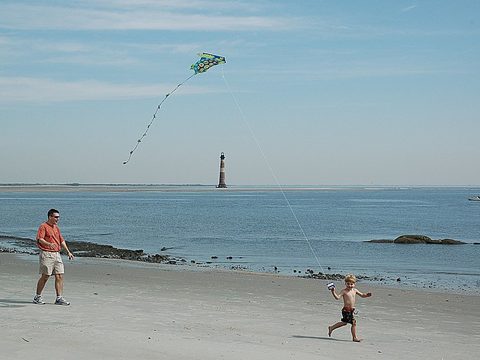 The wind was perfect, so the children ran along the beach holding the string while their
_____ climbed higher and higher.
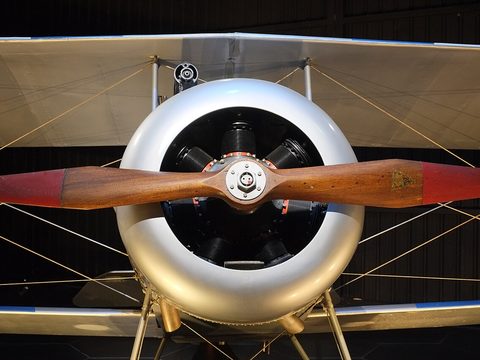 A wooden
_____ with two blades spun in front of the pilot and pulled the small plane forward.
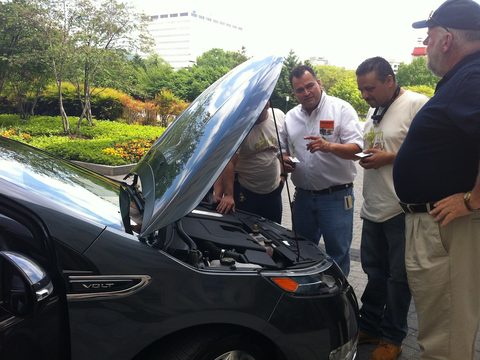 The car wouldn't start because the
_____ was too cold, so we waited ten minutes and tried again.
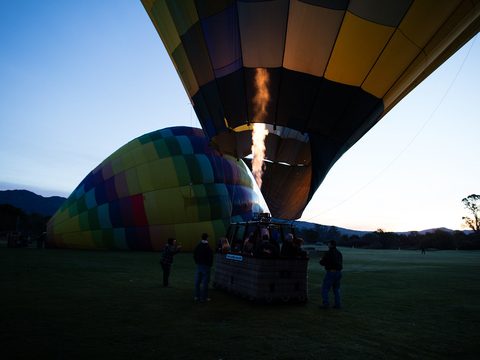 Standing in the basket, we watched the pilot fire the burner, and the huge colorful
_____ lifted us slowly above the fields.
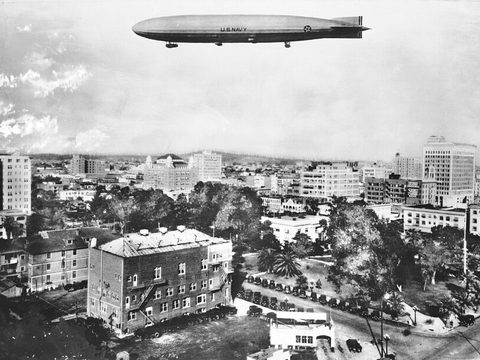 As long as a soccer field and filled with gas, the
_____ moved slowly over the city, its engines humming.
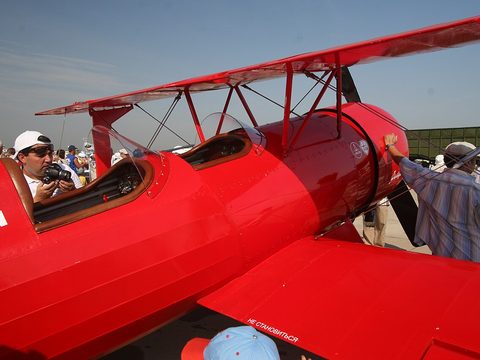 Its upper and lower wings were joined by wooden posts and wires: a classic
_____ from the 1920s, still flying at air shows today.
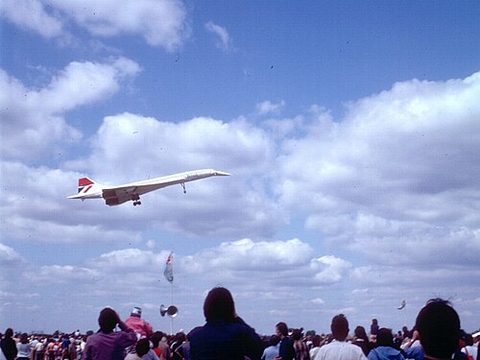 A
_____ jet flies faster than sound, so people on the ground hear the bang after it has already passed.
 The police asked every
_____ who had seen the accident to describe exactly what happened.
Two first flights
Watch the video first: two minutes, from the birds to the biggest passenger jet. It never mentions Santos-Dumont, and the text explains why a Brazilian would stop it at 00:44, when the Wright brothers fly. Dotted words have a definition: hover or tap them. The audio button reads each paragraph aloud.
On December 17, 1903, near Kitty Hawk, North Carolina, the Wright brothers made the first controlled, sustained flight of an airplane with an engine. It was not a public event, and there were few witnesses.
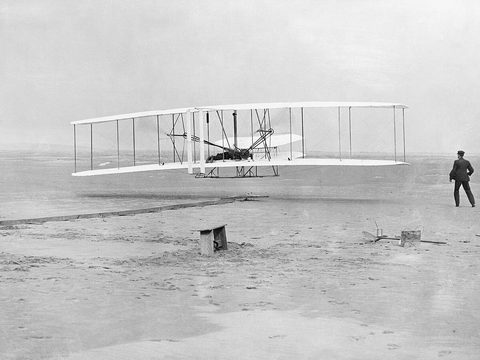
Without a crowd to confirm it, the brothers had trouble proving that their flights were real. In Europe especially, many people doubted them, and some took an openly anti-Wright position.
Europe wanted to see a flight with its own eyes, and in Paris a Brazilian was working on one. Alberto Santos-Dumont had already flown balloons and early airships; now he wanted wings.
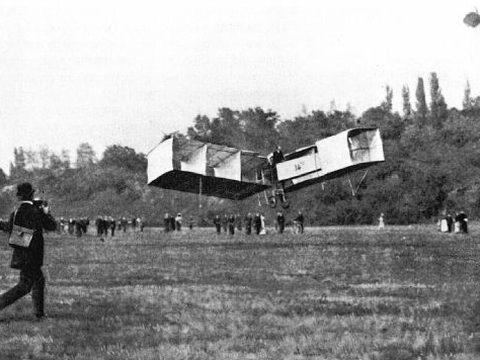
His answer was the 14-bis, a biplane with an engine. On October 23, 1906, in front of a crowd and official observers, he flew it about 60 meters and landed safely.
The Aéro-Club de France certified it as the first flight of its kind in Europe, and this time the public had watched. So Europe hailed Santos-Dumont as the inventor of the airplane.
Ernest Archdeacon, the club's founder, even scorned the Wrights' claims, although newspapers had published reports of their flights. In 1906, he wrote that the French would be the first to fly in public.
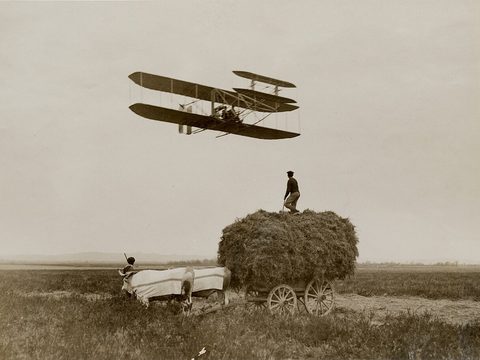
The brothers answered with a public show: in 1908, Wilbur Wright flew in France, in front of crowds. Europe finally saw what they could do, and Archdeacon admitted that he had done them an injustice.
Brazil never agreed. The Wright Flyer took off from a rail, in strong winds; the 14-bis took off on its own. For Brazilian scientist Henrique Lins de Barros, 1903 was only a long hop.
Peter Jakab, a Wright brothers expert in Washington, calls that absurd. In 1903, the Flyer stayed up for nearly a minute, and nothing stays up that long without its own power.
More than a century later, the question is still alive. At the opening ceremony of the 2016 Rio Olympics, Brazil honored Santos-Dumont in front of the whole world, and the argument took off again.
Multiple choice
Twelve questions about the story. Click an answer and you get the result right away, with the why.

-
What did the Wright brothers do near Kitty Hawk on December 17, 1903?
The brothers were Orville and Wilbur Wright, and every word counts: controlled (the pilot steered it), sustained (it kept flying), with an engine (not only the wind). And there was no crowd: it was not a public event.
-
Why did the brothers have trouble proving that their flights were real?
Without a crowd, it was their word against other people's doubts. What was missing was a public event, with experts watching and a record that anybody could check.
-
In the years after 1903, where did people doubt the Wrights most?
The text says "In Europe especially", and some Europeans went further and took an openly anti-Wright position. Brazil's doubts come later in the story, and they never ended.
-
What had Santos-Dumont flown before he "wanted wings"?
Machines lighter than air came first: gas balloons, and then airships, long balloons with an engine that a pilot could steer. Born in Brazil on July 20, 1873, he lived most of his adult life in Paris, where he studied aeronautics.
-
How was the flight of October 23, 1906 different from the Wrights' flight in 1903?
The 14-bis flew about 60 meters (197 feet), and it won a prize for the first officially observed flight of more than 25 meters. The rail and the winds belong to the Wright Flyer; the 14-bis took off on its own. And by then, the Wrights had already stayed in the air for over half an hour in their Flyer III.
-
What did the Aéro-Club de France do, and what happened next?
The flight was certified by the Aéro-Club de France and by the FAI, the international air sports federation. For the Brazilian side, it was the first public flight in the world. Hailed = publicly celebrated.
-
What did Ernest Archdeacon, the club's founder, do?
He did it even though reports of their flights had been published. He wrote several articles, and in 1906 he said that the French would be the first to fly in public.
-
What changed Archdeacon's mind in 1908?
Seeing is believing. After the flights in France, he publicly admitted that he had done the Wrights an injustice.
-
Why does Henrique Lins de Barros call the 1903 flight "only a long hop"?
For him, a true flight takes off without help, flies a distance fixed in advance in front of experts and lands safely, like the 14-bis. Some Brazilians go further and talk about a catapult, or at least a slope, to help the takeoff; a CNN report in 2003 found that even Santos-Dumont experts do not believe this.
-
How does Peter Jakab answer him?
Jakab leads the aeronautics division at the National Air and Space Museum. The video agrees with him on the time: 59 seconds, "for the very first time".
-
Why does the story end at the 2016 Rio Olympics?
At the opening ceremony, Brazil honored Santos-Dumont, the man it credits with inventing the airplane, in front of the whole world. Nothing was decided: the homage only made the old argument famous again.
-
Which sentence best summarizes the story?
The Wrights were first in the air; Santos-Dumont was first in front of the public. Nobody copied anybody, and two experts still disagree today.
The history of flying
Exam task: fill in the blanks with a word or a short phrase. Watch the video again, with the captions off if you can. Click a word in the bank, then click the gap. The stamp shows the moment in the video.
- People have always been inspired by _____ to reach the skies. 00:05
- In 1493, _____ started getting the first ideas of how we could fly. 00:27
- In 1804, a functional _____ was designed. 00:35
- A _____ inspired George Cayley's design. 00:40
- A hundred years later, the Wright brothers flew 59 seconds straight with their _____ for the first time. 00:44
- In 1919, the first _____ airplane was built, but it could only carry four passengers. 00:58
- In 1931, the Junkers Ju could transport seventeen people with its three _____. 01:06
- In 1952, the passenger jet the _____ started flying, and it looks a lot like the planes of today. 01:21
- Fifteen years later, the _____ Concorde flew a hundred people from Paris to New York in three hours. 01:30
- Today the Airbus A380, the biggest passenger jet, can carry up to _____ people. 01:39
Part 1: which word fits?
Eight sentences from the story of the two first flights, one gap each. Decide which answer best fits the gap.

Exam strategy for a multiple-choice cloze. Read the whole sentence before you look at the options. Then ask three questions: does the grammar fit (a preposition after it? an -ing?), does the meaning fit, and does the word go with its neighbors? Collocation decides most items: you make a mistake but do your homework, and the rain is heavy, never strong.
-
The homage in Rio ___ an old controversy, and soon people were arguing again about who really invented the airplane.
To spark something is to start it suddenly, like a fire: spark a debate, spark interest, spark protests. Result needs in; ended is the opposite of "arguing again"; and you cannot begin something that is already old.
-
During the ceremony, Brazil ___ homage to Alberto Santos-Dumont.
A fixed collocation: pay homage, like pay tribute, pay your respects, pay attention, pay a visit. The verb has nothing to do with money.
-
For most of the world, 1903 gives the Wright brothers the ___ of inventors of the airplane.
A title is an official name or position: the title of champion, of inventor, of doctor. A reign is the time when a king rules; nobody gave the brothers a medal; and the name of is followed by a name, not by a role.
-
Ask a Brazilian who ___ modern aviation, and you will hear a different name.
To father something is to create it, to be its origin. You raise children, born only works with be (he was born), and grow up takes no object: a child grows up, but you cannot grow up something.
-
Santos-Dumont ___ most of his adult life in Paris.
In English you spend time, money and energy. Pass is the Portuguese trap (passar a vida): in everyday English you pass the time when you are bored and waiting, but you spend your life, your vacation and your weekends somewhere.
-
There, he dedicated himself to studying aeronautics and ___ with balloons, airships and wings.
The preposition decides: you experiment with something. Test and research take a direct object (test a balloon, research aeronautics), and try is followed by to or -ing, never by with.
-
His 1906 flight was the first ___ flight in Europe to be certified by the Aéro-Club de France.
Powered = with an engine: powered flight, as opposed to a balloon or a glider that only uses the wind. Charged is what you do to a phone battery, and a forced landing is an emergency.
-
In the United States, almost nobody ___ the Wright brothers' place in history.
To dispute a fact is to question it, to say it is not true, and it takes a direct object. The others need a preposition: you argue about something, fight for or against it, complain about it.
Part 2: think of the word
No options this time. Write the one word that best fits each gap. The missing words are grammar words: articles, prepositions, pronouns, linkers.
- A verb in -ing after the gap often needs a preposition before it: she's good at cooking, I look forward to seeing you.
- The + a nationality adjective means all the people of a country: the Japanese, the Swiss.
- Many linkers come in fixed pieces: on the other hand, as a result, in spite of.
- A gap after a preposition, at the start of a clause, is often a relative pronoun: the house in which she grew up.
- Instead of repeating a noun, English uses one: My old phone was slow, so I bought a new one.
-
1There were many claims against the Wrights, and the strongest ___ was this: hardly anybody had seen them fly.
-
2___ that reason, they had trouble proving that their flights were real, particularly in Europe.
-
3___ contrast, Santos-Dumont's flight was public, with experts watching.
-
4He was hailed ___ the inventor of the airplane all over Europe.
-
5Archdeacon publicly scorned the brothers' claims, ___ the reports that had been published.
-
6In 1906 he published a statement in ___ he made a bold promise about French aviation.
-
7In it, he wrote that ___ French would make the first public demonstration of powered flight.
-
8In 1908, after the Wrights' flights in France, he admitted ___ having done them an injustice.
-
9___ Santos-Dumont's flight was watched by experts, the Wrights' first flight was not.
-
10More than a century later, the two sides are still arguing with each ___.
Part 3: form the word
Use the word in capitals to form a word that fits the gap. Decide first what kind of word the gap needs: a person, a noun, an adjective, an adverb. Then check if the meaning is positive or negative.

- People: -ist (science → scientist), -or (act → actor), -man (fish → fisherman).
- Nouns: -tion (educate → education), -acy (private → privacy), and some nouns change their form: high → height.
- Adjectives from verbs: -ed (excite → excited); adjectives from nouns: -al (tradition → traditional); adverbs: -ly (quick → quickly).
- Prefixes change the meaning, not the type of word: pre- = before (paid → prepaid), dis- and un- = not (disagree, unhappy).
-
PHYSICSHenrique Lins de Barros is a Brazilian ___ and an expert on Santos-Dumont.
-
LONGHe argues that the Wrights' flight was not a true flight but a ___ hop.
-
DETERMINESantos-Dumont flew a ___ distance in front of experts and then landed safely.
-
LEGITIMATEBrazilians question the ___ of the 1903 flight because the Flyer took off from a rail.
-
QUALIFYThe winds at Kitty Hawk were crucial for the takeoff, ___ the flight, according to Lins de Barros.
-
CHAIRPeter Jakab, ___ of the aeronautics division at the museum, says such claims are absurd.
-
INVENTEach country gives a different date for the ___ of the airplane.
-
FLYThe 14-bis made its most famous ___ on October 23, 1906.
-
CONTROVERSYMore than a century later, the question is still ___.
-
PUBLICThe Wrights flew in 1903, but they did not fly ___ until years later.
Part 4: key word transformations
Complete the second sentence so that it has a similar meaning to the first. Use the word given in capitals without changing it, and write between two and five words in total, including that word.
-
BEENSarah was late and missed her flight. → Sarah wouldn't have missed her flight ___ late.
-
ENOUGHMy brother was too young to travel on his own. → My brother was ___ to travel on his own.
-
SEEAfter his visit, we would all say goodbye to him at the airport. → After his visit, we would all ___ at the airport.
-
GRANTEDWe hardly ever think about how the airplane helps us in daily life. → We often ___ how the airplane helps us in daily life.
-
LIFETIMEThe agency promised me the best vacation I had ever had, but it was a total disaster. → I was promised the ___, but it was a total disaster.
-
FINDDid you discover who invented the airplane? → Did you ___ of the airplane was?
-
WISHIt's a pity you didn't tell me the flight was delayed. → I ___ me the flight was delayed.
-
DUEThe flight was canceled because of the storm. → The flight was canceled ___ storm.
-
SPENTIt took the passengers two hours to get through security. → The passengers ___ through security.
-
PREVENTEDBecause of the fog, the plane could not take off. → The fog ___ taking off.
How could air travel be improved?
Part A is about the text and the video, Part B is about your life. Part C is the exam speaking task: talk together for about two minutes, one card at a time, and then agree on the one improvement that matters most. Use the two-minute timer.

Useful language
An exam essay
Exam task, 120–160 words. In your English class you have been talking about inventions. Now your teacher has asked you to write an essay: "The airplane is the most important invention of the last 150 years." Do you agree? Write about 1. distance, 2. work and business, and 3. your own idea. Give reasons for your point of view, and use at least two phrases from Exercise 10 (take for granted, due to, prevent… from).
My results
Check your score, then copy it and send it to your teacher on WhatsApp.

One job for this week. Record a one-minute voice message defending the other side: if you think the Wrights were first, argue for Santos-Dumont, and the other way around. Use at least three words from Exercise 02 and one sentence built like the transformations in Exercise 10.