Why Oppenheimer Has Important Lessons for Scientists Today
A physicist almost nobody wanted, a secret laboratory in New Mexico and the weapon that changed the world. The story behind the movie, what a historian told Nature about it, and the difference between say and tell when you report what people said.
Warm-up
Ask and answer with a partner, or with me. Click a card when you have answered it.

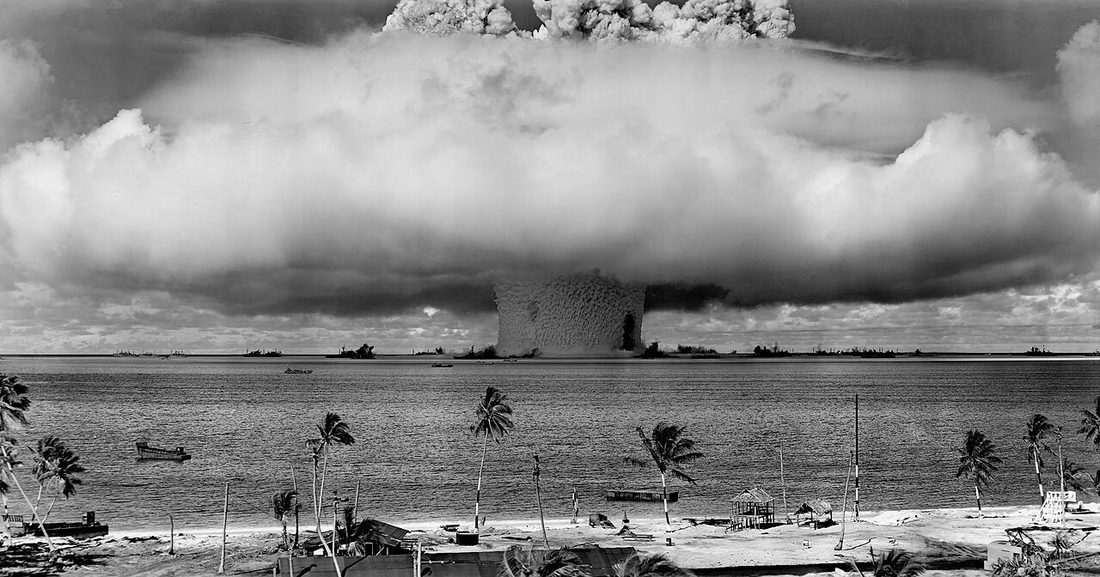
A mushroom cloud, a secret laboratory and a story that changed the world. Today we follow the physicist who led the laboratory that built the first atomic bomb, we hear what a historian thinks of the movie about him, and we practice say, tell and reported speech.
Useful language
Words from the interview
Click a word, then click its definition. Correct pairs turn green. The audio button says the word.
Two notes
Complete the sentences
Click a word in the bank, then click a gap. Click a filled gap to clear it. Read the whole sentence: the clues are all there, and none of these sentences is about the story you are going to read.

 After he shouted at his little sister, he felt so
_____ that he bought her an ice cream and said sorry.
 The weather app is useless: its forecasts have almost no
_____, and it promised sunshine on the rainiest day of the year.
 Her first novel was received with wide
_____: critics loved it, and it sold a million copies.
 In her
_____ class, students study how countries use oil, borders and armies to compete for power.
 The two brothers had a secret
_____ to take money from their own company, but the police discovered it.
 Her articles about the hospital scandal were so good that she won a
_____, one of the top awards in American journalism.
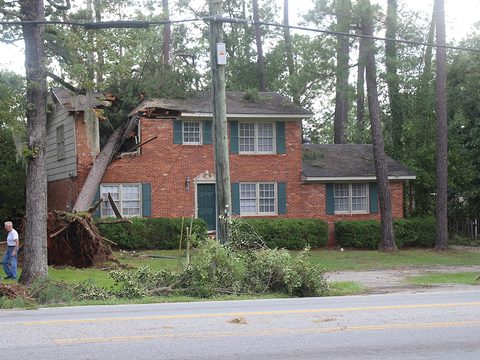 Nobody was ready for the
_____ of the storm: it knocked down trees, houses and power lines all over the city.
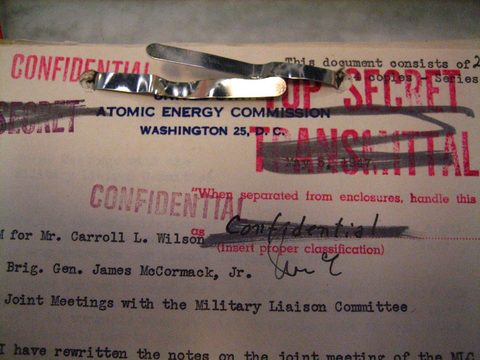 Only officials with a
_____ are allowed to open the government's secret files.
The man behind the bomb
Watch the one-minute video first. Then read the story, retold from the video and from an interview that historian Richard Rhodes gave to Nature. The highlighted parts report what people said. Dotted words have a definition: hover or tap them. The audio button reads each paragraph aloud.
In 1942, during the Second World War, US Army General Leslie Groves was in charge of a secret project: turning nuclear fission into a weapon. He needed a scientist to lead it.
Groves chose Robert Oppenheimer, although almost nobody else thought he was the right man. Oppenheimer was a theoretical physicist, only 38 years old, with no Nobel Prize and no talent for lab work.
Groves trusted him: whenever the general had a question, Oppenheimer had the answer. He also saw clearly that the best scientists had to work together in one place, and he wanted the job.
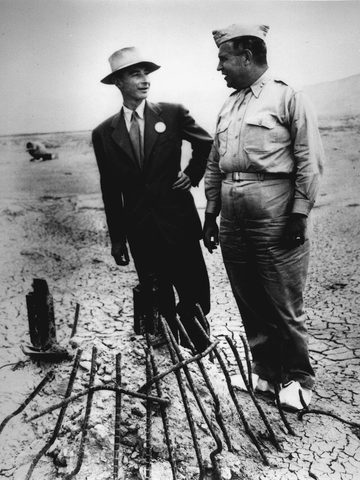
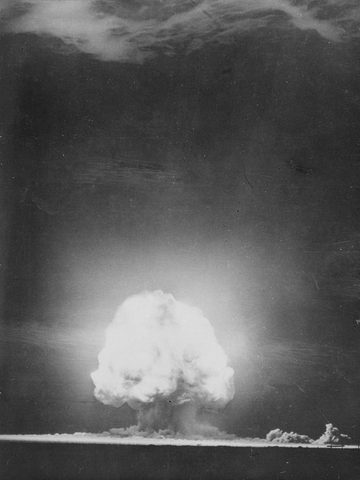
Oppenheimer set up that place: Los Alamos, a secret laboratory in New Mexico. There, his team built the first atomic bomb and tested it in the desert on July 16, 1945.
Soon after, the United States dropped atomic bombs on two Japanese cities, Hiroshima and Nagasaki. Far more people died than the Los Alamos officials had expected, because people stayed out of the shelters.
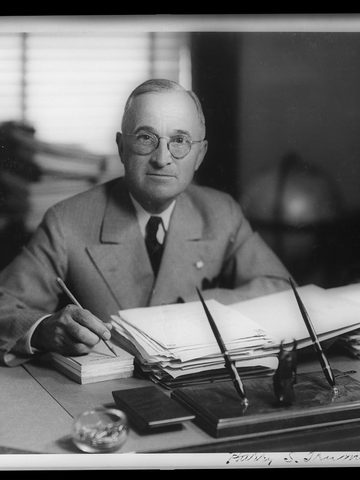
Oppenheimer knew that he had helped to create something terrible. He was proud but also remorseful: he went to see President Harry Truman and told him that he had blood on his hands.
After the war, his doubts turned into action: he spoke out against an even more powerful weapon, the hydrogen bomb. In his view, it had no military use: it was a weapon of mass destruction.
That position made him powerful enemies. The US Air Force wanted the new bomb, and Lewis Strauss, a scheming politician at the Atomic Energy Commission, hated him personally. Both wanted him out of the way.
His enemies used his old links to the Communist Party against him. They called him a security risk, and about a decade after the war, he lost his national-security clearance.
On July 21, 2023, Christopher Nolan's movie Oppenheimer opened in theaters to wide acclaim. Historian Richard Rhodes told Nature that it showed the warning the case had sent to scientists: stay out of politics.
Multiple choice
Answer from the text. Click an answer and read why.

-
What was General Groves in charge of in 1942?
A secret project with one goal: to use nuclear fission, discovered only a few years before, as a weapon. It was the Manhattan Project, the government program that produced the first nuclear weapons.
-
Why did almost nobody think Oppenheimer was the right man?
Thirty-eight is young to lead a project like that, a Nobel Prize was the usual sign of a top scientist, and he was a man of theory, not of experiments. Rhodes says that, as far as he can tell, only Groves thought he was the right choice.
-
Why did Groves trust him?
Whenever Groves had a question, he asked Oppenheimer, and Oppenheimer had the answer. Rhodes says that, in a way, Oppenheimer recruited himself for the job. He also saw, even more clearly than Groves, that the scientists needed one place.
-
What happened on July 16, 1945?
The test took place in the New Mexico desert, and it was the first nuclear explosion in history. The video gives the same date at 00:30. Groves had chosen Oppenheimer three years earlier, in 1942.
-
Why did far more people die than the officials had expected?
The officials thought people would be in their shelters. But people usually ran to them only when they heard a big group of B-29 planes. This time there were only one or two, so people thought the planes were just checking the weather.
-
How did Oppenheimer feel about what he had helped to create?
Both feelings at the same time: Rhodes says he was remorseful and proud, and that he knew how terrible the bomb was. Remorseful is in Exercise 02.
-
What did he tell President Truman?
To have blood on your hands is to feel responsible for people's deaths. Notice the reported speech: told him that he had. Tell + person, and the verb one step back into the past.
-
Why did Oppenheimer speak out against the hydrogen bomb?
A bomb many times stronger than the ones used in 1945 had, in his view, no real military target: it could only destroy on a gigantic scale. The text says nothing about cost.
-
Why did the Air Force want him out of the way?
Rhodes says the Air Force was a big part of the attempt to destroy Oppenheimer, because it wanted to develop the hydrogen bomb. Strauss had his own, personal reasons.
-
What happened about a decade after the war?
Without the clearance, he could no longer see secret government information. The article calls it his downfall, and at 00:41 the video says that his clearance was taken away.
-
According to Rhodes, what warning does the movie show?
Kai Bird, one of the authors of the book behind the movie, wrote that the case sent this warning to all scientists. Rhodes said that it was the movie's message, and that he was sure it was intentional.
-
The best title for this story would be:
The story follows one man: chosen against the odds, he built the bomb, doubted it, spoke out and lost his clearance. Groves is only the beginning, and Rhodes thinks the movie did a really good job.
The one-minute video
Watch the video in Exercise 04 again, with captions. The stamp shows the moment in the video. Click an answer and read why.
-
Cillian Murphy plays a scientist in the movie. What is the scientist's name? 00:03
Cillian Murphy is the actor. Thomas Shelby is his character in the series Peaky Blinders, and Christopher Nolan is the director of the movie.
-
The narrator says the movie is probably one of the ___ movies ever made. 00:08
Notice probably: the video was posted on July 18, 2023, three days before the movie opened in theaters, so it is a prediction, not a review.
-
Who was Robert Oppenheimer? 00:14
The video calls him one of the key figures in the development of the bomb. The general was Groves, and Rhodes says Oppenheimer had no Nobel Prize.
-
When did they develop the atomic bomb? 00:18
The first bomb was ready in 1945, before the war ended. At 00:30 the video gives the date of the first test, the Trinity test: July 16, 1945.
-
Why was he a controversial figure? 00:36
Because of those links, people saw him as a security risk, and he lost his clearance (00:41). The article shows the other side: his enemies wanted him out of the way.
-
He left a legacy that shaped the course of history because he… 00:51
The last sentence of the video gives the reason: his development of nuclear weapons. Princeton and the awards are in the video too, but not as the reason for his legacy.
Scanning: names and numbers
When you scan a text, you look only for specific information. First, go back to the text in Exercise 04 and find every name and every number, without reading the rest. Then read the questions and answer them as fast as you can.

-
aWho is the director of the movie?
-
bWhen did the movie open in theaters?
-
cWho did Nature interview to get a specialist's opinion of the movie?
-
dHow old was Oppenheimer when Groves chose him?
-
eWho oversaw Oppenheimer's work on the secret project?
-
fWhen did the team test the first atomic bomb?
-
gWhich politician at the Atomic Energy Commission turned against Oppenheimer?
-
hWhen did Oppenheimer's downfall, the loss of his clearance, take place?
Skimming: the interview
When you skim, you read fast for the main idea. Here are Richard Rhodes's eight answers to Nature, in the order of the interview, reported in the lesson's own words. Read the three questions first, then skim the answer and choose the question he was answering. You don't need to understand every word, and notice how every verb has taken a step back.
-
He said it was a really good job. Older Hollywood versions of the story had gotten almost everything wrong, like the idea that physicists could simply agree to keep the discovery of fission a secret.
A really good job is a verdict on the movie, and the comparison with older Hollywood versions confirms it. Rhodes remembers one from 1989 that got almost everything wrong.
-
He said yes, and that Oppenheimer was proud as well. He added that the movie left something out: the officials had expected people in Hiroshima and Nagasaki to be in their shelters, so their estimate of the deaths was far too low.
Yes, and proud as well: the answer is about a feeling. He was remorseful and proud at the same time.
-
He said that nobody but Groves had thought Oppenheimer was the right choice. Oppenheimer had no Nobel Prize and was bad in the lab, but he answered every question Groves asked. In a way, he hired himself.
The right choice and hired himself are about getting the job. Rhodes also says he used his own money to help Jewish people leave Nazi Germany and Austria: he knew how terrible Nazi Germany was.
-
He said that yes, it was the message, and that he was sure it was intentional. Besides Strauss's personal hatred, the Air Force had wanted Oppenheimer out of the way, because he was against the hydrogen bomb.
The message is the warning Kai Bird wrote about: his case told all scientists not to stand up in politics.
-
He said people thought Oppenheimer had led the Manhattan Project, but he had only led Los Alamos. He couldn't say if it would have worked without him, but without Groves it could never have happened.
Without Groves it could never have happened: the answer compares the two men's importance to the whole project. Other sites, in Tennessee and in Washington State, made the uranium and plutonium, and Rhodes says Groves worked on a scale that is hard to imagine.
-
He said most scientists came out as the good guys. The movie didn't show what happened on the ground in Hiroshima and Nagasaki, because the story was told from Oppenheimer's point of view, and it would be too much for viewers.
The good guys is about how the public will see scientists. Rhodes adds that some scientists, like the physicist Ernest Lawrence, were against Oppenheimer's position on the hydrogen bomb.
-
He said he would have liked more about Niels Bohr, who came to Los Alamos in 1943. Bohr believed the bomb could also change the world in a hopeful way: even a small country could protect itself from a big one.
More about Niels Bohr: the answer names a scientist who deserved more space. The interviewer's phrase was gives short shrift to, an idiom for "gives too little attention to".
-
He said yes, and that it was a potential disaster. Countries with nuclear weapons could now fight ordinary wars without fear of a nuclear answer, as in 1999 between India and Pakistan and in Russia's war against Ukraine.
Deterrence is having weapons so strong that nobody dares to attack you. Rhodes's point is its dark side: the same weapons now protect countries that start smaller wars.
Say and tell
Something that confuses many students of English. Read the rules, then choose say or tell in ten sentences.

Look right after the verb. Is there a person? Then you need tell: told me, told the reporter. Are the words themselves there? Then you need say: said that…, said goodbye. And when you report somebody's words, the verb inside takes one step back into the past.
- Say + the words: The pilot said (that) the sky was clear. · say yes, say sorry, say hello. To add the listener, use to: He said a few words to the crowd.
- Tell + person: The nurse told my mother (that) the doctor was on his way. For an order: tell + person + to + verb: The coach told us to run faster.
- Tell without a person, in a few fixed expressions: tell the truth, tell a lie, tell a story, tell a joke, tell the time, tell the difference.
- Two classic mistakes: not He said me, but He told me or He said to me · not She told that…, but She said that…
- Reported speech, one step back (when said or told is in the past): present simple → past simple · present continuous → past continuous · present perfect → past perfect · will → would · can → could. Pronouns and time words change too: I → he / she, you → me, tomorrow → the next day.
- Pronunciation: said rhymes with red, not with paid; says sounds like "sez".
-
Oppenheimer ___, "Now I am become Death, the destroyer of worlds."
The words come right after the verb, and there is no listener: said. It is one of his most famous lines, and he used it about the power of the bomb.
-
The project leader ___ his team that they had to keep going, whatever happened.
His team comes right after the verb: a listener, so told. With said, you would need said to his team.
-
I ___ my family that I really enjoyed watching the movie.
My family is the listener: told my family that…
-
He ___ the movie was really historically accurate.
No person after the verb: the words come directly (that is invisible here). He told the movie was… is one of the classic mistakes.
-
She ___ to her husband that the job was too much for one person.
The small word to decides it: said to her husband. With told, there is no to: told her husband.
-
Please ___ me the truth: did you break the window?
Two reasons in one sentence: a listener (me) and a fixed expression (tell the truth).
-
Can you ___ the difference between a physicist and a chemist?
No person here, but tell the difference is one of the fixed expressions with tell. It means "see or know how two things are different".
-
What did the teacher ___ about the test tomorrow?
The question is about the words, and there is no listener: What did she say? With tell, you need a person: What did she tell you?
-
He ___ goodbye to everyone and left the lab for the last time.
Say goodbye, like say hello and say sorry: the words themselves come after the verb, and the people come after to.
-
"Now I am become Death, the destroyer of worlds." (Am become is an old form of have become.) → Oppenheimer said that he ___ Death, the destroyer of worlds.
Present perfect goes one step back to past perfect: have become → had become. Becomes and has become stay in the present, but the reporting verb, said, is in the past.
Report it with say or tell
Write the whole sentence in reported speech. The frame shows where the person and the pronouns go: a person after the dots means told, no person means said. Imagine that everybody said these words to you, and move each verb one step back.
-
present simple"I play the guitar." → She … she …
-
present continuous"They are watching movies." → They … us they …
-
will"I'll call you later." → He … he …
-
can"He can work until 9 p.m." → She … me he …
-
present perfect"I have finished the report," Ana said to her boss. → Ana … her boss she …
-
present simple, negative"We don't understand the question," the students said. → The students … they …
-
present continuous + tomorrow"I'm going to the lab tomorrow," Leo said to me. → Leo … me he …
-
movie line · will"I'll be back." (the Terminator) → The Terminator … he …
-
movie line · present simple"I'm the king of the world!" (Jack, in Titanic) → Jack … he …
Complete the questions
Complete each question with a word from Exercise 02. Then ask and answer the five questions with a partner, or with me.

-
How does the development of nuclear weapons relate to ___?
Nuclear weapons change the balance of power between countries, and that is geopolitics. Remorseful is an adjective, and after relate to you need a noun.
-
Can you think of any real-life examples of ___ or plots that affected historical figures or events?
Or plots is the clue: a scheme is a secret, often dishonest plan. After examples of, the noun goes in the plural.
-
Why is it essential for historical movies to portray events with ___?
To portray events with accuracy is to show them correctly, as they really happened. That is exactly what scientists discussed after Oppenheimer opened.
-
Which recent movie or series won wide ___ from critics and audiences? Did you like it too?
Win acclaim and wide acclaim are the usual collocations: a lot of praise from many people.
-
Have you ever felt ___ about a decision you made? What did you do next?
Feel is followed by an adjective, and remorseful is the only adjective here: sorry for something you did.
Talking point
Part A is about the video and the text, Part B is about you, and Part C is for your opinions. At the end, report one of your partner's answers to the class: She told me that…, He said that…
Useful language
Report the interview
60–100 words. Choose three of Richard Rhodes's answers from Exercise 08 and report them for a reader who did not see the interview: what Nature asked and what he said. Use said (that) at least twice and told + person at least twice, and move the verbs one step back. Example: Rhodes told the interviewer that Groves was the only person who…

My results
Check your score, then copy it and send it to your teacher on WhatsApp.

One job for this week. Every day, pick one piece of news and report it out loud in one sentence: The minister said that…, The article told readers that… Before you finish the sentence, check the verb: did it take its step back?