Mothers
Hugs, home cooking, stay-at-home dads and maternity leave. Sixty-five questions in three levels, from a mother's favorite food to who takes care of the children in a modern family.
Warm-up
Ask and answer with a partner, or with me. Tap a card when you have answered it.

Everybody has a mother story. A mom, a grandmother, an aunt, a dad who does it all: today you talk about the people who take care of us. There are three sets of questions: Beginner, Intermediate and Advanced. Answer the ones at your level, then try one from the next level. You can always talk about another mother you know, or say “pass”.

Useful language
Words for family life
Eight words from today's questions. Click a word, then click its meaning. Correct pairs turn green. The audio button says the word.
Complete the sentences
Click a word in the bank, then click a gap. Click a filled gap to clear it.

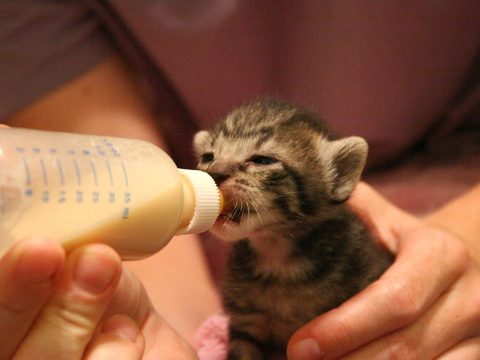 My neighbor is on vacation for two weeks, so I'm going to
_____ her cat: I'll give it food and fresh water every morning.
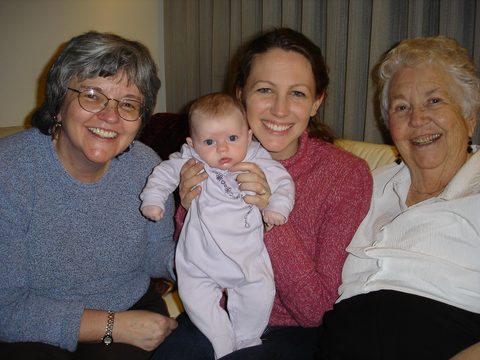 My mother had me when she was twenty-five, and her mother had her at twenty, so my
_____ was only forty-five when I was born.
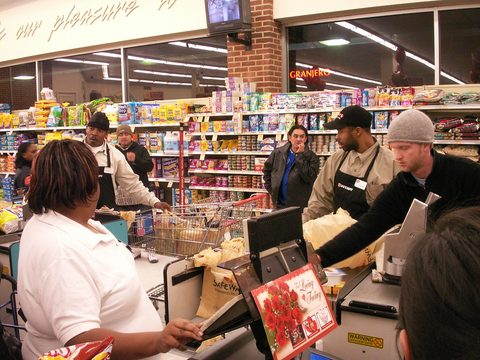 At the supermarket, the
_____ scanned my milk, bread and eggs and said, “That's $12.50, please.”
 My little brother ran to the door, put his arms around me and gave me a long
_____. He didn't want to let go!
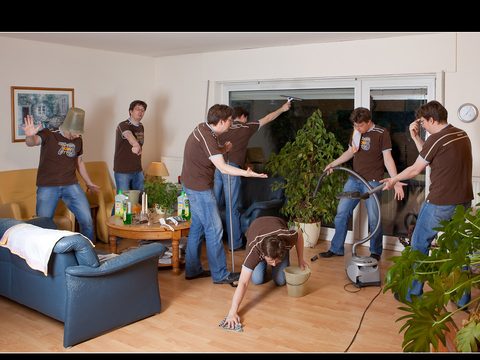 On Saturday mornings we do all the
_____ together: I vacuum the floors, my husband does the laundry and the kids clean their rooms.
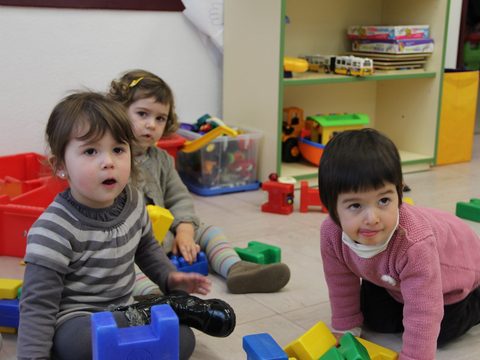 Both parents work full-time, so they pay for
_____: their two-year-old spends the day at a daycare center near the office.
 Tomorrow is my sister's birthday, so I bought her a
_____: a book by her favorite writer, in pretty paper with a red bow.
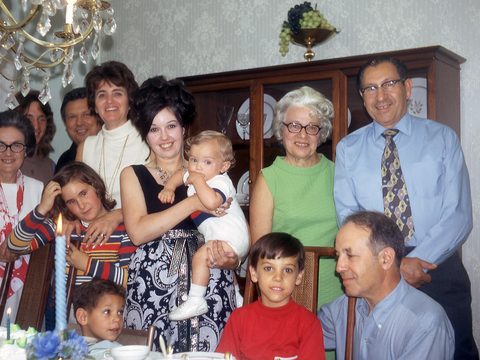 It's my parents' twentieth wedding anniversary, so the whole family is going to
_____ with a big dinner and a chocolate cake.
Beginner (A1-A2)
Ask and answer with a partner, or with me. Answer with short sentences — She is…, She likes…, I help her… — and add one more detail. Talk about your mom, your grandmother or another mother you know, and say “pass” if you prefer. Need help? Open the answer prompts and choose the words that are true for you. Tap a card when you have answered it.
Answer prompts
No, she is not very kind, but she is [funny / smart / busy]. 4 · I like her [smile / food / voice] because [it's sweet / it makes me happy].
I like her hugs because they make me happy. 5 · She likes [coffee / reading / music / flowers].
She likes to [cook / watch TV / go to the park]. 6 · She has [black / brown / blonde] hair and [big / small] eyes.
She is [tall / short / beautiful]. 7 · Yes, I have a photo. We are [at the park / at the beach / at home].
I like it because [we are smiling / it is a happy day / we look nice]. 8 · She cooks [rice and beans / soup / pasta / chicken].
I like it because [it tastes good / it's my favorite / it's hot]. 9 · She is a [teacher / doctor / cook / housewife / farmer / cashier]. 10 · She [wakes up early / cooks / works / cleans / takes care of me]. 11 · I [watch TV / go shopping / cook / play / talk] with her.
We have fun because [we laugh / we are together]. 12 · She is [funny / serious / both].
She is funny because [she tells jokes / she laughs a lot]. 13 · Yes, I help. I [clean my room / wash the dishes / take out the trash / help with cooking]. 14 · On weekends, she [rests / goes shopping / cooks special food / visits family]. 15 · I say, “Happy Mother's Day! I love you because [you are the best / you take care of me / you are my hero].” 16 · No, it is not easy. Mothers [work a lot / take care of everything / don't sleep much].
Yes, maybe, because [some moms stay home / some moms have help]. 17 · Yes, I buy [flowers / chocolate / a card].
No, but I [make a card / draw a picture / say I love you]. 18 · Yes, fathers can [cook / help / play / love] too.
Some fathers are very good with kids. 19 · Yes, some men are like moms. They [love / care / help] a lot.
Yes, because [love is the same / they do the same things]. 20 · She is happy when I [help her / get good grades / say I love you].
She likes [music / coffee / flowers / peace]. 21 · I want to say: “I love you, Mom! Thank you for [everything / the food / your help / the hugs].”
Intermediate (B1-B2)
Answer with a reason and a real example: because…, for example…, even when…. For experiences, use Have you ever…? and Yes, once I…. Then your partner asks you one more question. You can talk about any mother figure, and say “pass” if you prefer. The answer prompts are there if you need a start. Tap a card when you have answered it.

Answer prompts
Before, we [argued / didn't talk much], but now we [spend more time together / are closer]. 3 · Single mothers often face [money problems / lack of time / stress], especially when they [work and raise children at the same time]. 4 · Yes, I think so, because [being a parent is about love and care, not just gender].
However, some people believe it's different because [men and women often raise children in different ways]. 5 · One of the best memories is when [we traveled together / she helped me with a problem / we cooked together]. It was special because [we laughed a lot / I felt very close to her]. 6 · She taught me to [be kind / never give up / work hard], and that [family is important / honesty matters]. 7 · Yes, because [mothers work all the time — cooking, cleaning, helping with homework].
Even if they have a job, they also [take care of everything at home]. 8 · Yes, if they want to, because [they have dreams too / it helps the family / they can be good role models].
But it can be hard to [balance work and family life]. 9 · People usually [give gifts / write cards / take moms to lunch].
Some families also [spend the whole day together / do something special]. 10 · I admire her [strength / kindness / the way she always helps people].
Even when she is tired, she [keeps going / puts others first]. 11 · Yes, once I [made her breakfast / gave her a gift / wrote her a letter].
She was happy because [it was from the heart / she didn't expect it]. 12 · Yes, I know a dad who [takes care of everything at home / raises his kids alone].
He is a mother figure because [he gives love, support, and guidance]. 13 · Some single mothers get [financial support / free childcare / help from the government], but [it's not always enough].
Many people also [offer help / support charities]. 14 · She told me to [believe in myself / be kind to everyone / never give up], and I try to follow that every day. 15 · They can [say thank you / help at home / give hugs / listen more], especially when [mothers are tired or stressed]. 16 · They often worry about [their children's health, education, and future], because [they want the best for them]. 17 · Not always, because [mothers don't always talk about their stress / kids don't see everything they do].
But with time, they [start to understand and appreciate it more]. 18 · Yes, because [I love kids / I want a family / it's part of life for me].
Or: No, because [it's a big responsibility / I want to focus on my career]. 19 · A mother figure is someone who [guides you / takes care of you / gives you advice].
Yes, you can have more than one — like [a grandma / an aunt / a teacher]. 20 · We can [offer help / give them time off work / support them emotionally], especially when they feel tired or alone. 21 · Some people say mothers are always [soft / emotional / only caregivers], but in reality, many are also [strong / independent / leaders].
Advanced (C1-C2)
These questions are about society, not about anybody's private life. Take a position, support it with an example from your country, and bring in the other side with However…, whereas… or although…. Then ask your partner if they agree, and push back once. Tap a dotted word to see what it means. The answer prompts are there if you need a start. Tap a card when you have discussed it.
Answer prompts
However, some argue that extended leave can [affect career growth / place pressure on employers]. 3 · In some cultures, mothers are expected to [stay home / be the emotional caregivers], while fathers [focus on work / handle discipline].
However, in others, parenting is [more balanced / less defined by gender]. 4 · They often manage [schedules / emotional support / household planning], which is exhausting even though it's [invisible / undervalued]. 5 · By offering [childcare subsidies / flexible working hours / tax benefits], especially since [single parents juggle multiple roles without support]. 6 · Traditional roles may cause fathers to [avoid emotional conversations] while mothers may [be expected to nurture more].
This can limit [emotional development / co-parenting balance]. 7 · I believe it's perfectly valid, as [caregiving isn't about gender but about love and responsibility].
However, society still holds stereotypes that make this difficult. 8 · No, because this expectation often leads to [burnout / stress / guilt], whereas support from partners and society is [essential / often missing]. 9 · Many mothers try to maintain [hobbies / social lives / careers] in addition to parenting, although this balance is difficult due to [time constraints / societal expectations]. 10 · It can lead to [a shift in power dynamics / shared domestic roles], but also to [tension / identity challenges for both partners], depending on the couple's mindset. 11 · They often deal with [social stigma / legal issues / lack of representation], even though their parenting is [equally valid and nurturing]. 12 · It can lead to [emotional difficulties / insecurity / identity struggles], especially if the child lacks a strong [support system / nurturing figure]. 13 · By focusing on [nurturing, emotional support, and presence] instead of [gender or biology], we can [create a more inclusive view of caregiving]. 14 · I agree with it because [children benefit from a network of support / parents can't do everything alone], especially in [modern, fast-paced societies]. 15 · Yes, because mothers are often expected to be [perfect / patient / always available], despite [having their own needs and challenges]. 16 · Absolutely, because [children benefit from emotional support from both parents], and [sharing responsibilities creates healthier family dynamics]. 17 · In wealthier families, mothers may have [access to support / more choices], while in lower-income homes, they face [limited resources / higher stress levels]. 18 · They often act as [secondary caregivers / emotional anchors / sources of wisdom], particularly when [parents are working / unavailable]. 19 · Children might struggle with [trust, emotional regulation, or attachment], though [other supportive figures can help fill that gap]. 20 · Yes, because it can [prepare students for future responsibilities / promote empathy and communication].
It might also [reduce unrealistic expectations about parenting]. 21 · It depends, as [each child has unique needs / every culture values different traits], so parenting should be [adaptable and respectful]. 22 · Definitely, because caregiving [builds future generations / supports emotional well-being], yet it is [often unpaid and underappreciated]. 23 · By recognizing [diverse family structures — single parents, LGBTQ+ families, multigenerational homes], and understanding that [love and support are what truly define a family].
One question, one paragraph
80–120 words. Choose one question from your level (Exercise 04, 05 or 06) and answer it in one paragraph. Beginner: describe a mother you know — what she is like, what she does every day and what you do together. Intermediate: give your answer, two reasons and one real example. Advanced: take a position, give the strongest argument on the other side, and answer it. Start with the number of the question. Example: Question 20: My grandmother is happy when …

My results
Check your score, then copy it and send it to your teacher on WhatsApp.

One job for this week. Every day, notice one thing a mother does — at home, in the street, at work or on TV — and describe it out loud in English in two sentences: what she does, and why it matters. At the next club, tell us your best one in thirty seconds.