Greetings and Classroom Language
English has a different "hello" for the morning, the afternoon and the evening — and one more for when you leave. Learn the five, learn which one is formal, and learn the six sentences that will save you in every class.
Warm-up
Short answers. One or two words is fine today. Tap a card when you have answered it.

Welcome! Today you learn the first thing you say to anybody in English — and the sentences you need when you do not understand me. Those six sentences are more important than any grammar.

Useful language
Match the greetings
Click a greeting, then click when you use it. Correct pairs turn green. The audio button says the words.
Classroom language
Click a word in the bank, then click a gap. Click a filled gap to clear it.

 You open your book to page ten and
_____ the story.
You open your book to page ten and
_____ the story.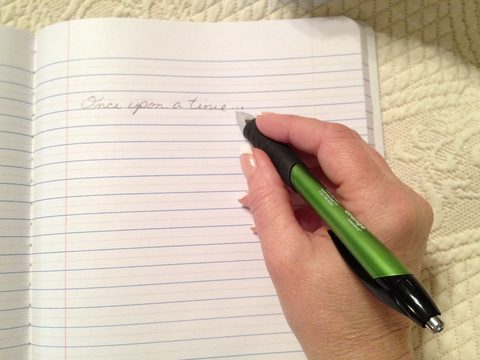 You take a pen and
_____ the new words in your notebook.
You take a pen and
_____ the new words in your notebook. You
_____ to the audio two times.
You
_____ to the audio two times.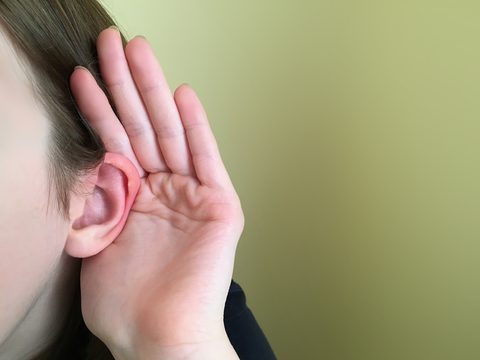 The phone line is bad and you do not hear your friend. You ask: "Sorry, could you
_____ that?"
The phone line is bad and you do not hear your friend. You ask: "Sorry, could you
_____ that?"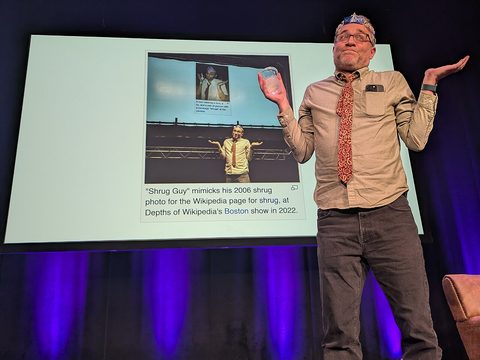 You do not have the answer, so you say: "I don't
_____."
You do not have the answer, so you say: "I don't
_____." The class started ten minutes ago, so you say: "Sorry, I'm
_____."
The class started ten minutes ago, so you say: "Sorry, I'm
_____." You want a new word, so you ask: "What's this in
_____?"
You want a new word, so you ask: "What's this in
_____?"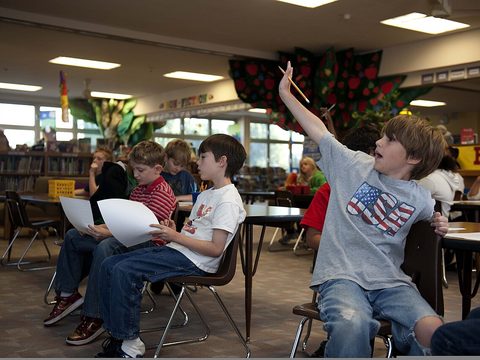 To get the teacher's attention, you
_____ "Excuse me."
To get the teacher's attention, you
_____ "Excuse me."
Six short moments in one day
Look at the clock in each one. The audio button reads it aloud.
8:00 a.m. Ana arrives at school and sees her teacher. Ana says: "Good morning!" The teacher says: "Good morning, Ana. How are you?"
10:15 a.m. In class, Ana does not hear the question. She says: "Sorry, can you repeat that, please?" The teacher repeats it slowly.
1:00 p.m. Ana meets her friend Bruno in the street. Bruno says: "Hi, Ana!" Ana says: "Hi! Good afternoon is too formal between friends."
3:30 p.m. Ana goes to the doctor. She does not know the doctor, so she says: "Good afternoon." The doctor says: "Good afternoon. Please sit down."
7:00 p.m. Ana arrives at a restaurant with her family. The waiter says: "Good evening!" Ana says: "Good evening. A table for four, please."

10:00 p.m. Ana leaves the restaurant. She says: "Good night!" Here good night is not hello. It is goodbye.
Multiple choice
Click an answer and you get the result right away, with the reason.

-
What does Ana say at 8:00 a.m.?
Before 12:00 p.m. it is always good morning.
-
Ana does not hear the question. What does she say?
She heard nothing, so she asks for it again. I don't know is for when you hear the question but have no answer.
-
What does Bruno say to Ana at 1:00 p.m.?
They are friends, so the short informal one. Good afternoon between friends sounds strange, and Ana says so.
-
Why does Ana say "Good afternoon" to the doctor?
With people you do not know, use the longer greeting. It is 3:30 p.m., so it is afternoon.
-
What does the waiter say at 7:00 p.m.?
After 6:00 p.m. the greeting changes to good evening.
-
Ana says "Good night" at 10:00 p.m. What does it mean?
This is the trap of the whole lesson. Good night is not a hello. You say it when you leave, or before you sleep.
-
You arrive somewhere at 9:00 a.m. You say:
9:00 a.m. is still before midday, so morning.
-
You arrive somewhere at 2:00 p.m. You say:
After 12:00 and before 6:00 p.m. — the middle part of the day.
-
You arrive somewhere at 9:00 p.m. You say:
You are arriving, so good evening. Good night is only for leaving.
-
Which one is more formal?
Hi is for friends. Hello works with anybody, and bye bye is not a greeting at all — you say it when you go.
-
You do not have the answer. You say:
Three very useful sentences, and each one has its own moment. This one is for an empty head, not an empty ear.
-
You want to know a word in English. You say:
Point at the thing and ask. This is the sentence that teaches you the most new words this year.
Which greeting, and when

Look at the clock, not at the sky. In English the greeting changes with the hour, not with the light. At 6:30 p.m. in December it is dark — and it is still good evening, never good night.
- Good morning — 12:00 a.m. to 11:59 a.m.
- Good afternoon — 12:00 p.m. to 6:00 p.m.
- Good evening — 6:00 p.m. to 11:59 p.m. You say it when you arrive.
- Good night — not a hello. You say it when you leave at night, or before you sleep. Good night = goodbye.
- a.m. is before midday · p.m. is after midday.
-
7:30 a.m. — you arrive at work.
a.m. means before midday, so morning.
-
12:30 p.m. — you arrive for lunch.
Twelve is the line. One minute after midday and the greeting changes.
-
8:00 p.m. — you arrive at a party.
Arriving, so good evening. You will say good night later, when you go home.
-
11:00 p.m. — you leave the party.
Same hour, different direction. Leaving at night is the one moment for good night.
-
Which sentence is TRUE?
In Portuguese "boa noite" does both jobs. In English the two jobs have two different words.
-
It is 6:15 p.m. and it is dark outside. You arrive at a shop.
The clock decides, not the sun. After 6:00 p.m. it is evening, even in summer when it is still bright.
-
What does a.m. mean?
And p.m. is the other half of the day.
-
Your friend goes to bed. You say:
Before sleep, always good night.
Formal or informal?

- Informal — friends, family, people your age: Hi! · Bye bye! · See you!
- Formal — a doctor, a client, somebody you do not know: Hello. · Good morning. · Goodbye.
- Hello works everywhere. When you are not sure, use hello — it is never wrong.
- In class, these six sentences are always polite: Excuse me. · I don't know. · Can you repeat that, please? · Sorry, I'm late. · What's this in English? · How do you spell that?
- Add please, and almost any sentence becomes polite.
-
You meet a new client at 9:00 a.m. You say:
A new client, so the formal one. Hi is for people you know well.
-
You meet your best friend. You say:
Short and warm. The long greeting would sound like a joke.
-
You are not sure if the situation is formal. The safest word is:
Hello is never wrong, with anybody, at any hour.
-
The class started five minutes ago and you arrive. You say:
Four words, and the problem is over. Say it and sit down.
-
You want to ask the teacher something. You start with:
Excuse me opens the door. After it, ask anything you like.
-
Which sentence is more polite?
The first two are orders. The question form plus please turns an order into a request.
-
You do not understand a word on the page. You say:
Point at the word and ask. Every teacher in the world wants to hear this sentence.
-
Which one is NOT a greeting?
It is the opposite: you say it when you go away, not when you arrive.
Look at the time and write the greeting
Write two words: Good + morning, afternoon, evening or night.

Read the whole line first. Two of these have the same hour and a different answer — because in one you arrive and in the other you leave.
-
a8:00 a.m. — you arrive at school.
-
b3:30 p.m. — you arrive at the doctor's.
-
c7:00 p.m. — you arrive at a restaurant.
-
d7:00 p.m. — you leave and go home to sleep.
-
e9:00 a.m. — you arrive at the office.
-
f9:00 p.m. — you arrive at a friend's house.
-
g2:00 p.m. — you arrive at the bank.
-
h10:00 p.m. — your friend goes to bed.
What do you say?
Write the whole sentence. Five of these are in the box in Exercise 07.

-
1You did not hear the teacher.
-
2The teacher asks you something and you have no answer.
-
3You want the teacher to look at you.
-
4You arrive ten minutes after the class started.
-
5You point at a thing and you want the English word.
-
6It is 11:00 p.m. and you leave your friend's house.
Speaking
Say the whole sentence out loud, not one word. Tap a card when you have answered it.
Useful language
My day in four greetings
40–70 words. Write four short moments of your day with the time and the greeting, like Ana in the reading. Example: 8:00 a.m. I arrive at work. I say "Good morning".

My results
Check your score, then copy it and send it to your teacher on WhatsApp.

One job for this week. Every time you look at your phone, say the correct greeting for that hour out loud. Ten times a day, two seconds each — and by the next class you will never think about it again.