Know Your Coffee
Six questions stand between you and a coffee in English: size, temperature, kind, milk, syrup, extras. Learn the three polite ways to ask, and the difference between an Americano and a latte.
Warm-up
Short answers. Tap a card when you have answered it.

Three words that open every door: Can I…?, Could I…? and I'd like… They work for a coffee, for a pen, for a favor — and for almost anything you will ever ask a stranger.

Useful language
Kinds of coffee
Click a word, then click its meaning. Correct pairs turn green. The audio button says the word.
Complete the sentences
Click a word in the bank, then click a gap. Click a filled gap to clear it.

- In summer I always have an _____ coffee, with a lot of ice.
- At the coffee shop, the small cup has a funny name: _____. It's the opposite of “short”!
- The medium cup is a _____. In Italian and Spanish, this word means “big”.
- The large cup is a _____. In Italian, this word means “twenty”.
- This milk comes from a bean, not from a nut: it's _____ milk.
- My favorite is _____ milk — it comes from a nut.
- When you cook sugar, it turns brown and sweet: that's _____.
- Careful: coffee is a drink, and a _____ is a place.
Six questions and a coffee
Read the conversation, then the six steps. The audio button reads each part aloud.
First, the coffees. An espresso is small, strong and black. An Americano is the same espresso with hot water — still black, still no milk.
A latte has a lot of hot milk. A cappuccino has milk and a thick layer of foam on top. A mocha has milk and chocolate. Five coffees, one espresso inside all of them.
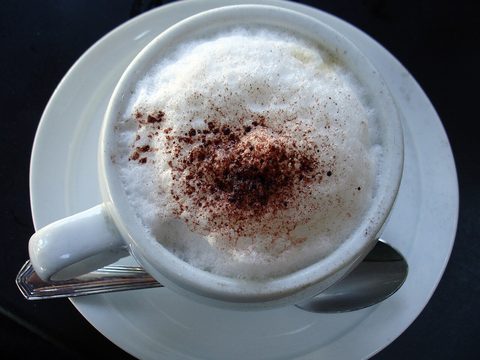
Now the conversation. The barista says: "Hello! Can I help you?" The customer answers: "Hi! Can I have a latte, please?"
"Iced or hot?" — "Hot." — "Tall, grande or venti?" — "Tall, please." At Starbucks the sizes have their own names: tall is small, grande is medium and venti is large.
"Decaf, regular, or with extra shots?" — "Regular." A normal coffee has one shot of espresso. Decaf has no caffeine, and extra shots mean more.
"Any syrup?" — "Vanilla, please." — "Any different kind of milk?" — "No, thanks. Regular milk." — "Anything else?" — "No, thanks."
So the six steps are always the same: choose the coffee, say the temperature, choose the size, say decaf, regular or extra shots, choose the syrup, and finally the milk.
Multiple choice
Click an answer and you get the result right away, with the reason.

-
An espresso is a black coffee.
Small, strong and with no milk at all.
-
An Americano is a coffee with milk.
It is espresso plus hot water, not milk. This is the one everybody gets wrong.
-
How many kinds of coffee are in the lesson?
Espresso, Americano, latte, cappuccino and mocha.
-
What is inside all five of them?
The differences are only what you add: water, milk, foam or chocolate.
-
Which one has chocolate?
Milk and chocolate together.
-
What does the customer order?
Hot, tall, regular, with vanilla syrup and normal milk.
-
At Starbucks, "tall" means:
Which is confusing, because tall normally means big.
-
And "venti" means:
Grande is the one in the middle.
-
How many shots of espresso does a normal coffee have?
If you want more caffeine, you ask for extra shots.
-
What is decaf?
The word is short for decaffeinated.
-
What syrup does the customer choose?
And regular milk, so no soy and no almond.
-
What is the difference between coffee and café?
You drink coffee, and you go to a café. They also sound completely different.
Three ways to ask

Same request, three levels of politeness. All three are correct and normal, and you will use all three in a week. What changes is only how careful you sound.
- Can I have a latte, please? — normal, friendly, used everywhere.
- Could I have a latte, please? — a little more polite. Just change one word.
- I'd like a latte, please. — I'd is I would. It is not a question, so there is no question mark.
- Careful with the meaning: Can I help you? = do you need help. Can I have…? = I want something. Same words, opposite direction.
- The verb after all three is plain: Can I have…, Could I use…, I'd like to pay — only I'd like takes to before a verb.
-
You want a coffee. You say:
One coffee counts cups, so use a coffee. And the third one sounds like an order, not a request.
-
To sound a little more polite, change can to:
One word, and nothing else in the sentence moves.
-
What does I'd mean in "I'd like a latte"?
And it is softer than I want, which is why everybody uses it.
-
"Can I help you?" means:
The barista says it. It goes from them to you.
-
"Can I have a latte?" means:
Same two words at the start, opposite direction. The verb after them decides.
-
Which sentence is WRONG?
After can and could the verb never takes to.
-
You want to pay by card. You say:
The same structure works for anything, not only for food.
-
Which one is not a question?
So it takes a period, not a question mark. Small thing, easy to forget.
The order of a coffee order

- 1. The coffee: Can I have a latte, please?
- 2. The temperature: Iced or hot? — Hot, please.
- 3. The size: Tall, grande or venti? — Tall, please.
- 4. The strength: Decaf, regular or extra shots? — Regular.
- 5. The syrup and 6. the milk: Any syrup? · Any different kind of milk? — No, thanks.
-
"Iced or hot?" is asking about the…
It is always the second question, right after the coffee.
-
"Tall, grande or venti?" is asking about the…
Three Italian-sounding words for small, medium and large.
-
"Decaf, regular or extra shots?" is asking about the…
None, normal, or more. That is the whole scale.
-
"Any different kind of milk?" is offering:
Or low fat. If you want the normal one, say regular milk.
-
The barista asks "Anything else?" You are finished. You say:
The same closing phrase as in the restaurant in Class 19.
-
How do you say the drink?
The drink is coffee. Café is the shop, and the stress is on the second part.
-
Which sentence is correct?
You go to a place and you drink a drink. Do not swap them.
-
You want more caffeine. You ask for:
A bigger cup usually means more milk, not more coffee.
Write the request with Can
Example: You want a Coke. → Can I have a Coke? Careful with the last three: they are not about food.

For a thing, use Can I have…? For an action, use Can I + the verb: Can I close the door? Read each line and decide which one it is.
-
aYou want an iced cappuccino.
-
bYou want a tall Americano.
-
cYou want a grande iced mocha.
-
dYou want almond milk in your coffee.
-
eYou want to close the door.
-
fYou want to use a pen.
-
gYou want to pay by credit card.
Say it another way
Rewrite each request using the word given. Remember: I'd like is not a question.

-
I'd likeCan I have a hot caramel latte?
-
CouldCan I have almond milk in my coffee?
-
CouldCan you help me, please?
-
I'd likeCan I have two shots of espresso in my coffee?
-
CanCould I have a tall vanilla latte?
Role-play: at the café
First I am the barista and you order. Then we change. Go through all six steps.
Useful language
My coffee order
60–100 words. Write the whole conversation between you and a barista, with all six steps. Use Can I…? once, Could I…? once and I'd like… once. Finish by asking the price.

My results
Check your score, then copy it and send it to your teacher on WhatsApp.

One job for this week. Every time you ask for anything — at work, at home, in a shop — build the sentence in English in your head first: Can I…? You ask for something ten times a day without noticing.