Sports and Workout
One verb, no -s, no do, no does. Can is the easiest verb in English to build and the hardest to hear — because it changes its sound depending on where it sits.
Warm-up
Short answers. Tap a card when you have answered it.

Today's verb has no rules to learn. Can is the same for everybody — I can, she can, they can. The whole class is about the sound, not the form.

Useful language
At the gym
Click a word, then click its meaning. Correct pairs turn green. The audio button says the word.
Complete the sentences
Click a word in the bank, then click a gap. Click a filled gap to clear it.

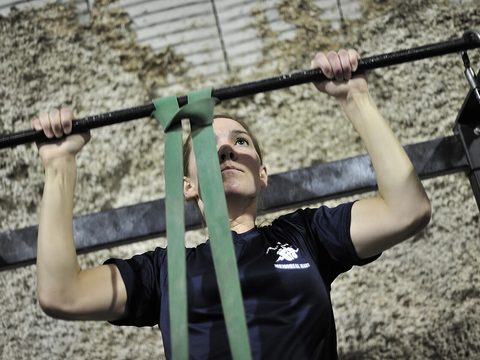 I
_____ at the gym for an hour every day: I do squats and push-ups.
I
_____ at the gym for an hour every day: I do squats and push-ups. When I wake up, I
_____ my arms up high, like a cat.
When I wake up, I
_____ my arms up high, like a cat.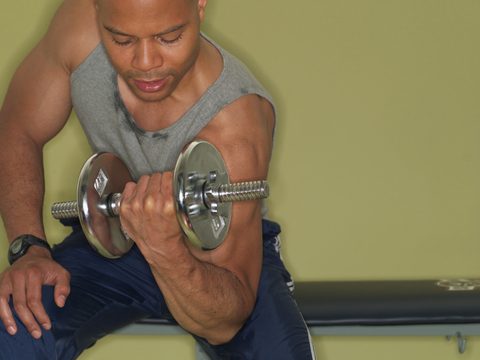 My brother has big, strong arms because he lifts heavy
_____ every day.
My brother has big, strong arms because he lifts heavy
_____ every day.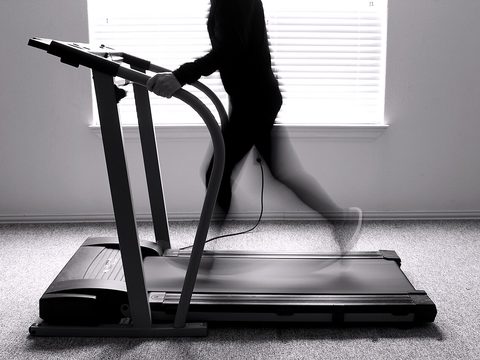 When it rains I run on the
_____ at the gym.
When it rains I run on the
_____ at the gym.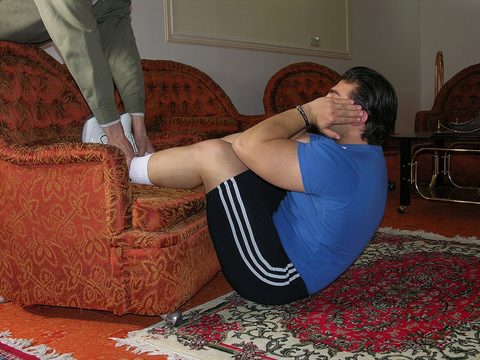 Lie on your back. Can you do twenty
_____ without stopping?
Lie on your back. Can you do twenty
_____ without stopping? A
_____ is a very long race: forty-two kilometers!
A
_____ is a very long race: forty-two kilometers! He smokes, so he isn't very healthy, but he runs every day, so he is very
_____.
He smokes, so he isn't very healthy, but he runs every day, so he is very
_____. Fruit and vegetables are
_____ food, but fries and candy are not.
Fruit and vegetables are
_____ food, but fries and candy are not.
How sporty are you?
Six questions. Choose A, B or C for yourself as you read — you will need your answers at the end.
1. In the morning. A: I get up at eleven. B: I go to the gym once a week and sometimes do housework. C: I get up at five, run, and then work out.
2. Sports. A: I can't play sports. B: I can play two sports, but not very well. C: I can play a lot of sports, and I love a competition.
3. Every day. A: I take the elevator or drive, and I never walk. B: I don't exercise daily, but I try to move. C: I feel bad when I don't go to the gym.
4. At the gym. A: I can't run far, so I drink water and talk. B: I can work out, but I can't lift weights. C: I run fast and I can lift barbells.
5. On the weekend. A: watching Netflix and ordering fast food. B: reading and sometimes walking in a park. C: running marathons.
6. The perfect breakfast. A: leftover pizza. B: oatmeal, because it's healthy. C: a protein shake and some sweet potatoes.
Results. Mostly A: you are a couch potato — time to start moving. Mostly B: you are healthy and active. Mostly C: you are the fitness master — but do not forget to rest.

Multiple choice
All of these are about the quiz. Click an answer and you get the reason right away.

-
What time does answer C get up?
Five, and then a run before the workout. Eleven is answer A.
-
How many sports can B play?
Two, "but not very well" — the honest middle answer.
-
What does A always take?
The elevator or the car, and never a walk.
-
What can B NOT do at the gym?
"I can work out, but I can't lift weights." The word but joins the two.
-
What does A do at the gym?
Because A can't walk or run for a long time. The last option is C.
-
What is C's weekend hobby?
Not one marathon — marathons, plural.
-
What is B's perfect breakfast?
"Because it's healthy" is the reason B gives.
-
What is a "couch potato"?
A couch is a sofa. The picture is somebody who lives on it.
-
What does the result for "mostly B" say?
And that you know how to exercise and relax — which the quiz treats as the best of the three.
-
What is the advice for "mostly C"?
Even the fitness master gets an instruction — in the imperative, from Class 17.
-
Which sentence uses but correctly?
But joins one positive and one negative. Two of the same take and.
-
Which of the three answers is the most honest for most people?
A trick question with no wrong answer in real life — but B is the one the quiz is built around.
Can and can't

Forget everything from the last six classes. No -s, no do, no does. Can is the same word for every person, and the verb after it never changes either.
- Positive: I can play soccer. · She can ride a bike. · They can run. The same word every time.
- The verb after it is plain: She can ride, never
She can ridesand neverShe can to ride. - Negative — can't: He can't lift a barbell. Also written cannot, in one word.
- Question — turn it around: Can you run on the treadmill? — Yes, I can. / No, I can't.
- Joining two: one positive and one negative take but — I can walk but I can't run. Two of the same take and.
-
She ___ run very fast.
No -s, ever. Can is the same for all seven persons.
-
He can ___ a barbell.
The verb after can is always plain: no -s and no to.
-
___ you walk on the treadmill?
Can makes its own question — it jumps to the front, like be does.
-
Can you cook? — No, I ___ .
The short answer repeats can, in the negative.
-
Which sentence is WRONG?
Can never borrows do or does. It makes its own negative.
-
I can walk ___ I can't run.
One positive and one negative, so but.
-
I can lift weights ___ I can work out.
Two positives, so and.
-
___ exercises can Camila do?
The question word comes first, then can, then the person, then the plain verb.
Two sounds for one word

- Strong /kæn/ — like the vowel in cat. You hear it in short answers, at the end of a sentence, and always in the negative: Yes, I can. · I can't run.
- Weak /kən/ — like the end of teacher or sofa. You hear it in normal positive sentences and also in questions: I c'n play soccer. · C'n you run?
- In a positive sentence the stress is on the verb, not on can: I can PLAY soccer.
- So the real clue is not the word, it is the stress. If you hear a strong, clear can in the middle of a sentence, it is probably can't.
- Copy the rhythm: Can you dance? — Yes, I can. · He can't lift weights. · I c'n work out every day.
-
In "Can you dance?" the word can is:
Questions are weak too: C'n you dance? The stress lands on dance, not on can.
-
In "I can work out every day" it is:
A normal positive sentence, so the word almost disappears: I c'n work out.
-
In "He can't lift weights" it is:
Negatives are always strong — the speaker wants you to hear the not.
-
In "Yes, I can" at the end of an answer it is:
It is the last word, so it cannot be weak. Short answers are always strong.
-
The weak sound is like the vowel in:
The small, quiet vowel at the end of sofa and teacher.
-
In a positive sentence, where is the stress?
I can PLAY. The important word is the action, not the ability.
-
You hear a strong, clear "can" in the middle of a sentence. It is probably:
This is the most useful listening tip in the whole class. Strong in the middle means negative.
-
Which sentence has the STRONG sound?
The negative is always strong. The other two — a question and a positive statement — are both weak.
Put the words in order
Twelve sentences: some positive, some negative, some questions. Write the whole sentence.

Look for the question mark. If there is one, can goes first (or right after the question word). If there is not, can goes after the person.
-
afast / she / run / can / very
-
bon the treadmill / you / walk / can?
-
clift / can't / he / a barbell
-
ddo / can / what / exercises / Camila?
-
ereally / the boys / play / can / basketball / well
-
fdo / can / how many / sit-ups / Pedro?
-
ga marathon / the students / can't / run
-
hyou / walk / can / faster?
-
itogether / play / they / can't / soccer
-
jJohn / lift / can / a barbell
-
kwith / the girls / can / play / rackets?
-
lcan't / my mom / stretch
Strong or weak?
Write S for strong or W for weak. Question, short answer or negative → strong. Normal positive sentence → weak.

-
aI can't do 20 sit-ups.
-
bCan you make oatmeal for breakfast?
-
cJulia can lift a barbell.
-
d— Can you cook? — No, I can't.
-
eI can order fast food.
-
f— Can you run a marathon? — Yes, I can.
-
gMy brother can help us with homework.
Can you do it? Prove it!
Answer with a short answer and then a sentence. If the exercise is safe and you feel like it, prove it.
Useful language
What I can and can't do
60–100 words. Write about your body and your sports: five things you can do and three you can't. Use but twice and and twice. Finish with your quiz result and whether you agree with it.

My results
Check your score, then copy it and send it to your teacher on WhatsApp.

One job for this week. When you watch anything in English, listen for can. If it is loud and clear in the middle of a sentence, it is can't — check the subtitles and see if you were right.