Friends: Getting to the Hospital
Rachel is in labor, and Ross has the fastest way to the hospital, or so he thinks. Watch the scene, learn how to say what hurts, spell names the American way and make a doctor's appointment.
Warm-up
Ask and answer with a partner, or with me. Tap a card when you have answered it.

Doctors, hospitals and a baby on the way. Today you race to the hospital with Ross and Rachel, and you learn to say what hurts, spell your name and make an appointment in English.

Useful language
At the hospital
Click a word, then click its meaning. Correct pairs turn green. The audio button says the word.
Complete the sentences
Click a word in the bank, then click a gap. Click a filled gap to clear it.

 My car isn't working today, so I'm taking a
_____ to the airport. The driver is already outside.
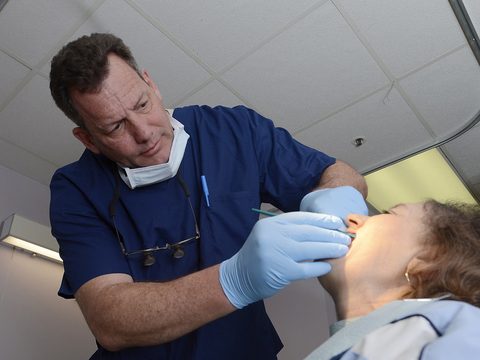 The dentist is very busy this week. Call the office and ask for an
_____ on Friday morning.
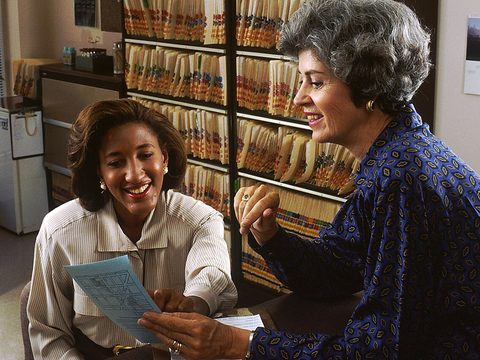 At the clinic, the
_____ smiles and says, "Please sit down. The doctor can see you in ten minutes."
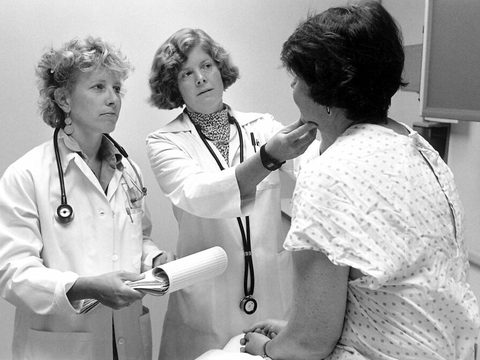 Every morning, the doctor sees a new
_____ every fifteen minutes, from eight to twelve.
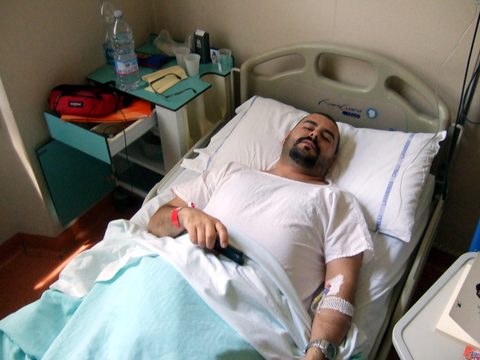 After his operation, my uncle stayed in the hospital for three nights. He wanted to be alone and quiet, so he paid extra for a
_____ with just one bed in it.
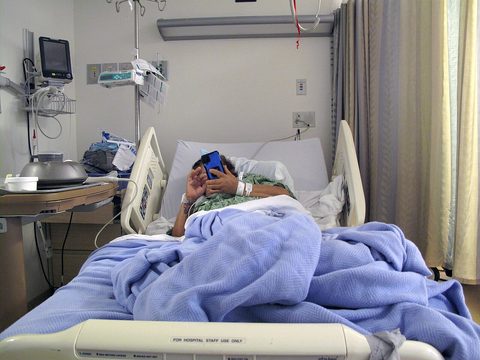 In a
_____, you can hear the other person's TV and phone calls, because your two beds are in the same space.
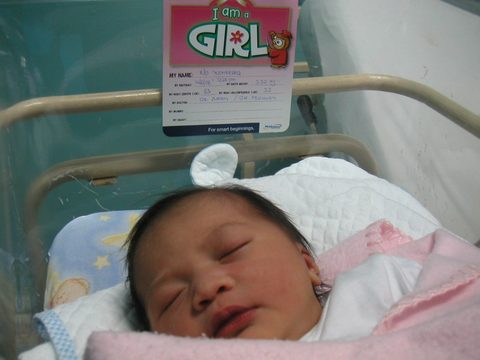 The mother went into
_____ at ten at night, and her baby girl was born fourteen hours later.
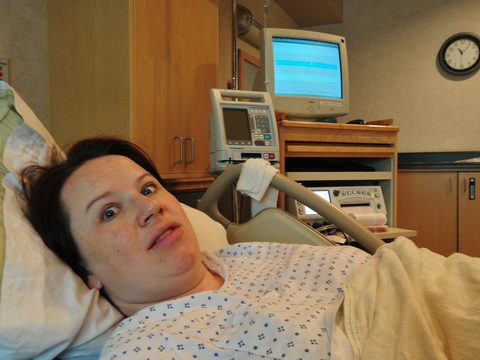 The nurse says the baby will be here soon: each
_____ hurts more than the one before, and now they come every three minutes.
Under seven minutes
Watch the scene first: about a minute and a half, from the TV series Friends. Then read the story. Tap a dotted word to see what it means.
Rachel was in labor, so Ross took her to the hospital in a cab. The trip took under seven minutes, and Ross was very proud.


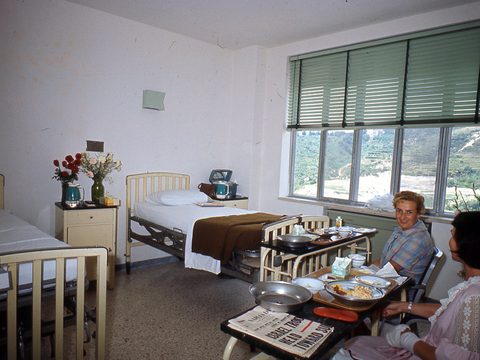
But when they got there, Monica, Phoebe, Chandler and Joey were already waiting for them. "You made it!" Monica said, and Ross's big moment was over.
Ross couldn't understand how his friends beat them there. They took a cab, Monica explained, and then she made a joke: did Ross and Rachel walk?
It made no sense to Ross, because he did test runs of the trip before the big day. Was there a magic tunnel to this hospital?
But Rachel had no time for this: her baby was coming. Ross could stay and talk, she said, but she was going to have a baby.
So Ross went to the desk and gave their names. They called from the cab, so a semi-private labor room was ready for them.
But Rachel didn't want a semi-private room, because they asked for a private one. She didn't want to share with another woman in labor.
The attendant was sorry, but all the private rooms were unavailable. Chandler joked that they needed to be faster, and that didn't help at all.
This made Rachel angry. She didn't like the attendant's tone, she said, and this wasn't the only hospital in the city.
But in the middle of her speech, a strong contraction came, and the fight was over. A semi-private room? Well, it couldn't hurt to look.
Multiple choice
The stamp shows the moment in the video. Click an answer and read why.

-
Why do Ross and Rachel go to the hospital?
"I'm gonna go have a baby," Rachel says at 00:37, and the hospital has a labor room for her. Nobody is sick, and there's no time for a tour!
-
How long is the trip from home to the hospital? 00:02
"From home to the hospital in under seven minutes." Under means "less than". For Ross, it's "some kind of a record".
-
Who is already at the hospital when they arrive? 00:16
"Oh, you made it!" Monica says, with Phoebe right next to her. Joey says the same thing a little later, at 00:28. The friends are there first.
-
How do Ross and Rachel get to the hospital? 00:24
"No, we took a cab too," Ross says. Monica's question, "Did you guys walk?", is only a joke: they didn't walk.
-
Ross says, "I did test runs." What does he mean? 00:26
A test run is practice before the real thing. Ross practiced the trip to find the fastest way, and his friends still beat him.
-
Rachel says, "Ross, you stay here and talk. I'm gonna go have a baby." What does she really want? 00:35
She doesn't really want Ross to stay. She's in labor, and he's talking about his trip! So he goes to the desk right away (00:41).
-
What does the hospital have for Rachel? 00:45
"We have a semi-private labor room waiting for you." They called from the car, so a room is ready. In a semi-private room, you share the space with one more patient.
-
Why can't they have a private room? 00:55
The attendant can't promise a private room, and right now other people have them all. And Ross did call from the car (00:44).
-
Chandler says, "If only you'd gotten here sooner." Why is it funny? 01:00
Under seven minutes, a "record" and test runs… and now Chandler says they were too slow. Sooner means "earlier".
-
What stops Rachel in the middle of her angry speech? 01:18
"Oh, gosh… Ow. Contraction." A moment before, at 01:11, Rachel says this is not the only hospital in the city. Then the pain comes.
-
At the end, what does Rachel agree to do? 01:25
"Yeah, it couldn't hurt to look." Looking is not a problem, and it can help. After that contraction, she doesn't say no to the room.
-
Which sentence best summarizes the story?
Each moment brings the next one: the fast trip, the friends who got there first, the room Rachel didn't want, her angry words and the contraction that ends the fight.
Complete the lines from the scene
Watch the scene again and complete seven lines with the words in the bank. Click a word, then click a gap.
- Ross: From home to the hospital in _____ seven minutes. 00:02
- Ross: I knew I'd get you here _____. 00:12
- Monica: Oh, _____! 00:16
- Ross: How did you _____ us here? 00:20
- Ross: No, we took a _____ too, but I did test runs. 00:24
- Attendant: We have a semi-private _____ room waiting for you. 00:45
- Rachel: Yeah, it couldn't _____ to look. 01:25
Now match four expressions from the scene to their meanings.
Aches and pains
Read the box, then choose the right answer.

Two small words for what hurts. Ache joins the body part and makes one word. Sore is an adjective, so it goes before the body part. Learn the five -aches, and use sore for the rest.
- Body part + ache, in one word: only five body parts usually do this: head, tooth, ear, back and stomach. I have a headache.
- a sore + body part: for all the others. Sore means "painful", and like any adjective, it goes before the noun: I have a sore knee. · My knee is sore.
- Some body parts take both: a backache is the same as a sore back.
- A or an? Listen to the first sound: a vowel sound takes an. I have an awful headache.
- Asking: What's wrong? · What's the matter?
- Being kind: Oh dear! I hope you get better soon. · What a pity! · Poor you!
-
Which body part makes ONE word with -ache?
Earache is one word. For the throat and the ankle, use sore: a sore throat, a sore ankle.
-
My tooth hurts. I have ___.
Tooth is one of the five -ache body parts: toothache, one word. A sore tooth is correct too, but sore never goes after the noun.
-
My throat hurts. I have ___.
Sore is an adjective, so it goes before the noun, like a red throat.
-
Which sentence is correct?
Earache starts with a vowel sound, so it takes an. And sore goes before the noun: a sore ear.
-
The word sore is…
A sore eye, like a red eye. After be, it can come last: My eye is sore.
-
Which sentence is WRONG?
Careful! An eyesore is a different word: it means something very ugly to look at, like a dirty old building. For your eye, say a sore eye.
-
A friend says, "I have a backache." The best answer is…
When somebody is sick or in pain, be kind: Oh dear!, Poor you! and I hope you get better soon.
-
"What's the matter?" means…
Two ways to ask the same question when somebody doesn't look well: What's wrong? and What's the matter?
What's the matter?
Pretend you are sick. Read the situation and the body part on the left, and complete B's answer with a or an. Then read the dialogues aloud with a partner. Partner A answers: Oh dear! I hope you get better soon.
-
toothA: What's wrong? B: I ate too much candy, and now one tooth really hurts. I have ___.
-
earA: What's the matter? B: The music at the party was too loud, and now my left ear hurts. I have ___.
-
backA: What's wrong? B: I carried heavy boxes all weekend, and now I can't stand up straight. I have ___.
-
stomachA: What's the matter? B: I ate three hot dogs and a big pizza for lunch. I have ___.
-
throatA: What's wrong? B: I sang at a party all night, and now it hurts to talk. I have ___.
-
eyeA: What's the matter? B: There's sand in my eye from the beach, and it's red. I have ___.
-
ankleA: What's wrong? B: I fell when I was running, and now it hurts to walk. I have ___.
-
chestA: What's the matter? B: I cough all day, and it hurts right here, under my shirt. I have ___.
The alphabet and spelling
Read the box and say every letter out loud. Then choose the answers, and listen to six names, letter by letter.

- The five vowels: A /eɪ/ "ei" · E /iː/ "ii" · I /aɪ/ "ai" · O /oʊ/ "ou" · U /juː/ "iu".
- Careful with E and I: the English E sounds like the Portuguese "i", and the English I sounds like "ai".
- Letters people mix up: G /dʒiː/ and J /dʒeɪ/ · R /ɑr/ · H /eɪtʃ/ · W "double-u" · Y /waɪ/ · X /eks/.
- The last letter: in American English, Z is "zee" /ziː/. In British English, it's "zed".
- Two letters that are the same: on the phone, people often say double: the SS in Ross is "double S".
- Asking: How do you spell your name? · How do you spell your last name?
-
Which letter rhymes with my?
I is /aɪ/, like my, bye and eye.
-
Which letter rhymes with no?
O is /oʊ/, like no, go and so.
-
Which letter rhymes with way?
A is /eɪ/, like way, day and say.
-
Which letter rhymes with he?
E is /iː/, like he, she and me. Don't say it the Portuguese way, like "é".
-
Which letter sounds just like the word you?
U is /juː/, the same sound as you. Y sounds like why, and W is "double-u".
-
Which letter sounds just like the word why?
Y is /waɪ/. I is close, /aɪ/, but it has no /w/ sound at the start.
-
In American English, the last letter of the alphabet is…
Americans say "zee". "Zed" is British English, and "zay" is nobody's English.
-
On the phone, how do people often say the EE in G-R-E-E-N?
G-R-double E-N. Saying the letter twice, E-E, is fine too.
Now tap the audio button: you hear a last name, letter by letter. Write the name.
-
1 Ross's last name
-
2 Rachel's last name
-
3 Chandler's last name
-
4 a doctor's last name
-
5 another doctor's last name
-
6 a patient's last name
Making an appointment
Read the phone call, then fill in the patient's appointment card.
- Receptionist: Good morning. City Medical Practice.
- Patient: Hello. I'd like to make an appointment, please.
- Receptionist: Sure. Can I have your name?
- Patient: John Smith.
- Receptionist: Thank you, John. How do you spell your last name, please?
- Patient: S-M-I-T-H.
- Receptionist: Got it. What's the problem?
- Patient: I have a sore eye.
- Receptionist: OK. How about eleven o'clock on Monday with Dr. Johnson?
- Patient: Eleven o'clock on Monday works for me. Thank you.
- Receptionist: Great. Your appointment is scheduled for eleven o'clock on Monday with Dr. Johnson. Is there anything else I can help you with?
- Patient: No, that's all. Thank you.
- Receptionist: You're welcome. OK, bye.
- Patient: Bye.
-
namePatient's name:
-
problemPatient's problem:
-
dayDay:
-
timeTime:
-
doctorDoctor:
- Patient, asking: I'd like to make an appointment, please. · I need to make an appointment.
- Receptionist, asking: Can I have your name, please? · How do you spell your last name? · What's the problem?
- Receptionist, offering: How about two o'clock on Wednesday with Dr. Patel?
- Patient, saying yes: … works for me. · … sounds good.
- At the end: Is there anything else I can help you with? — No, that's all. Thanks.
Sarah Anderson calls the same office. Her phone call is out of order: write a number from 1 to 12 next to each line.
-
aPatient: Goodbye.
-
bPatient: Sarah Anderson.
-
cReceptionist: Certainly. Can I have your name, please?
-
dPatient: Hi. I need to make an appointment.
-
eReceptionist: Thank you, Sarah. How do you spell your last name, please?
-
fReceptionist: OK, bye.
-
gReceptionist: You're welcome. Your appointment is scheduled for two o'clock on Wednesday with Dr. Patel. Is there anything else I can assist you with?
-
hPatient: Two o'clock on Wednesday sounds good. Thank you.
-
iReceptionist: Perfect. How about two o'clock in the afternoon on Wednesday with Dr. Patel?
-
jPatient: No, that's all. Thanks.
-
kPatient: A-N-D-E-R-S-O-N.
-
lReceptionist: Good morning. City Medical Practice.
Doctors, phones and big days
Part A is about the scene. In Part B, interview a partner (or me) and add one more detail: when, where or how. Part C is for your opinions.

Useful language
My phone call to the doctor's office
50–90 words. Write your own phone call to City Medical Practice. Use your own name, or invent a patient, and choose a small health problem from this lesson. Spell the last name, and choose a day, a time and a doctor. Then role-play the call with a partner, and change roles.
My results
Check your score, then copy it and send it to your teacher on WhatsApp.

One job for this week. Spell your full name out loud three times, the American way, as if you were on the phone with a receptionist. Watch out for E and I, and say zee, not zed.