A Student's Day
One student at Cambridge, one at Harvard, and two busy days from the alarm clock to bed. The -s of he and she, the time with past and to, and three small words that go before every time: at, in and on.
Warm-up
Answer with a time when you can. Tap a card when you have answered it.

Tell me your day in order, from the alarm clock to your bed. Today we look at two students and their days: one in England and one in the United States. By the end of the class you can tell your own day with every time right.
Useful language
Daily routine
Click a phrase, then click its meaning. Correct pairs turn green. The audio button says the phrase.
Complete the sentences
The bank has only verbs. Read the whole sentence: the words around the gap tell you which verb goes there. Click a word in the bank, then click a gap.

 When my alarm rings, I
_____ out of bed right away.
 I
_____ my face with cold water to wake up.
 My first class
_____ at eight o'clock.
 In the evening I
_____ my homework at the kitchen table.
 My roommate
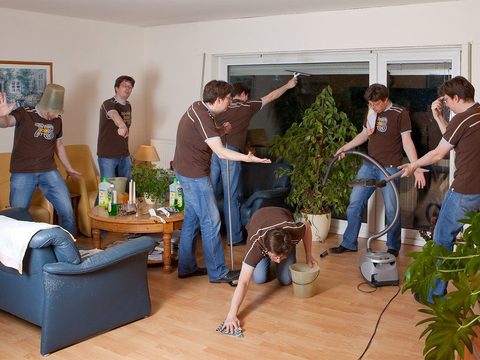
_____ not do any housework, so I clean the whole apartment.
 I love to cook, so every night I
_____ dinner from fresh vegetables.
 My friends and I love this café. After class we
_____ out here for hours.
 On Sundays I'm always tired, so I don't
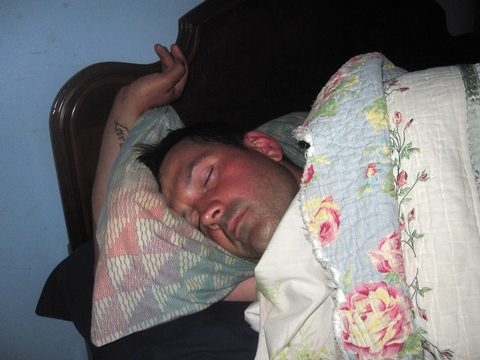
_____ for a walk: I stay in bed and sleep all afternoon.
The smart routine of a Cambridge student
One day, hour by hour. Look at the verbs after he: almost all of them end in -s.
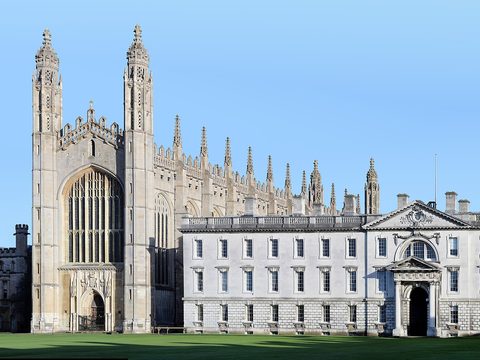
Sam Martin studies at Cambridge University, in England, and he gets top grades. But he doesn't study all day: his secret is a smart routine.

His day starts at seven. He gets up and exercises, because he believes exercise is good for the brain. He has a protein shake and fruit.
Now his brain is awake, so at ten to eight he goes to the library. He studies all morning and listens to his study playlist.
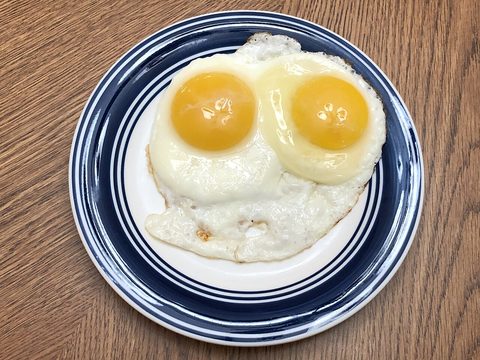
After a long morning, it is lunchtime. At 12:15 he has the same meal every day: two fried eggs and ham pitas. He doesn't like heavy food.
One hour later, at a quarter past one, he goes back to the library. He studies one more hour, then it is time for a break.
At 2:15 he goes to a park, takes off his shoes and relaxes with some music. He says fresh air gives the brain energy.
With that new energy, he studies all afternoon and takes one more break. At six o'clock he stops and has dinner in a café or a restaurant.
Dinner is also his time for friends. He meets them there, because he says time with friends makes you creative.
After dinner, at half past seven, he learns in an easy way. He watches a documentary about the topics he is studying at the moment.
Then, at 8:30, his me time starts: soccer, FIFA or a call to his family, and no study at all. At eleven he goes to bed.
Multiple choice
Click an answer and you get the result right away, with the reason.

-
Where does Sam study?
Cambridge University, in England. The student at Harvard is Anthony, in the video later in this lesson.
-
What time does Sam's day start?
He gets up at seven. At ten to eight — 7:50 — he is already in the library.
-
Why does he exercise every morning?
And it is exam time: there is a lot to learn, understand and memorize, so he never starts the day without exercise.
-
What does he have for breakfast?
The eggs and the pitas are real, but they are his lunch.
-
What does he do in the library in the morning?
A special study playlist, from ten to eight until lunchtime.
-
What is special about his lunch?
Two fried eggs and ham pitas, every day at 12:15 — and nothing heavy, because he doesn't like heavy food.
-
What does he do at a quarter past one?
One more hour of study. After that, at 2:15, comes his first break of the afternoon.
-
What does he do in the park at 2:15?
Shoes off, some music and fresh air. He says fresh air is good for the brain and for his energy — and he needs that energy for the whole afternoon.
-
Why does he have dinner with friends?
Dinner is at six, usually in a café or a restaurant, and friends are part of the plan.
-
What does he watch at half past seven?
A documentary about the topics he is studying. He learns, but without books.
-
In his "me time", which one does Sam NOT do?
No study at all after 8:30. He also watches debates at the Cambridge Union or has a drink with a friend — and at eleven, he sleeps.
-
Which sentence best summarizes the story?
He doesn't study all day, and he sleeps eight hours, from eleven to seven. He studies a lot, but he also exercises, eats light, takes two breaks in the afternoon, sees friends and has free time. Sam says success is not about too many hours — it is about the plan.
A day in the life of a first-year student
Before you watch: what is Anthony's job, and what does he do on a typical day? Watch and check. Then watch again and write the missing words — the stamp shows the second where each sentence starts.
-
aEvery day, when I ___, I still can't believe I'm at Harvard. 00:05
-
bLike every freshman, I get to ___ in Harvard Yard. 00:12
-
cAnd I get to ___ breakfast in Annenberg Hall. 00:17
-
dI really ___ my freshman seminar, "The Evolution of Aging." 00:22
-
eAnd I get to ___ directly with my professor on research projects. 00:31
-
fI'm also training to become an EMT. I ___ to become a doctor. 00:47
-
gEvery day, I get to ___ with my friends and try something new. 00:51
Now the words. Each stamp takes you to the sentence in the video.
-
"Like every freshman…" A freshman is… 00:12
Freshman is the American word for a student in the first year of high school or college.
-
Anthony says "I get to" again and again. Here it means… 00:12
It is informal and positive: I get to live in Harvard Yard = I have this good opportunity. It is not the same as I have to, which is an obligation.
-
"It's just me, 15 other students and a faculty member." A faculty member is… 00:26
The faculty are the teachers and professors of a college or university.
-
So how many people are there in his seminar? 00:26
Count them: Anthony, 15 other students and one faculty member.
-
"…or the medical school, which is pretty cool." Pretty cool means… 00:44
Here pretty means "very" and cool means "great". Nothing to do with the temperature.
-
"I'm glad I've got the next three years to try them all." Glad means… 01:01
He is a freshman, so he still has three more years at Harvard — and he is happy about it.
-
Where is Anthony from? 01:05
The last line of the video: "I'm from Tucker, Georgia." Georgia is a state in the United States.
What time is it?

Minutes first, then the hour: a quarter past seven. But there is a second way, like a digital clock: the hour first, then the minutes — seven fifteen. Both are right, and you need to understand both.
- On the hour: 8:00 → eight o'clock
- 30 minutes = half: 1:30 → half past one
- 15 minutes = a quarter: 5:15 → a quarter past five · 5:45 → a quarter to six
- Other minutes: 7:05 → five past seven · 11:50 → ten to twelve
- In the US you also hear after for past: ten after seven.
- Way 2: hour + minutes. 4:20 → four twenty · 8:05 → eight oh five (say the letter O for the zero).
- Not exact? Say at about: I get up at about seven.
Questions 01–04: a first-year student's busy Wednesday. He says the times of his schedule with Way 1.
-
7:15 — gym. "I go to the gym at…"
Fifteen minutes after seven, so past. A quarter to seven is 6:45.
-
11:45 — first class. "My first class is at…"
Forty-five is more than thirty, so count back from the next hour: fifteen minutes to twelve.
-
6:30 p.m. — a birthday party. "The party is at…"
Half past the hour that just finished — six, not seven.
-
9:10 p.m. — a live class on YouTube. "I watch it at…"
Ten minutes after nine. Ten to nine is 8:50.
-
10:40
Forty minutes past ten is the same as twenty minutes before eleven — and after thirty you use to.
-
9:05 — which one is WRONG?
Nine past five is 5:09. With past, the minutes come first.
-
Another correct way to say 3:35 is…
Way 2: the hour, then the minutes, with no and. With Way 1 it is twenty-five to four.
-
You get up at seven, more or less. You say:
A time always takes at, and about comes right after it.
Write the time in words
Each line tells you what the clock shows. Write the time with o'clock, past or to (Way 1). Example: 3:20 → twenty past three
-
aA red alarm clock: 6:00
-
bA digital clock: 7:45
-
cA black round clock: 4:30
-
dA brown clock: 10:55
-
eA white clock: 9:15
-
fA blue alarm clock: 10:10
-
gA digital clock: 7:30
-
hA digital clock: 4:45
-
iA digital clock: 2:15
-
jYour phone: 12:25
At, in, on — and to

Three boxes for time. At for an exact moment, in for the long periods, on for days and dates. And to is not about time at all: it comes after go — but never before home.
- in — parts of the day, months, seasons, years: in the morning · in the evening · in January · in the winter · in 2024
- on — days and dates: on Friday · on November 1st · on the weekend (British English says at the weekend)
- at — times and special moments: at 2 o'clock · at midday · at midnight · at night · at Christmas
- go + to: He goes to school. · They go to the gym.
- No to before home: I go home after class.
-
My birthday is ___ July 3rd.
A date takes on. Only the month alone takes in: in July.
-
They go on vacation ___ August.
A month is a long period, so in.
-
She always goes to bed ___ 11:30.
An exact time on the clock takes at.
-
We have English classes ___ Tuesdays and Thursdays.
Days take on — one day or every week, with the -s.
-
Ana has yoga ___ Saturday mornings.
The trap of the day. In the morning, yes — but when a day comes first, the day wins: on Saturday mornings, on Monday evening.
-
Pedro doesn't work ___ the afternoon.
A part of the day, with no day name before it: in.
-
Which sentence is WRONG?
Home never takes to after go: I go home at six.
-
Which sentence is correct?
A day of the week: on, and no the.
A busy time of the year
An event planner tells us about the busiest months of her year. Write at, in, on or to — one word in each gap.
-
aI always get up ___ 5:45 a.m.
-
bI work from Monday ___ Friday.
-
cI take a shower, have breakfast and go ___ work.
-
d___ the mornings I always have meetings with clients.
-
e___ October 12th we have Children's Day.
-
f___ November I organize the end-of-the-year party.
-
gSo I usually go home very late, ___ about 9:00 p.m.
-
hSometimes we travel ___ my parents' house for a few days.
-
i___ New Year's Eve we usually have a big dinner with friends.
-
jI love being with my family ___ this special time of the year.
Present simple: he studies, he doesn't study, does he study?

One letter, and only for three people. He, she and it get the -s. In negatives and questions the -s moves to does, and the main verb goes back to its plain form.
- Most verbs: + s — make → makes · help → helps · play → plays
- After s, sh, ch, x and o: + es — miss → misses · push → pushes · teach → teaches · fix → fixes · go → goes
- Consonant + y: y → ies — fly → flies · copy → copies · cry → cries
- Two special verbs: have → has · do → does
- Negative: don't / doesn't + plain verb — She doesn't eat meat. (never
doesn't eats) - Question: Do / Does + person + plain verb — Does he work on Sundays? · Do they live near you?
-
My roommate ___ the housework. I always have to do it!
One roommate = he or she, so doesn't — and after it the plain verb do.
-
She wants to be a doctor, but she ___ enough.
The -s is already in doesn't. The verb stays plain.
-
___ your teacher ___ you a lot of homework?
One teacher = he or she, so Does — and the -s stays in does: the main verb is plain give.
-
___ your classmates help you when you need it?
Classmates = they, so Do.
-
Ana is a medical student. She ___ her classes very late.
It ends in sh, so it needs es: finishes.
-
Rick and Carl are on the college team. They normally ___ to games.
They never takes the -s.
-
Which sentence is WRONG?
Has is only for affirmative sentences. After doesn't and does, it goes back to have.
-
Which sentence is correct?
Before the y there is a consonant, d, so the y becomes ies.
Clara's week
These are notes from Clara's weekly planner. Write the verb for she — one or two words. Check the spelling rule first.
-
wake upOn Monday she ___ at 8:00 a.m.
-
haveIn the evening she ___ dance class at 7:00 p.m.
-
startOn Tuesday she ___ work at 2:00 p.m.
-
doOn Wednesday she ___ housework in the morning.
-
meetAt 6:00 p.m. she ___ her friends.
-
studyOn Thursday she works all day and ___ at night.
-
goOn Friday she ___ shopping in the afternoon.
-
watchAt 9:00 p.m. she ___ a movie with friends.
-
playOn Saturday she ___ tennis at 9:00 a.m.
-
relaxOn Sunday she ___ all day.
-
not workShe ___ on Sunday. It's her day off.
-
not playShe ___ tennis on Monday — only on Saturday.
Write the sentences
Write the full sentence. A question mark means a question; not means a negative. Example: she / not / like / coffee → She doesn't like coffee.

-
awhat time / she / take a shower?
-
bshe / not / start work / at nine
-
cmy brother / go home / very late
-
dhe / have lunch / with his coworkers
-
ewe / not / do our homework / in the evening
-
fyou / relax / at night?
-
gthe baby / go to bed / at eight
-
hmy mom / not / make dinner / every night
-
ihe / wash his face / in the morning?
Talking point
Part A about Sam and Anthony, Part B about your life, Part C with opinions. Put at, in or on in front of every time.
Useful language
My day, hour by hour
60–90 words. Write your weekday like Sam's: at least five times (with at), one part of the day (with in) and one day (with on). Finish with two sentences about the day of someone you know — every verb with its -s.

My results
Check your score, then copy it and send it to your teacher on WhatsApp.

One job for this week. Tonight, write tomorrow's schedule in English, like the student's Wednesday: the time, then the activity. Tomorrow, say each line out loud when it happens — it's a quarter past seven, I'm at the gym.