Sneaky Ways Fast Food Restaurants Get You to Spend Money
Big pictures, small prices, a combo that saves nine cents and a kiosk that makes you linger: the psychology of the fast-food menu, and the expressions that describe it.
Warm-up
Think of the big fast-food chains, like McDonald's, Burger King and Starbucks. Talk with a partner, or with me. Click a card when you have answered it.

Fast food is supposed to be cheap. So why does the bill so often surprise you? Today you find out, and you learn the expressions that describe it: grab your attention, it turns out, do the math, end up with.
Useful language
Fast-food words
Seven of the eight appear in the video and in the reading; the last one comes back in the comic strip of the writing task. Click a word, then click its definition. Correct pairs turn green. The audio button says the word.
Complete the sentences
Click a word in the bank, then click a gap. Click a filled gap to clear it. Read the whole sentence: the clues are all there.

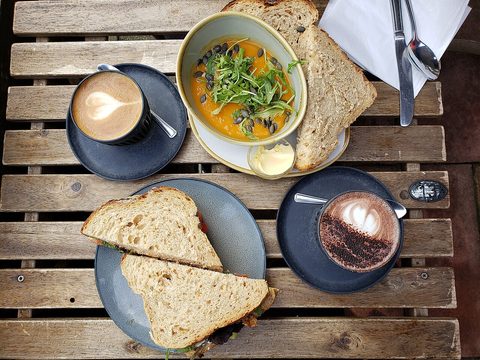 At the café near my office, the lunch
_____ includes soup, a sandwich and a coffee, all sold together for one price.
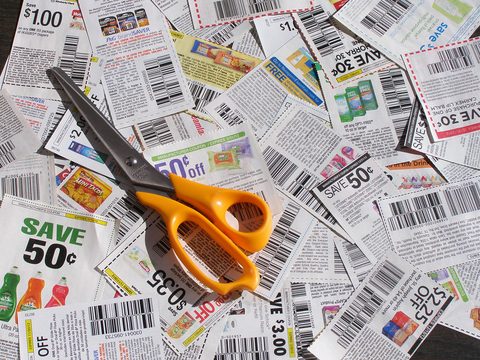 Cut this
_____ out of the newspaper and show it at the register: it takes two dollars off any large pizza.
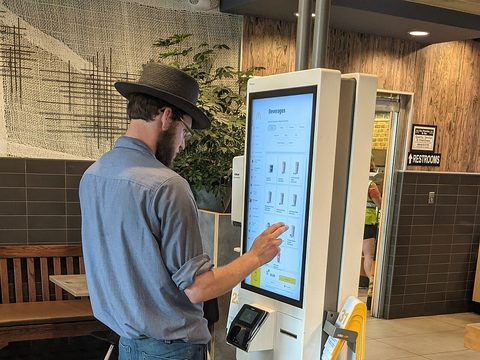 There was a long line at the register, so I ordered on the touch-screen
_____ by the door and paid with my card.
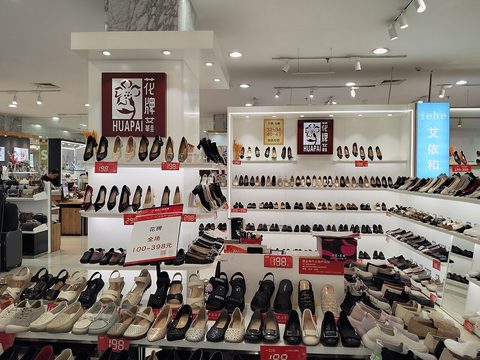 Keep your
_____ in case the shoes don't fit: it proves that you bought them here, and without it the store won't take them back.
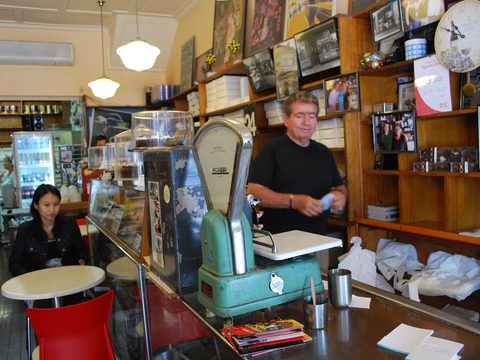 The cashier stood behind the long
_____, took my money and handed me my change.
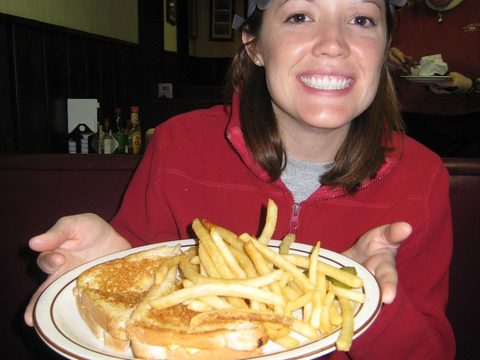 The diner near my house serves a huge
_____ of fries with every sandwich: one plate is enough for two people.
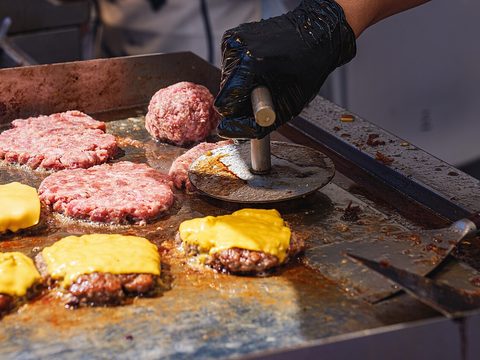 She pressed the ground beef into a thin, round
_____ and put it on the grill for four minutes on each side.
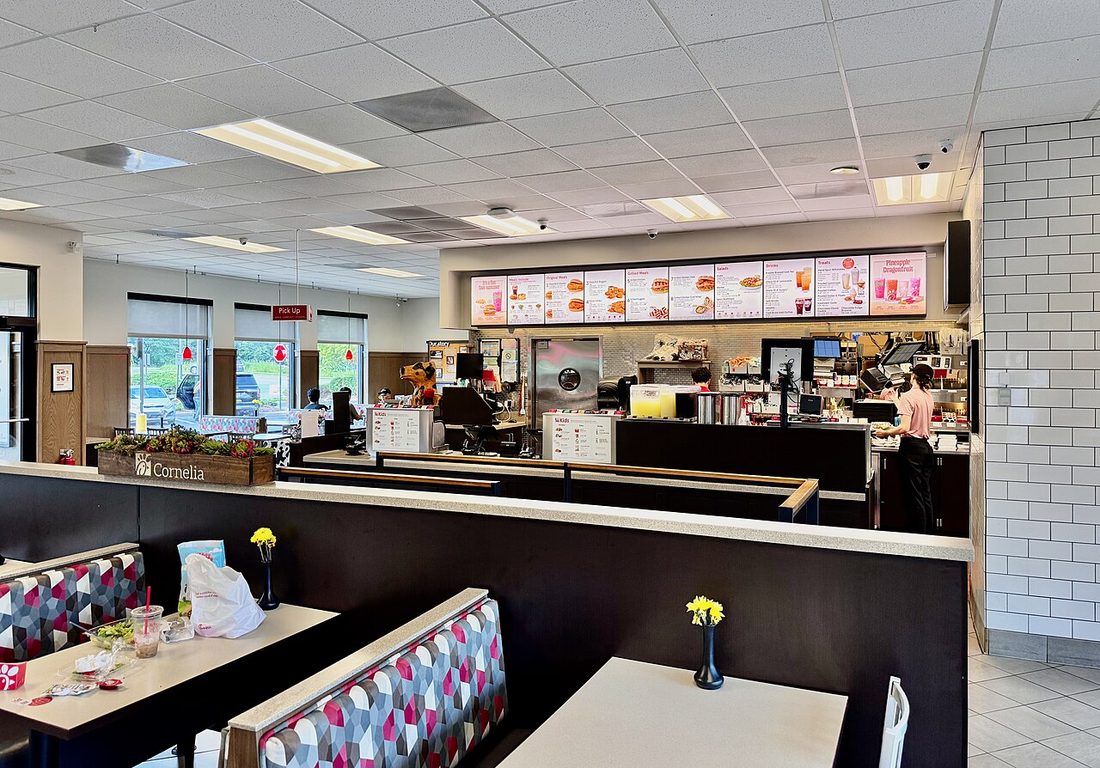
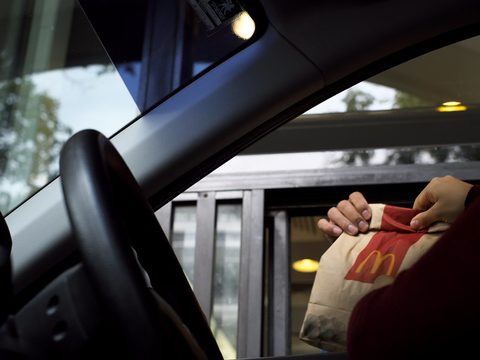 It was raining, so we didn't get out of the car: we ordered at the
_____ window and ate on the way home.
Nine cents
Watch the video first: almost seven minutes, with captions. Then read the story, which follows one customer through the tricks of the video. Click a dotted word to see what it means.
In New York City, a hungry woman walks into McDonald's for a quick lunch. Everyone says fast food is cheap and convenient, so she expects to spend very little.
She is about to spend more than she planned. One study says Americans spend around $1,200 a year on fast food, and chains do everything in their power to get them to spend more.
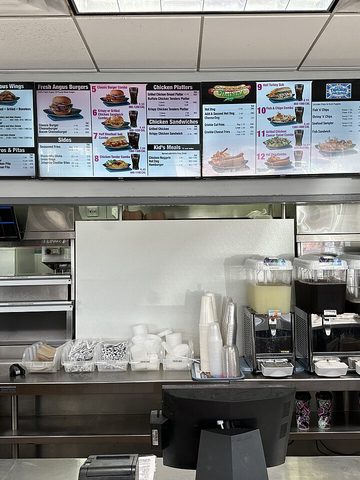
The first trick is the menu board above the counter. Next to a calm fine-dining menu, it is a noisy mess of options, and its bright reds and oranges grab her attention.
Then the photos take over. Huge pictures of juicy patties light up the brain, especially a hungry one, so she hardly notices the small prices next to them.
Those prices are designed to be missed. They have no dollar sign, and 9.79 looks like nine dollars, not ten. The cheap value menu is there too, hidden in a far corner.
The board is so confusing that it is only easy to read near the counter, when it is time to order. The pressure is mounting, so she just says, "Number 3."
That number is the combo, the menu's real secret. Ordering by number is quick, but it turns out the Number 3 costs just nine cents less than the same items bought separately.
The combo also controls her order. It includes a soda, which has a much higher profit margin than a burger, and a cheap upgrade means she ends up with a huge portion.
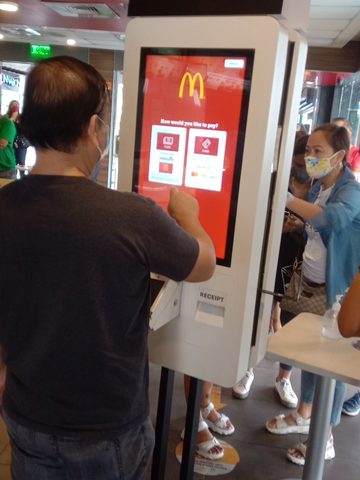
At the bottom of her receipt, a coupon that expires within the week brings her back. This time she uses the kiosk, but she lingers over its pictures and spends even more.
Her lunches there also cost more than before: Bloomberg says burger prices have risen 54% in a decade. But healthier options cost even more, so her best defense is to fight off the tricks.
Multiple choice
The stamp shows the moment in the video. Click an answer and read why.

-
According to one study, how much do Americans spend on fast food every year? 00:18
Around $1,200 a year. That is where the video starts: fast food is supposed to be cheap and convenient, and yet people spend more than they expected to. The Number 3 in the opening scene costs $11 in New York City (00:05).
-
How is a fast-food menu different from a fine-dining restaurant menu? 00:47
Simple and not very stimulating on one side; a noisy mess of options and categories on the other. The fast-food menu only looks simple: it actually hides most of the options (00:42).
-
Which visual strategy do fast-food menus use with prices? 01:10
There is a hierarchy: big pictures, small prices. The items that cost more are shown really big on the left side, where you start reading (01:14). You are not wondering if that burger is worth six dollars; you are looking at the juicy patties.
-
Why does Hans Taparia say that large food pictures are key for a food company? 01:29
"Food pictures, they light up the brain, particularly when you're hungry." Taparia is a health food entrepreneur and a professor of business and society at NYU (01:37). The playbook, he says, has been around since the '80s: simplicity, cheap, bold and bright.
-
Why do restaurants write a price like 9.79 instead of 10? 02:03
Pretty much ten dollars, but you read left to right, so the nine is what you see. Not showing the dollar sign is another trick from the same family (01:57).
-
Why are combos labeled with numbers? 03:07
"It takes a lot less time to order the Number 6 than a 10-piece nugget, medium fry, and a medium drink." The combo is the star of the menu (03:00), and its speed is part of the trick: you say a number before you do the math.
-
Does the Number 3 combo really save money? 03:20
$10.39 for the combo, $10.48 for the Double Quarter Pounder, medium fries and medium drink bought separately: nine cents. (In the opening scene, in New York City, the same Number 3 costs $11.) And often you end up with things you didn't even want, in portions that are way bigger than what's healthy (03:32).
-
Why do fast-food restaurants make more money when customers buy multiple items? 04:14
Soda has a much higher profit margin than a burger, so companies do everything they can to get you to buy a drink (04:18). Multiple sizes and cheap upgrades make it hard to walk away with a small in every category (03:57).
-
What does McDonald's CEO Steve Easterbrook say about ordering kiosks? 04:38
"Customers spend more on average at kiosks 'cause they linger longer." If you think you have more control at a kiosk, you're wrong (04:31). And guess what the kiosks also have: lots and lots of pictures.
-
According to Bloomberg, what has happened to the price of a fast-food burger in the last decade? 05:49
Up 54% in a decade, faster than at fast-casual and fine-dining restaurants. That is the deeper issue of the video (05:41): fast food isn't as cheap as it used to be.
-
Why is fast food still the choice of many families? 06:06
Healthy fast-casual offerings are often so much more expensive that they no longer target the same people, especially if you're feeding a family (06:14). KFC gives you a lot more food per dollar than an organic salad chain (06:16), and in low-income areas fast food is sometimes the only option (05:56).
-
Which sentence best summarizes the story?
Menu, prices, combos, kiosks, coupons and apps: every trick is engineered to get you to spend more money. Fast food can be cheap and convenient, the video says, but you have to fight off the tricks, and you shouldn't be paying a premium for low-quality, unhealthy food (06:31).
Which strategies are in the video?
In the warm-up you guessed the strategies fast-food chains use. Now check: which of these seventeen does the video actually mention? The stamp shows where.
-
Offering sophisticated dishes.
The opposite. The playbook, says Hans Taparia, has been around since the '80s, and it is centered around simplicity, cheap, bold and bright (01:44).
-
Displaying an attractive but messy menu. 00:54
A noisy mess of options and categories, in bright reds or oranges, with big appetizing photos.
-
Serving fewer dishes, but homemade fresh food.
Nothing in the video is homemade, and the menus are big, with confusing layouts (02:36).
-
Giving discounts. 00:35
"Fast food is all about the deals": value meals, combos, coupons. Later come buy-one-get-one-free nuggets (05:04) and special daily deals in the app (05:24).
-
Showing big photos and small prices. 01:10
"The pictures are big, but the prices are small." The expensive items are shown really big on the left, where you start reading.
-
Not showing the dollar sign. 01:57
One of the "other tricks": without the sign, the number looks less like money.
-
The more you buy, the less you pay for each ounce. 03:40
Taparia calls it a perception "which is quite real": the per-ounce cost of something bigger is lower, so you feel you are getting better value. Forget the fact that 32 ounces of soda has half a cup of sugar.
-
Using a 9.79 or 0.89 pricing format. 01:59
Pretty much ten dollars, but you still think it's nine, because you read left to right.
-
Showing a clear and visible menu.
The opposite again: confusing layouts make it difficult to find exactly what you're looking for, and the menu is easiest to read only when you're close to the counter, and then it's time to order (02:39).
-
Offering combos. 03:00
"The star of the menu is the combo meal": an entree, a side and a drink, ordered with one easy number.
-
Serving healthy food.
Portions way bigger than what's healthy (03:36), and, at the end, "low-quality, unhealthy food" (06:40).
-
Advertising deals on signs, posters and TV commercials. 04:56
"They advertise the most outrageous deals on signs, posters, and TV commercials." Buy-one-get-one-free nuggets get you in the door, and then you buy a drink too.
-
Using brand tie-ins. 05:13
A brand tie-in is an advertisement or promotion that connects one brand or product with another. The video's example is Doritos Locos Tacos, from Taco Bell; another one is the Oreo McFlurry, McDonald's ice cream with Oreo cookies.
-
Giving coupons. 05:17
Coupons that expire within the week, like the ones you may have seen on the bottom of your receipt.
-
Providing apps with reward points. 05:22
App reward points and special daily deals found only in the app, just like the old-fashioned punch card: you eat there more often if each purchase brings you closer to free food.
-
Giving free refills.
Not mentioned. The video's drink trick is a different one: soda has a much higher profit margin than burgers, so they do everything they can to get you to buy one (04:14).
-
Adding fries for just a dollar more. 05:09
"You can make that a meal and add fries for just a dollar more." Multiple sizes and cheap upgrades make it hard to walk away with a small in every category (03:57).
Fixed expressions and collocations
Eight expressions from the video. First, watch each moment again (the stamp shows where) and write the missing words. Then read the note and choose what each expression means in its sentence.

Learn the whole chunk, not the word. Nobody in this video says "catch your attention" or "make the calculation": they say grab your attention and do the math. The words come in fixed groups; when you learn the group, you sound natural, and you understand fast speech, because you know what is coming.
Listen and complete
-
a00:25 Places like McDonald's and Burger King do everything ___ to get you to spend more money.
-
b00:29 And ___ fast food isn't as cheap as you think.
-
c01:00 Fast food restaurants ___ with bright reds or oranges.
-
d01:29 Food pictures, they ___ the brain.
-
e03:14 But have you actually ___ to see if that combo is saving you any money?
-
f03:32 And often you'll ___ things you didn't even want.
-
g04:52 Fast food companies are experts at ___.
-
h06:33 But you have to ___ all the psychological tricks.
What do they mean?
- do everything in your power (to + verb): the pronoun changes (my, his, their). I'll do everything in my power to finish the report by Friday.
- it turns out (that) + sentence: it introduces a surprise. Past: it turned out. It turns out that the quiet new neighbor is a famous chef.
- grab somebody's attention: grab my / your / the reader's attention. The first line of an email has to grab the reader's attention.
- light up (something): make something bright, or become bright. Past: lit up. The Christmas tree lights up the whole living room.
- get somebody to do something: never get you buy; the to is part of the chunk. My sister finally got me to try sushi.
- get customers in the door: also get people / shoppers in the door. A big red SALE sign can get customers in the door.
- do the math: American English; British English says do the maths. Twenty dollars a week on coffee? Do the math: that's over a thousand dollars a year.
- end up with + noun (or end up + place / -ing). I went into the store for one T-shirt and ended up with three.
- fight off + something that attacks you: an illness, an attack, a temptation. It was hard to fight off the temptation to check my phone.
- Two more from the video: pay a premium (for) = pay more than the normal price (06:39), as in Many people pay a premium for organic vegetables; and the tip of the iceberg = the small visible part of a much bigger problem. The narrator jokes "the tip of the, um, Frosty" (04:48): a Frosty is a frozen dessert from Wendy's.
-
"Places like McDonald's and Burger King do everything in their power to get you to spend more money." In their power means… 00:25
Your power is what you are able to do. Do everything in your power means you try every possible way. The law and the customers have nothing to do with it.
-
"It turns out fast food isn't as cheap as you think." The narrator uses it turns out because… 00:29
It turns out introduces the real situation, which is different from what people thought: everybody thinks fast food is cheap; the truth is different.
-
"Fast food restaurants grab your attention with bright reds or oranges." Which sentence is closest in meaning? 01:00
To grab something is to take it quickly with your hand. The colors "take" your attention: your eyes go to the menu. Hunger comes later, with the photos.
-
"Food pictures, they light up the brain." Here, light up means… 01:29
A room lights up when you turn on the lamp; a face lights up when a person is happy; a brain lights up when it gets excited. Taparia is talking about the brain, not about the lamps behind the menu board.
-
"Have you actually done the math to see if that combo is saving you any money?" Do the math means… 03:14
$10.39 or $10.48? You only know if you add the numbers. Do the math is also used when the conclusion is obvious: "Two combos a day, thirty days: do the math."
-
"Often you'll end up with things you didn't even want." End up with means… 03:32
You wanted a burger; at the end, you have a burger, large fries and a 32-ounce soda. End up is about the final result, usually an unplanned one: we ended up at a Chinese restaurant.
-
"Fast food companies are experts at getting customers in the door." Get customers in the door means… 04:52
The hard part of any business is the first step: making people walk in. The deals get them in the door; once inside, they buy a drink too.
-
"You have to fight off all the psychological tricks." Fight off means… 06:33
You fight off an attack, an illness, a temptation: something comes at you, and you push it away. The tricks are engineered to get you to spend; you have to fight them off.
Use the expressions
Complete each sentence with the expression on the left, in the right form: change the tense or the pronoun when the sentence asks for it. Write only the missing words.
-
turn outWe thought the hotel was near the beach, but it ___ that it was a forty-minute drive away.
-
in … powerThe doctors did everything ___ to save the patient, and she survived.
-
grab … attentionA bright yellow poster ___ when I walked past the store yesterday, so I went in.
-
light upWhen the little girl saw the birthday cake, her face ___.
-
get me / go backThe coupon on my receipt ___ to the store twice in the same week.
-
do the mathBefore you sign a two-year phone contract, ___: is it really cheaper than paying month by month?
-
end up withNobody wanted to cook, and all the restaurants were closed, so we ___ a frozen pizza again.
-
fight offIn winter, drink water and sleep well to help your body ___ colds.
-
get … in the doorFree samples are a cheap way to ___: once people are inside, they usually buy something.
-
pay a premiumNear the stadium, you ___ for a bottle of water: five dollars instead of one.
Questions with the expressions
Put the words in order to build eight questions with the expressions of Exercise 07. Write the whole question. Then ask and answer them with a partner, or with me, and make up two more questions of your own with the other expressions.

-
akind / grabs / of / what / your / ad / attention / ?
-
bgotten / ever / a / has / deal / you / buy / to / something / didn't / you / need / ?
-
cturned / it / ever / has / out / that / a / meal / cheap / expensive / was / ?
-
dup / lights / what / brain / your / when / hungry / you're / ?
-
emath / you / do / do / the / before / order / you / combo / a / ?
-
fended / ever / you / have / up / food / with / didn't / you / want / ?
-
geverything / you / do / do / power / in / your / to / healthy / eat / food / ?
-
hin / how / restaurants / your / do / city / customers / get / the / in / door / ?
Talking point
Part A is about the video, Part B is about your world, and Part C is for your opinions. Use the expressions: it turned out that…, what grabbed my attention was…, I ended up with…, I never do the math.
Useful language
The comic strip and the video
100–140 words. In a Frank and Ernest comic strip by Thaves, two men are in a car at a fast-food drive-through. The driver has a huge burger in his hand, his friend has a drink, and the driver says: "My problem is restaurants have drive-throughs, and fitness centers don't." Discuss it with a partner first, then write a paragraph: what is the joke, how does it connect to the video, and what would you say to the driver? Use at least three expressions from Exercise 07.

My results
Check your score, then copy it and send it to your teacher on WhatsApp.

One job for this week. Next time you buy anything, a coffee, a combo, a bus ticket, do the math out loud in English: "It turns out the large is only fifty cents more." Then send me one sentence with ended up with about what you bought.