What Happens When a Night Owl Wakes Up Early
Everybody has a clock inside, and not every clock runs on the same time. A short science video about night owls, early birds and social jet lag, and the phrasal verbs of a normal day: wake up, get up, turn it off, look after.
Warm-up
Read the description of the cartoon on the first card. Then ask and answer with a partner, or with me. Tap a card when you have answered it.

Some people jump out of bed at six. Others are still asleep at nine, and they are not lazy. Today you find out why, and you learn the small words that come with every morning: wake up, get up, turn off, put on.
Useful language
Words from the video
All eight words are in the video or in the reading. Click a word, then click its definition. Correct pairs turn green. The audio button says the word.
Complete the sentences
Click a word in the bank, then click a gap. Click a filled gap to clear it. Each sentence has its own clues: only one word fits.

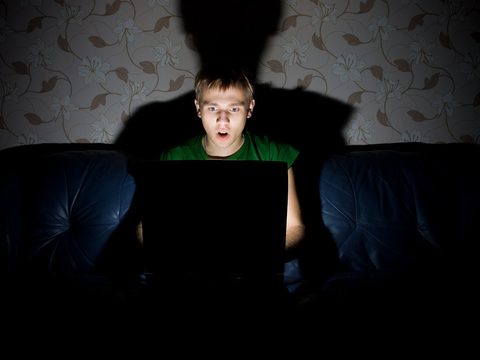 My brother is a real
_____: he does his best work after midnight and never goes to bed before two.
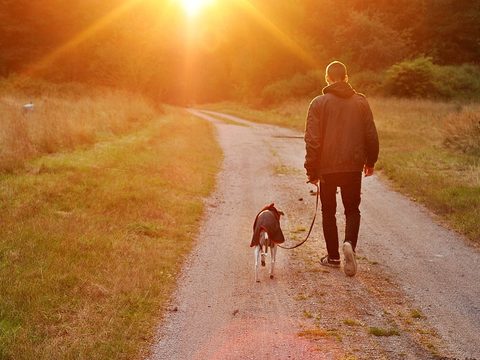 Grandpa is an
_____: he is out walking the dog at five in the morning, while the rest of the family is still asleep.
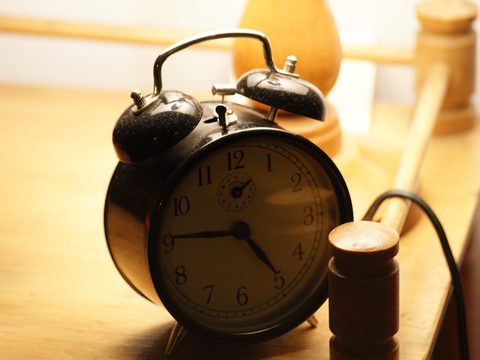 My new alarm clock has no
_____, so when it rings, I have to get out of bed right away.
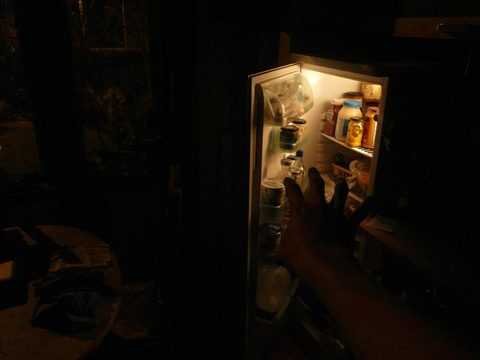 After flying from Brazil to Japan, I had terrible
_____ for a week: I was hungry at 3 a.m. and sleepy at lunchtime.
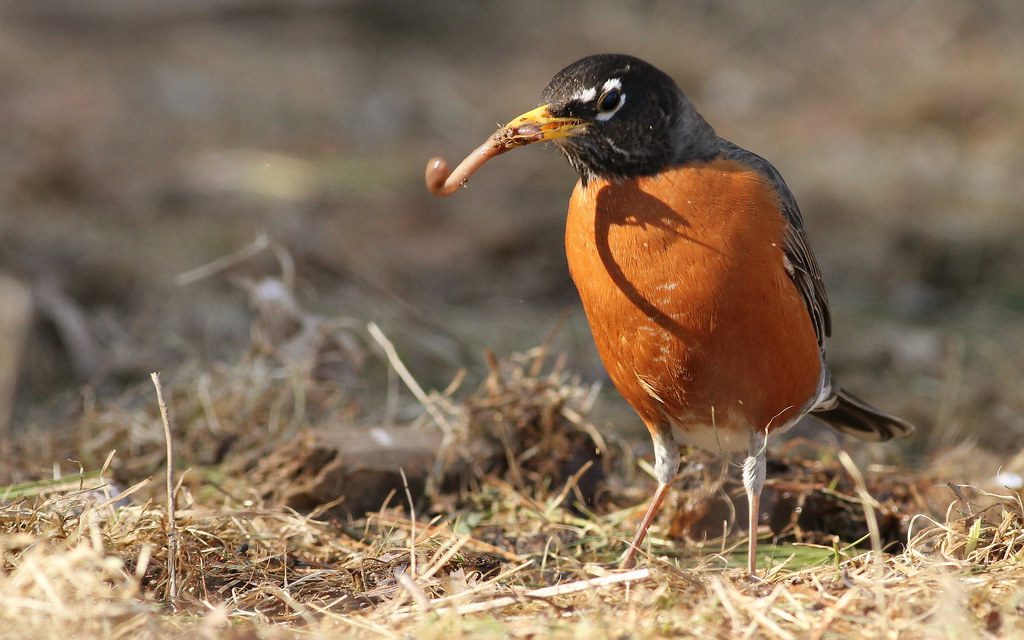
 A shark is a dangerous
_____: it hunts fish, seals and other sea animals.
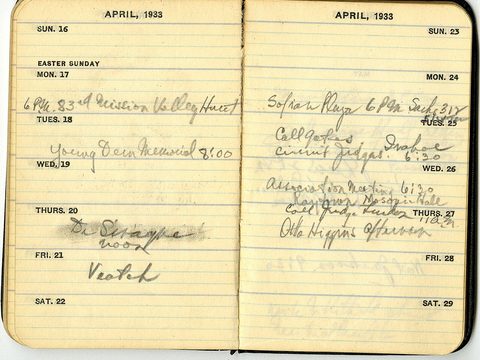 My
_____ is really full this week: meetings every morning, classes every night and a dentist appointment on Friday.
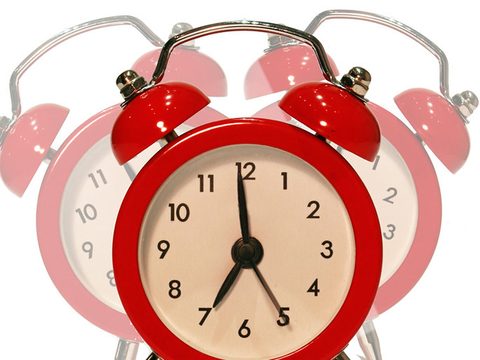 I set three alarms because I'm afraid I won't
_____ in time for my 6 a.m. flight.
 Our trip to Rome was short, so we walked everywhere to
_____ the atmosphere of the old city.
A clock that runs late
Watch the video first: three and a half minutes, from Insider Science, with captions. While you watch, take notes on paper under three headings: general advice to improve sleep, the circadian rhythm, and social jet lag. Then read the story. Maya is not in the video: she is a typical teenage night owl, and everything the text says about the body clock comes from the video. The phrasal verbs are in bold. Tap a dotted word to see what it means.
At 6:30 a.m., Maya's alarm goes off, and she hits the snooze button for the third time. She is sixteen, school starts in an hour, and she can't get up.
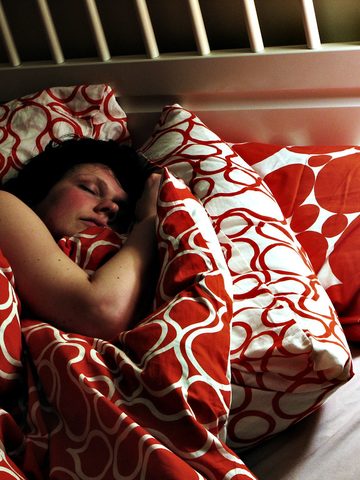
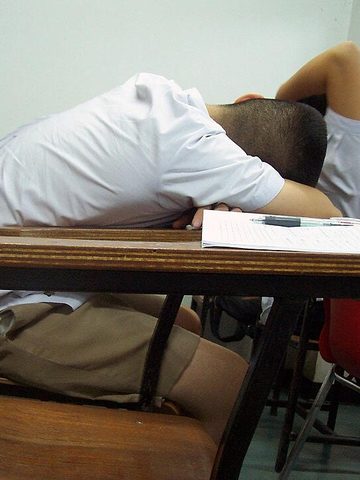

Everyone gives her the same advice: go to bed at the same time, avoid screens after dark, never hit snooze. Every tip says she's doing something wrong.
But maybe it isn't her fault. Inside her brain, in the hypothalamus, there is a clock: her circadian rhythm. It controls sleep and helps the heart, lungs and brain work together.
And Maya's clock runs late. Like other night owls, her body makes melatonin, the sleep hormone, later at night, so she feels tired later than early birds do.
For most of human history, a late clock like hers didn't matter. Night owls were even useful: they stayed up and protected their tribes from predators that hunt in the dark.
Then, in recent decades, society turned late clocks into a problem. About 80% of Americans follow schedules between 6 a.m. and 6 p.m., but nearly a third of people call themselves night owls.
So every school day, Maya's body lives on one clock and her schedule on another. This is social jet lag: like jet lag after a flight, only worse, because it doesn't go away.
And sleeping enough doesn't fix it. In one study, each hour out of sync raised the risk of obesity by 33%. In another, people with bigger gaps reported more serious symptoms of depression.
Teenagers like Maya feel it most, because the body clock shifts with age. Yet most U.S. public schools start before 8:30, and tired teens pay the price in class and behind the wheel.
Luckily, her clock isn't set in stone: light resets it. Now, when Maya wakes up, she goes outside and soaks up some morning sun. On gray days, she turns on the lights.
Multiple choice
The stamp shows the moment in the video. Click an answer and read why.

-
Every tip that Maya hears comes down to one idea. What is it? 00:11
Go to bed at the same time, avoid screens after dark, don't hit snooze: all these tips say the problem is you. Right after that, at 00:16, the video says it may not be your fault at all.
-
The body clock is famous for controlling sleep. What else does it do? 00:37
The video calls them primary organs, and says the clock helps them work "in harmony". So a clock out of order is not only a sleep problem, and that matters later in the story.
-
Why does a night owl feel tired later than an early bird? 00:54
The hormone is melatonin. Night owls often produce a lot of it later at night, so sleepiness comes later too. They have a clock like everyone else; it just runs on a later time.
-
Why does the story mention predators? 01:09
Someone had to stay awake in the dark. Night owls could protect their tribes from animals that hunt at night, and their cities from enemies, so for most of history a late clock was not a problem at all.
-
In recent decades, society turned late clocks into a problem. How? 01:16
About 80% of Americans follow a six-to-six schedule, but nearly a third of people see themselves as night owls. For them, a later schedule would be better.
-
Why is social jet lag worse than jet lag after a long flight? 01:44
After a flight, your body gets used to the new time in a few days. Social jet lag comes back every school day and every workday, so it doesn't disappear.
-
Can a night owl solve the problem just by sleeping enough hours? 01:57
Even with the recommended amount of sleep, the video says, a clock that is out of sync has consequences. The problem is when you sleep, not only how much.
-
What did one study find? 02:05
33% for every single hour, and obesity brings other health risks with it. The problem isn't only physical: a second study, at 02:23, found more serious symptoms of depression in people whose clocks were more than two hours off.
-
Why do teenagers feel social jet lag the most? 02:33
The clock is not the same all your life: it shifts as you age, and the video says social jet lag is especially clear in teens. The next part of the story is about their schools.
-
What does the CDC, the U.S. public health agency, warn about? 02:41
Too early means before 8:30. According to the RAND Corporation, this costs the country nine billion dollars a year, mostly in lost school results and in car crashes with tired teens behind the wheel.
-
What resets the body clock, according to the video? 03:06
The clock mostly follows light signals that reach your eyes. That is why the video says to get outside and soak up some morning sun when you first wake up, or, if you can't, to make your home well lit.
-
Which sentence best summarizes the story?
The advice at the start blames Maya, but the story blames the clash between her clock and her schedule. Screens appear only in the old advice. And the end brings a solution: light.
Correct the sentences
Every sentence is false. First, from memory, write the words that should replace the part in bold. Then watch the video again to check: the stamp shows the moment.
-
aThe circadian rhythm is in the part of our brain called the frontal lobe. 00:32
-
bEveryone's circadian rhythm is the same. 00:49
-
cAbout 80% of Americans follow a schedule that starts at 6 a.m. and finishes at 9 p.m. 01:21
-
dNearly a third of the population considers themselves early birds. 01:29
-
eSocial jet lag is not as bad as the jet lag you feel after a long plane trip. 01:44
-
fThe two studies in the video link a body clock out of sync with heart disease and asthma. 02:05
-
gSocial jet lag is especially apparent in adults. 02:35
-
hTo reset your body clock when you first wake up, the video recommends coffee. 03:11
Phrasal verbs in context
Match each beginning with its ending. The phrasal verbs are in bold. Then test a partner: read a beginning, and your partner says the ending without looking.
Phrasal verbs: three kinds

Look at the phrasal verbs of Exercise 07 again. Some never take an object. Some take one and can split around it. Some take one and never split. And one rule never breaks: when a verb can split, a pronoun goes in the middle.
- 1 · No object: never separated. Nothing comes after the verb, so there is nothing to put in the middle. My alarm went off at six. · She grew up in a small town. In Exercise 07: get up, check in, go back, sit down, wake up.
- 2 · With an object: can be separated. The object goes after the particle or in the middle. Pick up your toys. = Pick your toys up. In Exercise 07: put on, take off, give up, turn off, turn on; in the video, soak up.
- 3 · With an object: never separated. The object always comes after the whole verb. I ran into an old friend at the mall. In Exercise 07: look for, look after, and go on + verb-ing (go on talking = continue talking).
- Object pronouns (me, you, him, her, it, us, them): with the verbs of group 2, the pronoun always goes in the middle: Pick them up, never Pick up them. With group 3, it goes after the whole verb: I ran into her, never I ran her into.
- Careful: a few verbs work in two ways. I woke up at six has no object, but in The noise woke me up the verb has one, and the pronoun goes in the middle.
-
"So when you first wake up, get outside and soak up some morning sun." Which phrasal verb in this sentence from the video has an object? 03:11
Nothing comes after wake up: you is its subject, so the verb has no object here. Soak up has one: some morning sun.
-
Say the same thing with it in place of some morning sun. Which is correct?
Soak up can split, so a pronoun must go in the middle. After the particle, a pronoun is always wrong.
-
"We need somebody to look after the baby." Say it with him in place of the baby. Which is correct?
Look after never splits, so the pronoun goes after the whole verb. And after a verb we use the object form: him, not he.
-
Night owls often ___ late into the night.
Stay up means not go to bed. The verb comes first and the particle second: never up stay. Take off is for planes and clothes.
-
Early birds are famous for their ability to rise and shine: ___ early and are full of energy.
Subject first, then the verb and its particle: they wake up. Rise and shine! is a friendly way to tell someone to wake up and get up.
-
It's late. I will ___ the lights and go to sleep.
To sleep, you want the room dark: turn off. Turn on is the opposite, and you can't wake up a light.
-
The plane will ___ in a minute.
A plane takes off when it leaves the ground. Here take off has no object; with clothes it has one: take off your coat.
-
Please ___ your shoes.
Take off means remove clothes or shoes. Its opposite is put on. You turn on machines and lights, not shoes.
-
I will ___ the TV to watch the documentary about owls.
To watch, the TV has to be on. Turn off does the opposite, and give up means stop doing something.
Right or wrong?
Look at the words in bold. Some are in the right order and some are wrong. Write the bold words correctly: if they are already right, write them as they are.
-
aCome on! Wake up! Breakfast is ready.
-
bThis game is too hard. I need to give up it.
-
cI get up myself at 6:30 a.m. every day.
-
dIf you want to listen better, you have to go practicing on.
-
eYou must go back to school before 10 a.m.
-
fI'm bored. Let's turn the TV on.
-
gThese are your shoes. Put on them for the party tonight.
-
hThe neighbors are looking Peter's dog for.
-
iMake sure you arrive on time to check in.
-
jI sometimes work as a nanny and look after my friend's children.
-
kYour boots! Please take off them before you come in.
-
lPlease turn this music off! I need to study.
-
mLet's start. Please sit down you.
Talking points
Talk for about a minute about each card and ask your partner follow-up questions. Part A is about the video and the story, Part B about your life, Part C about your opinions. Use the phrasal verbs of the lesson when you can.

Useful language
From alarm to pillow
6 to 8 sentences. Describe a normal weekday, from the moment you wake up until you go to bed, and say if your schedule suits your body clock: are you an early bird or a night owl? Use at least six phrasal verbs from this lesson, and at least one with a pronoun in the middle (pick it up, turn it off).
My results
Check your score, then copy it and send it to your teacher on WhatsApp.

One job for this week. Every morning, tell yourself your morning in English, out loud: "My alarm went off at…, I turned it off, I got up…" Five phrasal verbs before breakfast. And if the sun is out, go outside and soak some of it up.